By Korin Miller
Medically reviewed by Michael Tang, MD
Key takeaways
Anger management for teens involves raising awareness of their emotions, identifying emotional triggers, and learning coping strategies to help them navigate irritation and rage.
Anger in teens shows up differently depending on the person, and it doesn’t always look like classic “outward” anger. It can also present as suppressed or passive-aggressive anger, making it difficult at times to understand the underlying emotions your child is grappling with.
Parents can teach their teen anger management strategies to help them cope with big emotions, but it’s equally important for parents to learn how to respond when their teen is angry in order to best support them.
Mood swings and irritability are a normal part of adolescence, however if your teen’s anger is frequent, intense, or paired with other behavior changes, it could be a sign of an underlying struggle that warrants professional support.
It’s easy to feel helpless when a small disagreement with your teen suddenly escalates into an intense stand-off. Cue the yelling, slamming doors, and a general feeling that you have little knowledge on managing anger for teens.
The teenage phase can be an emotionally volatile one, and you may even remember having similar issues with your own parents. But not knowing what to make of your teens’ anger management—or lack thereof—is common for parents, and not a sign that you’re missing something obvious.
Anger doesn’t look the same between adolescents and, with that, anger management strategies for teens can vary. Recognizing the different ways your teen’s anger might be showing up and learning how to respond to it in the moment without escalating things can go a long way toward navigating this life stage with more harmony. Here’s what parents should know about anger control for teenagers, plus when it might be a sign of something bigger and how to find the right support.
What does teen anger actually look like?
Teen anger doesn’t always look like classic anger, and it’s rarely the only emotion being felt in the moment. “Anger is a complex emotion that can manifest in many different ways,” says Tara Rickard, a licensed professional counselor and Behavioral Health Department Manager at Blackbird Health. “I often describe anger as a secondary emotion, meaning that it is frequently a response to another underlying feeling.”
Your teen may be angry on top of being embarrassed at being corrected or called out in front of others, scared of being bullied or excluded by peers, or stressed from the pressure of school or their sports coach, according to Rickard.
Every teen’s anger is unique, but it can generally be categorized into one of these three presentations, per Rickard:
Outward anger: This can include classic signs associated with anger such as yelling, slamming doors, and arguing.
Suppressed anger: This may include refusing to engage in conversation, ignoring messages, shutting down emotionally, or leaving the room.
Passive-aggressive anger: Your teen may use jokes, mockery, or dismissive comments to express their frustration. They may also procrastinate to avoid conflict, or “forget” responsibilities.
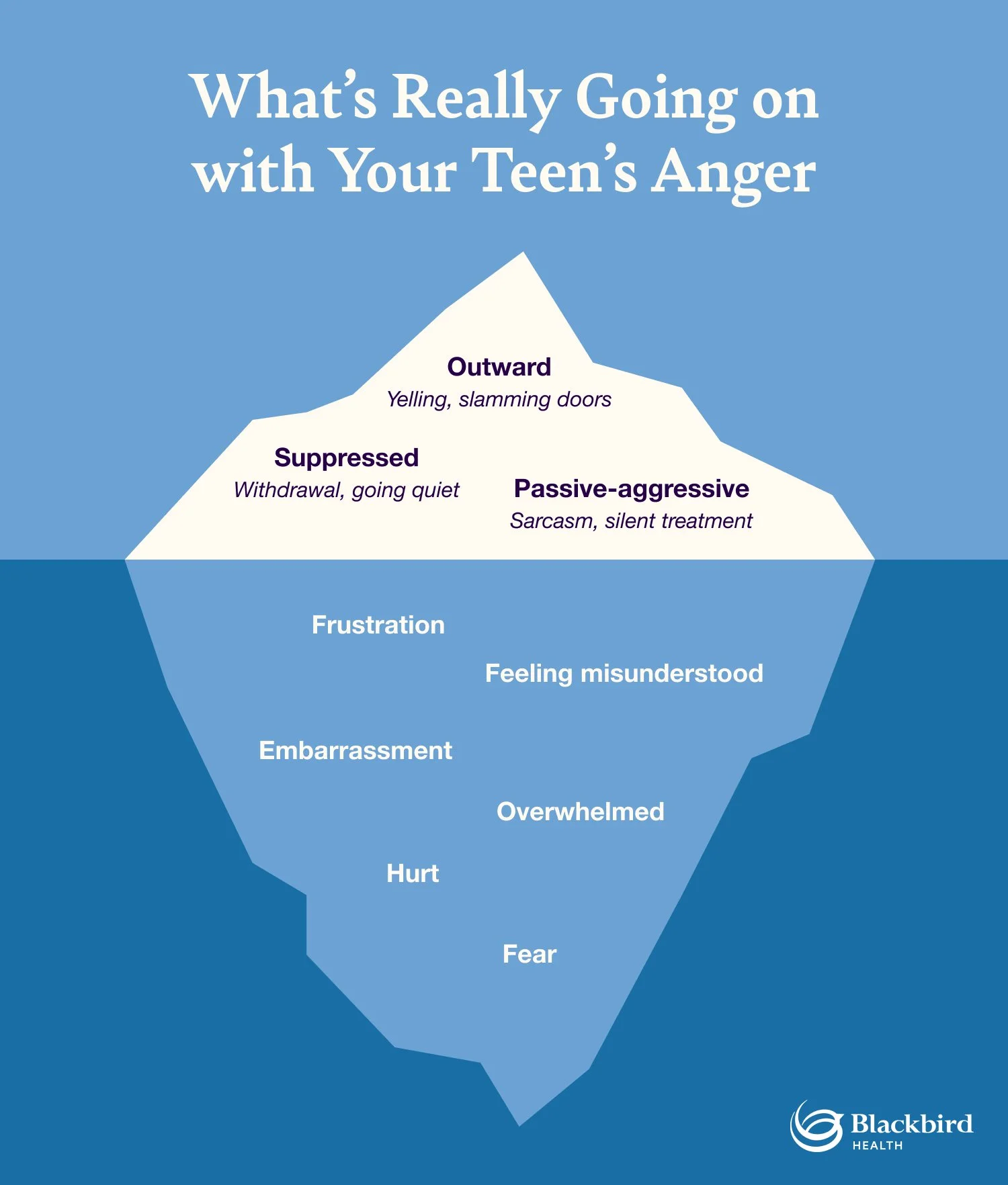
“Recognizing these presentations of anger can help parents and caregivers look beyond the behavior and better understand what their teen may truly be experiencing,” Rickard says. Most of this is developmental, given that mood swings and irritability are considered a normal part of adolescence, per research published in the journal Scientific Reports.
However, anger and emotional dysregulation in teens may point to a deeper concern, especially if it’s frequent, intense, or paired with other changes such as pulling away from friends or slipping grades at school, according to Molly Kotocavage, an occupational therapist at Blackbird Health.
In some cases, anger could be a sign that your teen is dealing with attention-deficit/hyperactivity disorder (ADHD), anxiety, or autism spectrum disorder (ASD), she notes. Links between ADHD, autism, depression, and anger are the strongest, but teens with anxiety may have irritability in response to worry, threat sensitivities, and frustration intolerances.
“Anger is often an outward expression of an underlying challenge, so identifying its root cause and presentation is essential,” Kotocavage says.
How should you respond in the moment when your teen is angry?
It can be hard to know how to respond when your teen is angry, especially if the anger suddenly surfaced. Leaning on certain strategies can help diffuse the situation. “Supporting an angry teen can be challenging, but certain responses can significantly reduce conflict and promote healthy emotional growth,” Rickard says. Here’s what she suggests.
Stay regulated as the parent: Your response and tone often set the stage for how things will proceed from here. “When parents remain calm and regulated, they help prevent escalation and create an environment where the teen feels heard,” Rickard says. She stresses that the anger isn’t always directed at the parent. “When parents assume the anger is personal and react defensively, teens may feel misunderstood, which can intensify their frustration,” Rickard says. “Remaining calm allows parents to focus on the underlying issue rather than the emotional reaction itself.”
Validate the feeling without validating the behavior: Your child has the right to feel angry or frustrated. “By acknowledging the emotion while maintaining expectations around behavior, parents demonstrate that expressing emotions is healthy while also helping teens learn appropriate ways to communicate those feelings,” Rickard says. You could respond by saying, “I understand you’re upset, but you should not be yelling.”
Give space before problem-solving: While tempting, it’s hard to resolve an issue while your teen is still heated. “Often, teens first need time to process what they are experiencing and identify the root of the issue,” Rickard says. She suggests allowing your child the space to calm down and think about possible solutions before you step in. This approach “promotes confidence, independence, and critical thinking,” Rickard says.
Set boundaries collaboratively: Once your child has calmed down, it’s important to set clear boundaries for the future. “Families benefit from establishing expectations regarding respectful communication, such as avoiding insults, threats, property damage, or aggressive behavior,” Rickard says. She suggests doing this together, to raise the odds these boundaries will be respected in the future. This can involve discussing how much time your teen may need to cool down, how they prefer to be approached when they’re upset, what respectful communication looks like during conflict, and what behaviors are never acceptable, regardless of how angry someone feels.
How to Respond to Teen Anger by Age
| The Response | Younger Teens (13-15) | Older Teens (16-18) |
|---|---|---|
| Stay regulated | Maintain your cool and try to keep your tone even when speaking. | Calm and consistent responses matter here, given that your teen is more likely to call out your own tone or hypocrisy in the moment. |
| Validate feelings | Offer your child the language to name their emotions, such as “It seems like you’re really frustrated here.” | Try open-ended questions that give them more control, such as “I know you’re frustrated. Do you want to talk about it?” |
| Give space | Staying nearby by lowering the intensity can be more reassuring than leaving the room. | Respect your teen’s request for space; pushing to resolve things quickly may backfire. |
| Set boundaries together | Give a short, calm reason in the moment about what boundaries should not be crossed while angry. | Asking your child “what do you think would help here?” allows your teen to feel like a participant in the solution. |
Anger management techniques you can teach your teen
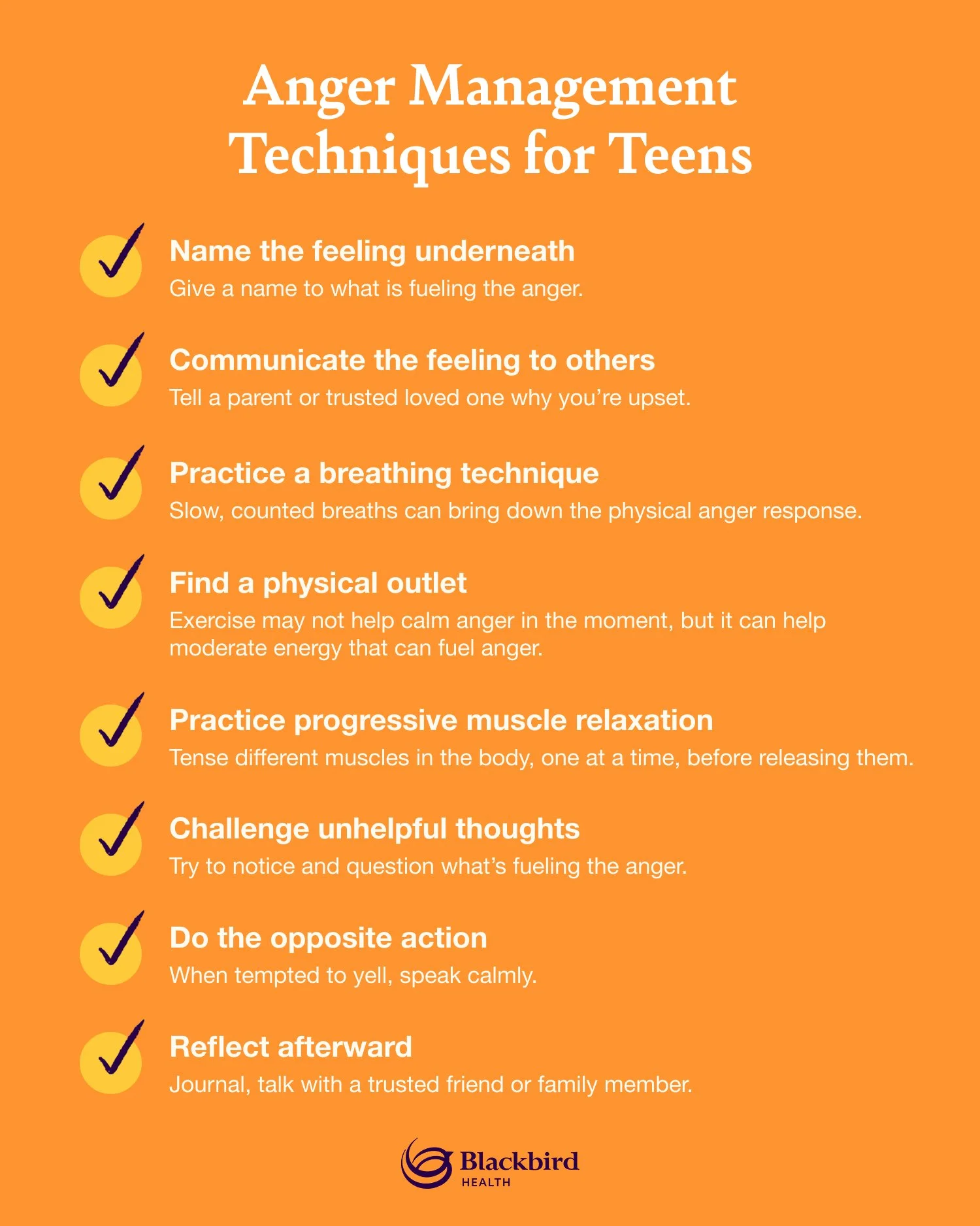
The techniques listed above are about how parents should respond in a conflict with teens. But teens need their own anger management strategies to use whether you’re there or not. Here are a few you can encourage your teen to try so they can find the best fit for themselves.
Name the feeling underneath. Ask your teen to try to figure out what’s fueling their anger. This is a private, internal step and can help to diffuse its intensity, per Rickard.
Communicate the feeling to others. If your child is embarrassed, this may mean saying something like “I feel embarrassed when you correct me in front of my friends.”
Practice a breathing technique. This can be slow, counted breathing to directly counter the body’s physical anger response.
Have a physical outlet. Research published in Clinical Psychology Review suggests that conventional wisdom to exercise or go for a run when you’re angry doesn’t actually help people calm down. However, movement during other times can help give a teen an outlet for physical energy that can build into anger.
Practice progressive muscle relaxation. This encourages your teen to tense and release different muscle groups to relieve physical tension in the body, per research published in Evidence Based Complementary Alternative Medicine.
Challenging unhelpful thoughts. This is a cognitive behavioral therapy (CBT) technique that teaches a teen to notice and question the thought fueling the anger and consider a more balanced view of the situation.
Use Opposite Action. This is a form of a dialectical behavior therapy (DBT) that encourages deliberately doing the opposite of an urge (such as speaking calmly when you want to shout), per the journal Behaviour Research and Therapy.
Find a way to reflect afterward. That could mean journaling or talking through what happened once things have cooled down. This can allow teens to notice their own patterns and triggers over time, per Rickard.
When should you seek professional help for a teen’s anger?
This is one of the harder calls a parent has to make. If anger has led to violence, self-harm, or a safety concern, that calls for more immediate action than a gradual approach would. In that situation, you can call or text the Suicide and Crisis Lifeline at “988” for free, confidential support.
There are still other signs it may be time to seek support, outside of a crisis situation. Here are a few to consider.
The anger is frequent or intense enough that it’s affecting daily life, school, friendships, or family relationships—not just an occasional bad day.
Nothing that has worked in the past is working anymore. Conflicts are escalating.
Anger is showing up alongside other changes, such as withdrawing from friends, slipping grades, changes in sleep or eating, or new risk-taking behavior.
Your teen has an existing diagnosis, such as ADHD, anxiety, or autism, and the anger has gotten noticeably worse or looks different than before.
Your child’s school has raised concerns.
You’re unsure of what’s normal anymore, and you’re trying to manage your own stress surrounding your teen’s anger.
Your teen’s situation doesn’t need to check every box to reach out for help—even experiencing one of these is reason enough to request an evaluation and support. That may include a diagnosis to help you understand what’s driving your teen’s anger, along with therapy.
“Professional support can provide teens with a safe, unbiased environment to explore their thoughts, feelings, and experiences,” Rickard says. “Therapy offers an opportunity for teens to discuss challenges involving parents, peers, school pressures, relationships, self-esteem, and other stressors without fear of judgment.”
The main goal of therapy for teens is to help them understand the triggers behind their anger, develop better emotional awareness and communication skills, learn effective emotional regulation and coping strategies, and reduce behaviors that negatively impact relationships, school performance, or overall well-being, according to Rickard.
Therapy can also foster a collaborative process to help families reduce conflict, improve relationships, and have a greater sense of understanding, she says.
Blackbird’s New Patient Evaluation can help give you clarity, along with potential supports your family may benefit from. If your child’s anger is connected to difficulty at school, Blackbird can also help you navigate those conversations.
The bottom line
Mood swings and irritability are considered a normal part of development for teens, but anger doesn’t look the same for every teen. Learning whether your teen’s anger presents as outward, passive-aggressive or suppressed will help you better understand their underlying emotions. Both parents and teens can benefit from anger management strategies. Learning them, and teaching them to your child, can help foster more communication and emotional awareness in the future.
Frequently asked questions (FAQs)
-
Every teen is different, but suppressing anger instead of expressing it may show up as going quiet and withdrawing from a situation. Teens who suppress their anger may also ignore messages or physically leave the room.
-
Taking away privileges or grounding your teen for angry outbursts will give them a punishment, but it doesn’t teach them how to regulate their emotions going forward. “Intense behavioral outbursts can frequently be linked to sensory processing challenges, executive dysfunction, or emotional overload, meaning the initial reaction may be largely involuntary rather than deliberate defiance,” says Rickard. Taking away privileges or grounding your child “often creates a cycle of frustration where privileges are repeatedly lost without the teen gaining the actual skills needed to manage future stress.”
She suggests working with teens rather than relying on fear- or punishment-based consequences. “Teaching frameworks like Social Behavior Mapping helps teens understand the natural chain reaction of their actions—how their behavior impacts both others and themselves,” Rickard explains. “Shifting the focus toward natural consequences and collaborative skill-building empowers teens to take ownership of their actions and learn effective self-regulation.”
-
Medication can help with anger in teens, but it works best as part of a larger toolkit for emotional regulation over a standalone fix, according to Rickard. If you suspect your child may benefit from medication as part of their anger management, it may be recommended along with psychotherapy and sensory-based interventions to get to the root cause of the anger and provide a balanced, personalized care plan.
-
A teen’s anger can be stacked on top of other emotions your child is feeling, according to Rickard. Sadness related to divorce or other significant life stressors such as a move can manifest as anger in a teen.
How can Blackbird help?
Our goal is to initiate the right course of treatment as quickly and as smoothly as possible, so “how it works” can be a little different for everyone. We customize your treatment plan to meet your unique needs, on a timeline that works for you. Click here to get started today.