By Dahlia Rimmon
Medically reviewed by Michael Tang, MD
Key takeaways
Coping skills are strategies that help children and teens manage big emotions and challenging situations by calming the body’s stress response to better regulate feelings.
The most effective coping skill depends on the child. Try different strategies and consider your child’s age, developmental stage, personality, and individual needs.
Younger children often benefit from parents modeling and guiding them through coping strategies. Teens may prefer more independence and can better use strategies that involve reflection.
Neurodivergent children may need to utilize different coping skills since they may experience and express emotions differently.
Big emotions are a normal part of childhood, but if they consistently interfere with daily life, consider reaching out to a mental health professional for support.
Sudden outbursts seemingly out of nowhere, shutting down completely, slamming bedroom doors, or melting down over something pretty minor are all things parents likely experience in their home. When they happen, it’s understandable to feel totally helpless. How do you help your child navigate big emotions in a healthy way, without dismissing their feelings or accidentally making things worse?
Like most children, mine have big emotions. And when they’re dealing with everyday kid stuff, it helps to have a few coping skills they can turn to. Big feelings are a normal part of childhood, but kids need to learn how to recognize, express, and manage those emotions. The goal isn’t to stop big emotions or prevent your child from expressing themselves—it’s to equip kids with a toolbox of coping skills that they can use when those feelings become overwhelming or too intense.
In this article, we’ll walk you through 11 coping skills to try at home, how to figure out which strategies work best for your child, and when it may be time to seek extra support.
What are coping skills, and why do they matter?
Coping skills are tools that help children manage stressful emotions. And while it might seem like managing feelings should come naturally, children aren’t born knowing how to do it. These skills take time to develop, and children learn them through practice, guidance, and watching adults around them.
Think of coping skills as a way to self-soothe when emotions start to take over. When your child is scared, embarrassed, frustrated, or angry, those feelings can trigger a child’s sympathetic nervous system (fight or flight) to respond, per Frontiers of Psychology. Their heart rate may increase, they may start to breathe really fast, their muscles might clench or tighten up, and their attention may become focused on whatever is upsetting them.
At the same time, their neocortex, the area of the brain that’s responsible for reasoning and problem-solving, becomes less active. In other words, when your child is upset or overwhelmed, it's not easy for them to stop, think things through, and figure out what to do next. That’s where coping skills come in. These skills can help children calm their nervous system and shift their attention away from the stressor.
11 coping skills for kids and teens
Here are 11 coping skills your child can try at home or at school. Keep in mind that every child is different, and what works for one may not work for another. “It definitely depends on the individual’s needs and learning styles,” says Molly Kotocavage, an occupational therapist and Occupational Therapy Manager at Blackbird Health. “Everyone is different, but it’s especially important to know what is beneficial for the child.”
1. Positive self-talk
Best for: All ages
Positive affirmations can help kids get into the habit of saying positive things about themselves and internalizing those messages, per a meta-analysis published in the American Psychologist. This can be especially helpful when they’re having a tough day or feeling low. Write positive affirmations about your child on sticky notes and place them in high-traffic areas around your home, such as the bathroom mirror, the dresser, or bedside table. Seeing these messages throughout the day can help your child remember their strengths.
Other ways to encourage positive self-talk:
Create a values checklist and identify the qualities they like about themselves.
Replace self-judgment with positive thoughts. Instead of “I’m so lazy,” they may try “I can take small steps to accomplish something.”
Talk through challenges they've worked through in the past. This builds confidence and reassures them that they can handle difficult feelings.
2. A coping jar or calm-down box
Best for: Children 11 years and under
For school-age children, a coping jar can be a fun, interactive way to practice coping skills. Parents can write down coping strategies for kids on popsicle sticks and place them in a jar. When emotions run high, your child can pull out a stick to choose a coping strategy to try, rather than having an adult tell them what to do. This visual, hands-on approach can be especially helpful for children who struggle to make decisions or resist direct adult guidance. Just be sure to include strategies you already know work well for your child.
For younger children who find comfort in familiar objects, a calm-down box can have a similar purpose. Fill it with different soothing items, such as a favorite stuffed animal that your child can turn to when they need to manage big emotions.
3. Deep breathing exercises for kids
Best for: All ages
Taking slow, controlled breaths can help calm the body’s stress response. There are several ways to practice deep breathing, so experiment with a few of the following different techniques to see what works best for your child.
Trace your fingers: Have your child slowly trace up and down on each finger, inhaling as they move up and exhaling as they move down.
Smell the flowers and blow out the candles: Ask your child to imagine they’re smelling flowers as they breathe in slowly, then imagine blowing out their birthday candles as they breathe out.
Belly breathing: Have your child place a hand on their belly and take a deep breath in to inflate their stomach. They can hold their breath for a few seconds and then slowly breathe out to deflate their stomach.
Box breathing: For older children and teens, try inhaling for four seconds, holding for four seconds, exhaling for four seconds, and pausing for four seconds before starting again.
For younger children (five and under), practice together or have them copy your breathing. Older children or teens can practice independently.
4. Movement
Best for: All ages
When the body goes into fight-or-flight mode and the muscles tense up, gentle movement can help release pent-up energy, loosen and relax the muscles, and make it easier for kids to settle and focus. “It's similar to how adults go to the gym to work out and release stress,” says Kotocavage. “This is the same concept for children—movement helps re-regulate our nervous systems.”
For children who are still developing their emotional regulation skills, regular physical activity can be a great place to start. This might mean joining a soccer league, taking a gymnastics class, or riding a bike around the neighborhood.
Heavy work activities, or activities that require effort from muscles and joints, may help calm the brain and help kids refocus, according to the journal Children. “It requires deep muscle activation and joint compression, which stimulates the parasympathetic nervous system,” explains Kotocavage.
For example, a teen might carry a heavy backpack with some books in it, help carry grocery bags, or push a trash bin to the curb. A younger child may push around a laundry basket with clothing or build a fort with heavy couch cushions. You can also try isometric exercises, which involve contracting muscles without moving the joints, such as holding a yoga pose for 30 seconds.
5. Creative projects
Best for: All ages
Creative activities can be a helpful way for kids to work through complex feelings. Focusing on something hands-on can help refocus their attention toward something positive and enjoyable. Crafts and other creative projects can easily be tailored to different ages, interests, and skill sets. Some ideas include:
An activity that you can pick up and put down every day, such as macrame, crochet, or painting
Scrapbooking
Making a vision board and discussing it with a friend or family member
Drawing, doodling, or painting
Photography
Clay sculpting
Building with Legos
6. Connecting with the internal body
Best for: All ages
Tuning in to what’s happening inside the body can be a helpful coping strategy. These interoception activities help children become more aware of their body’s signals. Try having your child focus on one part of the body for a minimum of 30 seconds, such as their hands, feet, arms, or legs. Ask them to notice what they feel, whether the area feels warm or cool, and any other sensations they can identify. Do I have a full bladder? An empty stomach? Do I feel tired?
“Being able to notice body signals and being able to discriminate from different sensations, such as ‘Am I hungry?’ or ‘Am I anxious?,’ helps the child know what to do in order to make themselves feel better,” says Kotocavage.
Another option is having your child check their pulse. Have your child sit with their hand rested in their lap and feel for their pulse at their wrist, with their palm facing up. They can count the beats for 15 seconds and multiply the number by four to estimate their heart rate per minute. Then, have them take a few slow breaths and check again. This will help them recognize how their breathing influenced their pulse.
7. Sensory integration
Best for: All ages, especially children under 12 who struggle with talk therapy
When kids are overwhelmed by loud noises, bright lights, crowded spaces, or other chaotic sensory input, sensory-based coping skills can help, according to the Journal of the Academy of Child & Adolescent Psychiatry. The goal is to reduce the overwhelming input and replace it with calming ones. Some strategies to try include:
Dimming the lights
Using a weighted blanket
Trying mild scents in the home (vanilla or lavender)
Using noise-canceling headphones
Humming
Slow, gentle movements, such as head rolls and rocking
Using consistent steady movement (such as riding in a car)
8. Emotion-body connection
Best for: All ages
Another interoception skill is connecting physical feelings to emotions. Through emotion-body connection, children can better understand what they’re feeling and in turn, recognize when they need the help of a coping strategy. Some examples include:
Create an “emotion thermometer” or “feeling wheel” so children can identify how their feelings range from mild to intense.
Play “guess my emotion” using body cues, such as “My tummy hurts and my hands are shaking—what might I be feeling?”
Have your child use a mirror to observe their facial expressions or posture and notice how they change when experiencing different emotions.
Practice naming emotions and body cues to help your child connect their body sensations to their emotions, such as “When you feel sad, where do you feel it in your body?”
Build a body awareness journal using pictures, emojis, or words to reflect on their internal cues throughout the day.
9. Mindfulness
Best for: 12+ years
Being mindful means slowing down your thoughts and paying attention to the present moment. For children, it can be a helpful way to refocus their thoughts and feelings. It takes a lot of practice, but with time, it can help children become more aware of their emotions, so that they may regulate them. Some ways children can practice mindfulness include:
Guided meditations: You can find age-appropriate ones on YouTube or podcasts so your child can follow along.
Mindful eating: Encourage your child to slow down their chewing and describe the taste, texture, and temperature of their food, as well as their hunger and fullness cues.
Using mantras: Have your child repeat a positive phrase to themselves, such as “I am brave,” or they can think of the mantra during a challenging time.
Mindful breathing exercises: Have your child lie down with a stuffed animal on their belly and watch it rise and fall as they breathe.
10. TIPP
Best for: All ages, especially 12+
TIPP, an acronym for temperature, intense exercise, paced breathing, and progressive muscle relaxation, is a coping skill used in dialectical behavior therapy (DBT) that helps children regulate their emotions and build distress tolerance. It’s an especially useful coping skill for teens who can better recognize their body signals, but it can also be used for younger kids.
TIPP activities help children calm their body because they provide a quick and easy way to change the body’s chemistry, which can help regulate intense emotions.
Temperature: Splash cold water on the face, hold an ice cube, or take a cold shower.
Intense exercise: Participate in movements that release tension, such as jumping rope, jumping jacks, push-ups, sprinting, or running.
Paced breathing: Take slow, controlled breaths (belly breathing).
Progressive muscle relaxation: Guide your child to tense and relax their muscles and notice the physical change between the two.
11. Cognitive restructuring
Best for: 12+ years
If your child regularly has negative, disruptive, or upsetting thoughts, having them reframe their thinking, or challenge their thoughts, can help improve symptoms of anxiety, obsessive compulsive disorder (OCD), or be useful for children who need to correct negative tendencies in their thinking. According to the American Psychological Association, cognitive restructuring is a core technique used in Cognitive Behavioral Therapy (CBT) and includes five steps:
The situation: Describe the situation and what’s causing negative thoughts.
The feeling: Identify the negative emotions associated with the situation.
The thought: Pinpoint the upsetting thought behind the feeling.
Evaluate the thought: Consider evidence that supports or challenges the thought.
Make a decision: If evidence does not support the thought, replace it. If evidence supports the thought, create an action plan to address it.
| Coping Skill | Example | Suggested Age |
|---|---|---|
| Positive self-talk | Write positive affirmations on sticky notes and place them around your house | All ages |
| Coping jar or calm-down box | Put a stuffy in a special box for hard moments | 11 and under |
| Deep breathing | Belly breathing | All ages |
| Movement | Push a heavy laundry basket | All ages |
| Creative projects | Painting | All ages |
| Connecting with the internal body | Check your pulse before and after slow breathing | All ages |
| Emotion-body connection | Keep body awareness journal | All ages |
| Sensory integration | Dim the lights | All ages, especially under 12 |
| Mindfullness | Guided meditation | 12+ |
| TIPP | Jumping jacks | All ages, especially 12+ |
| Cognitive restructuring | Replace “I hate going to school” with “I get nervous going to math class because I don’t understand the material. I will ask my teacher for help tomorrow.” | 12+ |
How do coping skills differ for younger kids vs. teens?
While children of all ages can benefit from coping skills, the strategies that work may change as they grow. What helps a seven-year-old calm down after a frustrating moment at school may look very different from what helps a teenager manage a stressful social situation.
In younger children
School-age children can’t always verbalize what they’re feeling and why. Your child might start crying or have a meltdown in the middle of the grocery store without being able to tell you what’s wrong. That’s why coping strategies that don’t require them to identify or explain their emotions may be the best place to start.
As previously mentioned, kids aren’t born knowing how to manage their big emotions. These skills take time and practice to develop. Co-regulation, when a parent helps the child work through their emotions together, can be especially helpful, according to a research article in Infant and Child Development. For example, you might sit with your child on their bed while they tantrum or help them take deep belly breaths to calm down.
In teens
Teens are more likely to want space and independence than hands-on help from a parent. Plus, they’re more likely to reject anything that feels too childish, so how you frame a skill matters just as much as the skill itself. Since teens have a greater capacity for reflection, they’re better able to identify what they're feeling and why. Naming their emotions and recognizing physical cues can be a helpful part of their coping toolkit.
What coping skills are best for neurodivergent kids?
Autistic and ADHD kids may experience and express emotions differently than neurotypical children. In practice, a coping skill that works well for one child may not work for another, especially when neurodivergent children have a harder time with emotional regulation in the first place.
For autistic kids
Coping skills are helpful when they focus on preventing behaviors from escalating. Emotional and behavior dysregulation often occurs because autistic kids are overstimulated by their environment or have sensory overload. Coping skills that provide predictable sensory input can help.
Here are some examples:
Playing with fidget tools
Taking frequent movement breaks (jumping, stretching, walking, wall push-ups, dancing)
Using weighted items like a weighted blanket, bean bag, or eye mask
Dimming the lights
Finding a quiet space
Practicing simple breathing exercises
Stimming (rocking, hand-flapping, repetitive movement)
For ADHD kids
Children with attention deficit hyperactivity disorder (ADHD) may benefit from coping strategies tailored to their specific needs or challenges, such as techniques that improve focus or help them stay organized. Here are expert-recommended strategies:
Heavy work: For children who feel restless or disorganized, proprioceptive activities (such as pushing, pulling, or lifting) may help them feel more grounded.
Visual tools: Timers, checklists, and color-coded schedules can support kids who struggle with their working memory and time blindness. “Externalizing abstract concepts into concrete visual tools reduces cognitive load,” says Kotocavage.
Fidget tools: For children who seek sensory input or have sensory processing difficulties, tools such as worry stones, therapy putty, tactile strips, or silent fidget spinners can help with focus, according to a 2021 study published in Behavior Analysis in Practice.
Body awareness and breathing: Kids who go from zero to 60 may miss early body signs of dysregulation, such as their heart racing, muscles tensing, or “butterflies” in their stomach, and can benefit from slowing down and noticing how their body feels.
Movement: Structured movement games such as Simon Says, multi-step obstacle courses, or speed relays can help children with ADHD practice planning and organizing while burning off energy.
How to teach and model these coping skills
Knowing which coping skills to teach your child is only half the battle. For example, coping skills for kindergarteners work well when modeled first, and anger coping skills for kids helps give them specific tools to manage those big emotions. The frustrating reality is that even if you find a strategy that seems like a good fit, it doesn’t automatically mean your child will use it—at least not on the first try.
Learning to manage big emotions takes time, patience, and plenty of repetition. It’s not something you explain to your child once and hope they use it the next time they’re upset. Here are a few ways to teach coping skills for children:
Start small: Pick one or two skills to introduce as options. Let your child try them and see which ones feel helpful.
Practice when they’re calm: Practicing a coping strategy mid-meltdown isn’t the best place to start. Jen Fremuth, Director of Behavioral Health at Blackbird Health, recommends practicing these strategies when children are calm so they become more automatic and easier to use when they’re feeling overwhelmed.
Model the skill yourself: Children learn by watching us, so when you’re stressed or frustrated, use the coping skill in front of your child.
Give it time: Explain that it may take a few tries for a coping strategy to be effective, and it may not work every time. Remind your child that after a few tries, if the coping strategy doesn’t help, they can try something else.
If you need additional support learning about healthy coping skills and how to implement them at home, Blackbird Health’s parent coaching program can help. Trained clinicians can help you develop strategies tailored to your child’s needs and work with you to ensure your family builds these habits more consistently.
When it’s time for extra support
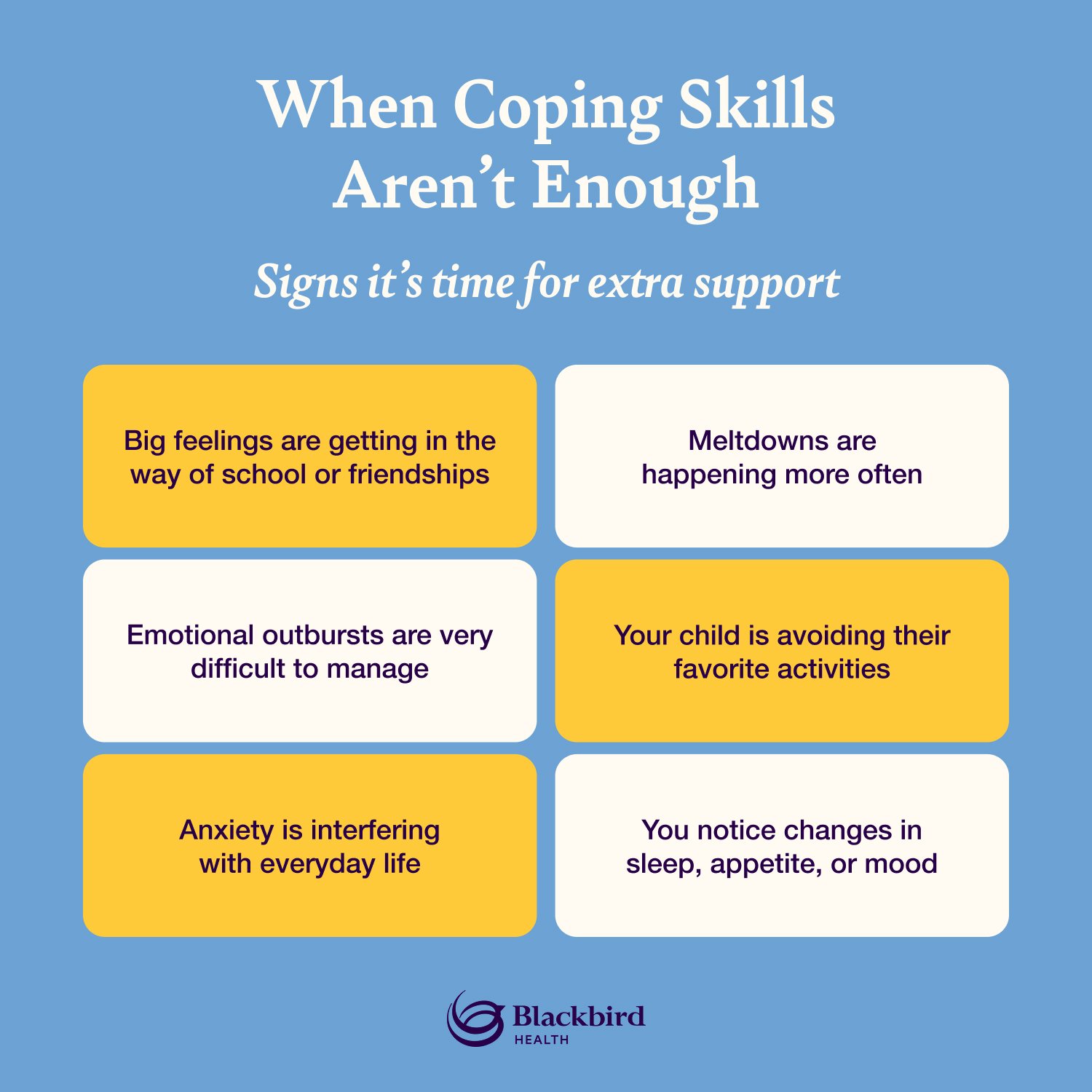
Having big feelings is a normal part of childhood and adolescence. An emotional outburst is not a sign that something is wrong, rather that your child is dysregulated and needs support calming down. But there are also scenarios when additional support from a mental health professional may be warranted. Consider seeking help if:
Emotional outbursts or meltdowns are becoming more frequent or increasingly difficult to manage
Your child is struggling at school
Your child avoids their favorite activities or social gatherings
Everyday tasks become too overwhelming
Your child’s anxiety interferes with everyday life
You notice changes in your child’s sleep, appetite, or mood
When your child’s behavior is impacting the whole family
Safety becomes a concern, such as aggression toward others, running away, or other risky behaviors
Self-harm becomes apparent, such as aggression toward themselves or making statements about wanting to die
If any of these scenarios sound familiar, a comprehensive evaluation such as Blackbird Health’s New Patient Evaluation can help identify what’s behind your child’s struggle and how to best support them.
If you or your child is in crisis and there are issues with safety, self-harm, or harm to others, call or text 988, call 911, or go to the nearest emergency room. There are many resources available, 24/7.
Take this with you
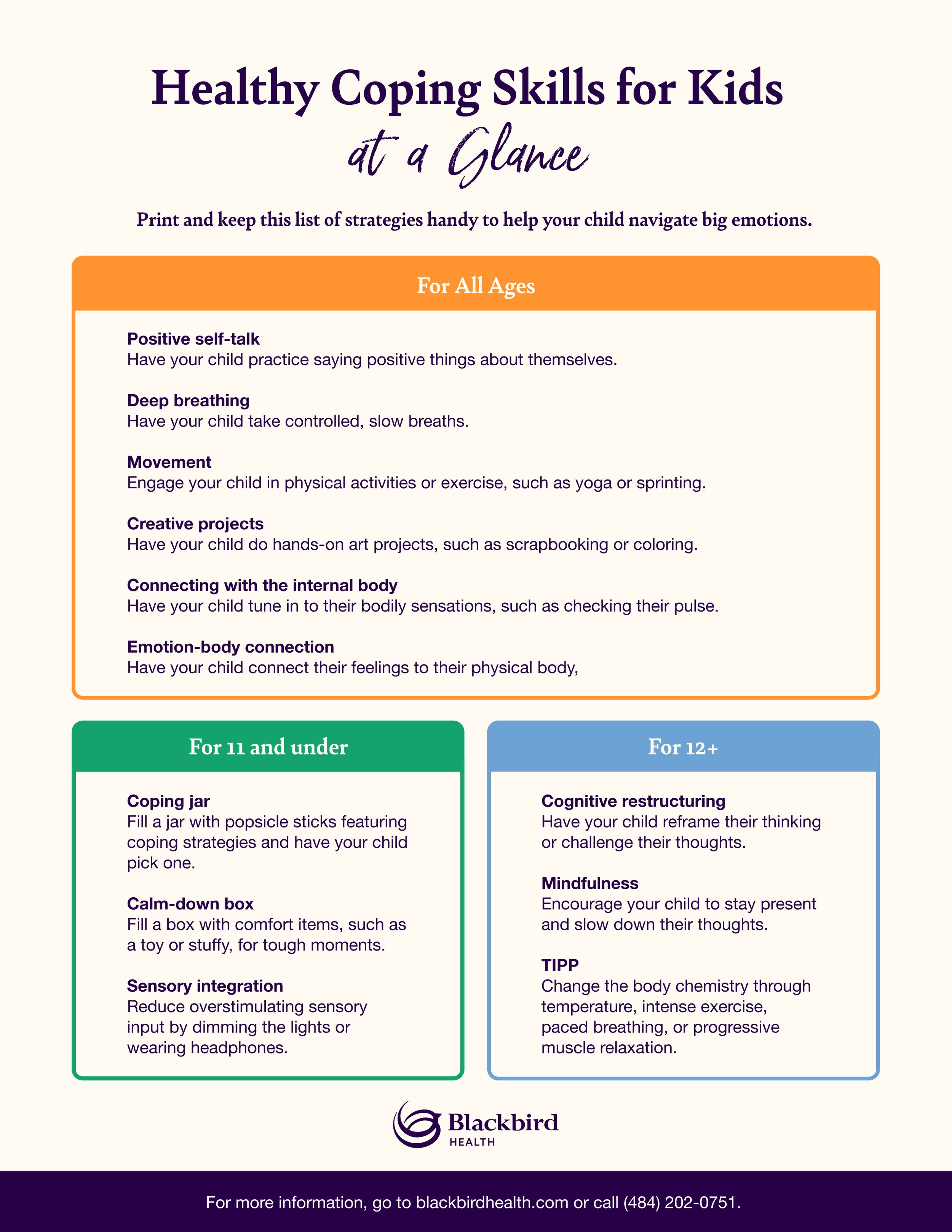
Download this printable list of coping skills or share it with someone else.
The bottom line
Modeling coping skills for your child and teaching them strategies to build their own coping toolkit is something they will carry with them for life. With practice, they can learn how to calm their body and mind, process their emotions, and better navigate the ups and downs of childhood and adolescence. If big emotions continue to interrupt your family life or your child’s routine, reach out to a healthcare professional for additional support.
Frequently asked questions (FAQs)
-
The most important thing to do is remain calm. “Lowering our voices, using fewer words, and reducing stimuli such as taking [the child] away from crowds and into a calm environment can be very helpful,” says Fremuth. “Save processing, problem-solving and teaching for after the child is regulated.” Mid-meltdown, a child’s brain is not in the right place to learn or employ skills. Focus on getting them regulated and in a safe space and if instructions are needed, keep them short and direct.
-
You may not be able to—and that’s okay. If your child is overwhelmed or in the height of emotional distress, they probably won’t be able to use coping skills. Instead, focus on getting your child to a safe space to reduce stimulation so they can begin to regulate. Fremuth recommends giving choices if possible, such as “Do you want to go to your room or my room to calm down?” Once your child is calm, you can revisit a coping strategy.
-
Coping strategies are only successful if they’re practiced enough that they become a habit, which works well in both home and school settings. “School-appropriate coping skills should have low-disruption, and be easy to execute within a classroom setting,” says Kotocavage.
This could be breathing exercises that a child can do at their desk, positive self-talk, mindfulness, heavy work (such as carrying textbooks or walking with a full backpack), or anxiety coping skills for kids who have a difficult time at school drop-off or experience social anxiety.
How can Blackbird help?
Our goal is to initiate the right course of treatment as quickly and as smoothly as possible, so “how it works” can be a little different for everyone. We customize your treatment plan to meet your unique needs, on a timeline that works for you. Click here to get started today.