By Sabrina Rojas Weiss
Medically reviewed by Michael Tang, MD
Key takeaways
Demand avoidance is when a person’s most common response to demands or requests is to refuse, freeze, or react emotionally. While common in ADHD, demand avoidance is most closely associated with autism.
ADHD-driven avoidance isn’t typically defiance, but rather a response to struggles with executive functioning. Difficulties with task initiation, working memory, emotional regulation, and time management may cause a child with ADHD to freeze, cry, fight, or seemingly ignore demands that seem too hard, overwhelming, or not urgent enough.
Strategies to address demand avoidance in ADHD include addressing the individual’s executive functioning challenges, such as by breaking a task into smaller steps and providing visual cues in the form of calendars or checklists.
Children with autism and those with no diagnosis may also display avoidant behavior, particularly in a profile often called Pathological Demand Avoidance (PDA), which can be driven by anxiety over perceived threats to autonomy. Since autism commonly co-occurs with ADHD, it’s important to understand what’s driving the demand avoidance in order to determine the best supportive approach.
When you ask your child to do things, do they freeze or simply ignore you? Does your kid burst into tears as if telling them to put on their shoes is a form of punishment? Have you heard reports from school that your child refused to take a test or complete an assignment in class? You may be dealing with pathological demand avoidance, ADHD, or even both. All children try to test boundaries at some point, pushing back on commands just to see what will happen or to assert their independence, but some go beyond the typical response.
While PDA and ADHD demand avoidance can look like the same thing on the outside, what’s going on inside can be very different. “The good news is that we can provide support and improve relationships by understanding what is driving the perceived ‘avoidance’ we are seeing,” says Bethany Barney, a licensed clinical social worker, diagnostician and Director of Clinical Evaluation at Blackbird Health.
In this article, we’ll discuss what demand avoidance is (particularly as it relates to ADHD), how it shows up differently depending on what’s driving it, and how those causes should determine your response. We’ll also share tips on what to try with your child at home and how to decide when it’s time to ask for professional support.
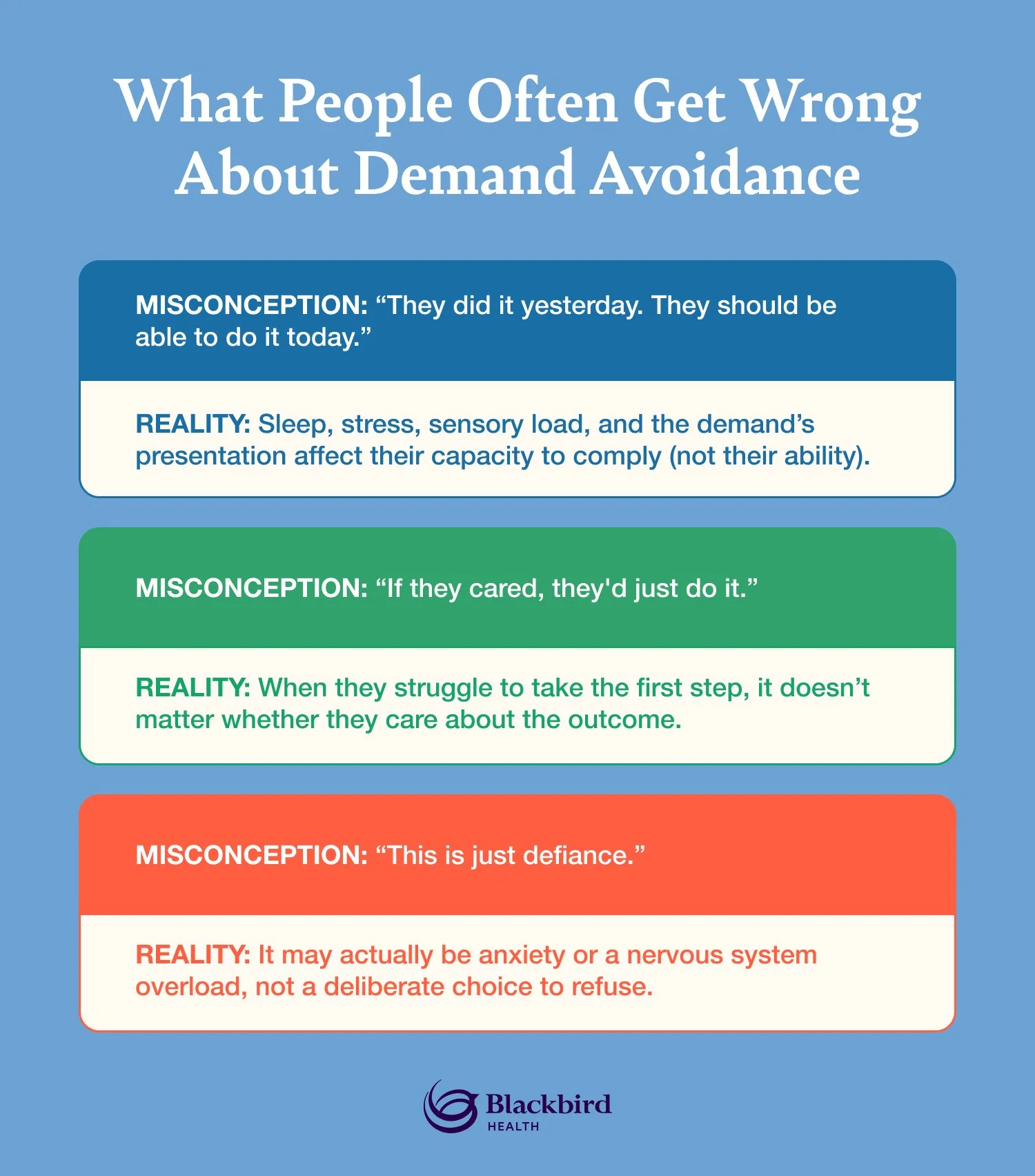
Is this just normal kid resistance or something more?
“Most children will have a reaction to being asked to do something they may not enjoy or want to do at that moment,” Barney says. “We have all seen an eye roll or heard a complaint from a child at some point when we ask them to get dressed or put away a toy.”
Resistance alone is not a cause for concern. But these may be signs there’s something bigger going on:
Requests or orders trigger outsize physical reactions (throwing themselves on the ground) or emotional ones (in tears or anger).
They often freeze or act like they haven’t heard your requests.
Neither punishments nor rewards seem to work.
These behaviors aren’t just in response to chores or homework, but in different settings and with different types of demands.
If any of this seems like what your child is going through, it’s time to take the next step and identify what’s driving their avoidance.
Is it ADHD, PDA, or both?
Demand avoidance in ADHD is commonly an issue with executive functioning. Children and adults with ADHD have difficulty breaking larger tasks into steps, remembering steps, planning, initiating tasks, switching tasks or strategies, estimating time, and regulating emotions. When a demand requires one or more of those things, a child might freeze, refuse to do it, or respond emotionally.
PDA is characterized by extreme avoidance of demands to do everyday activities, triggered by a need for autonomy and control. It often occurs in people with autism, but some experts believe it can occur in others, including those with ADHD. As a systematic review in Frontiers in Education explains, there is no current consensus about whether PDA should be its own diagnosis, so it does not appear in the Diagnostic and Statistical Manual of Mental Disorders, 5th Edition (DSM-5) or the International Classification of Diseases (ICD-10).
In children with both ADHD and autism, it can be difficult to identify whether their behavior is triggered by executive function difficulties or PDA. According to a 2017 study published in the Journal of Attention Disorders, approximately one in eight children (12.5%) diagnosed with ADHD were also diagnosed with autism, so parents should consider the possibility their child may have ADHD as well as autism and/or PDA.
ADHD vs. PDA-Style Avoidance
| Primary driver | ADHD-driven avoidance | PDA-driven avoidance | Both are present |
|---|---|---|---|
| Avoidance trigger | Executive function difficulties | Need for autonomy/control | Overwhelmed by tasks but resists threats to control |
| Response to structure/routine | Positive; finds these helpful | Negative; views as a greater threat to control | May crave routine but will resist the demand in the moment |
| Response to preferred activities | Does not typically avoid | Avoids if someone else suggests them | May still avoid |
| What helps | Improving executive functioning skills, adding structure, providing flexibility | Providing limited choices, letting them pick the path, setting expectations instead of demands | Same as with PDA alone |
This table explains where these avoidance drivers differ and overlap. It is not a tool for diagnosis.
How does ADHD-driven demand avoidance actually show up?
What could look like laziness, defiance, or lack of motivation in a child with ADHD could actually be an issue with how their brain takes in and processes the demand before they can begin a task.
“I had a high school student who was preparing to transition to college and was really struggling to pack for the move,” says M. Laura Pappa, a licensed clinical psychologist and the Mid-Atlantic Lead Director of Behavioral Health Services at Blackbird Health. “On the surface, the task was incredibly simple: She essentially needed to go through her closet and pull out the clothes she wanted to take. But she could not get herself to start. The task did not feel urgent to her, yet at the same time, she experienced it as a huge, amorphous ‘ask,’ which made it very difficult to initiate.”
Pappa says that the brain chemical dopamine is part of the problem. Dopamine levels in the prefrontal cortex of the brain play a role in executive function, including working memory, time management, and emotional regulation, according to the Journal of the Canadian Academy of Child and Adolescent Psychiatry.
Though scientists still don’t know the exact mechanisms of how ADHD works, a leading theory has to do with dysregulated dopamine activity, according to Frontiers in Psychiatry. It’s the brain’s reward system, and it seems like people without ADHD don’t require as much of this reward to spur them into actions that don’t immediately interest them.
“Dopamine is a chemical in our brain that among other things, gives us the extra push we need to initiate tasks—particularly those tasks we would prefer to avoid,” Pappa explains. “This difference often causes people with ADHD to be mislabeled as lazy or unmotivated.”
Here’s a closer look at how that can play out:
Task initiation friction: You ask your kid to clean their room, and they instead lie down on the floor and pretend to go to sleep. In school, they’re told to write an essay, and they instead disrupt class, stare into space, or ask to go to the bathroom, leaving the page blank. What may be happening here is that the child or teen with ADHD can’t easily figure out the first step of these tasks. Instead of being able to break it down into manageable pieces, they’re so overwhelmed by the whole that they don’t feel like they can begin.
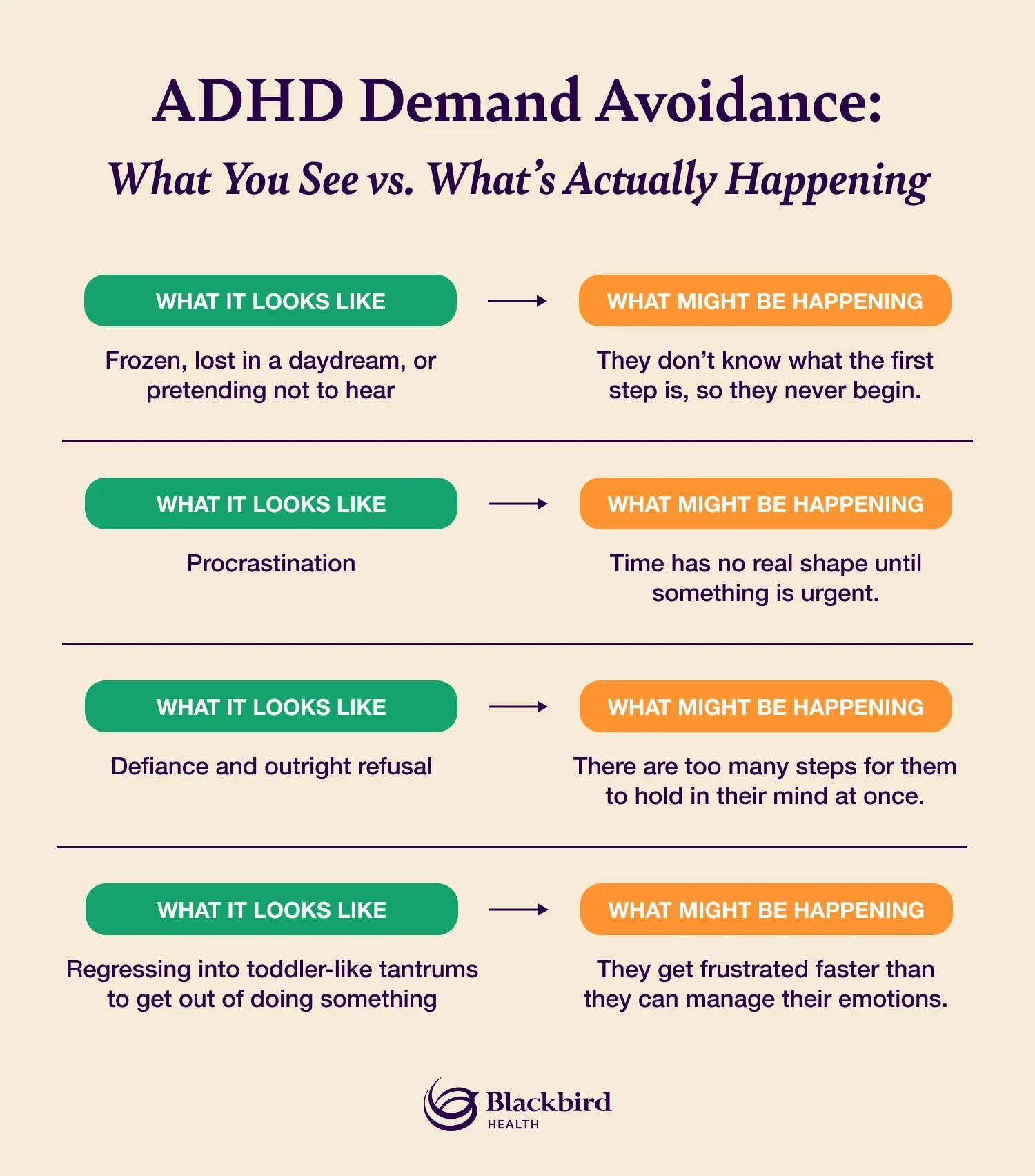
Time blindness: No matter when you wake them up in the morning, they can’t seem to get dressed and ready until it’s past time to leave. They don’t start big school projects given weeks in advance until the night before. For an ADHD brain, time often feels too abstract to be a motivator. It’s not until things are urgent that their brain is aroused enough to switch into active mode.
Working memory load: When you tell them to get ready for bed, they continue playing or doing anything but what you asked. Their teacher says that they rarely follow directions for class projects or require multiple prompts to transition from one subject to the next. These big tasks require working memory to understand and process a request and all the small steps it will require. When memory fails them, the whole thing can fall apart.
Emotional flooding under pressure: A pop quiz at school or a last-minute chore request at home results in a flood of tears or a full-on tantrum, even in a kid who seems too old for such things. Emotional dysregulation is a common symptom of ADHD, and children with it tend to react more strongly than others, according to Clinical Psychological Review. They may be able to handle only so many feelings in a day, and when this latest request comes, they’re just past capacity. They’re not just feeling one demand but all of the emotions that came before it, and they finally react before being able to regulate themselves.
These underlying mechanisms of what your child is experiencing can help guide how you approach resolving the situation.
How to figure out what’s driving demand avoidance
Of course, every child is unique, so the above examples aren’t mirror images of what your child is doing at home and at school. We suggest observing their behavior closely for a few days with the following questions in mind. This isn’t a diagnostic tool or quiz, but it may help you figure out what they’re going through.
At home, what does the lead-up to a shutdown or refusal usually look like?
Are there settings or times of day where this seems to ease up?
Is there a difference in how the child responds to things they want to do versus things they don’t?
What have you tried that made things calmer? What made things worse?
If you decide to meet with a teacher, therapist, or evaluator about your child’s avoidance, your answer to these questions will give them something concrete to work with that’s much clearer than, “They refuse to do anything I ask.” You can also use your answers to guide your next strategies, as we outline next.
What actually helps with ADHD-driven demand avoidance?
As you’ve probably realized by now, repeating yourself a million times, raising your voice, and threatening dire consequences have limited long-term success with your child’s avoidant behavior. If their avoidance stems from executive function and ADHD difficulties—task friction, time blindness, working memory, and/or emotional flooding—there are ways to address them.
Keep in mind that an ADHD child isn’t behaving this way intentionally. “I think most of us generally want to do well and avoid getting into trouble, but we just need more tools to get there,” Barney says.
If it’s looking like your child has more of a PDA-style pattern of avoidance than one driven by ADHD, the tactics below may seem like an even bigger threat to their autonomy. You may want to try these methods first and take note of how they respond.
Break it down: This strategy is great for when task friction and working memory are the obstacle, and a statement such as “clean your room” caused your child to freeze.
“For ADHDers, we often see breaking it down into simple, manageable parts being effective: ‘Here is a bin, put your blocks in it,’” Barney explains. “In this case, we are giving one piece of the larger task, using simple language, and also giving them the container they need. We took out the steps of decoding what clean your room meant, where to find the materials needed to clean, and the burden on working memory by keeping it one step at a time.”
Give them scaffolding they can see and hear: Visual calendars, reminders, and checklists are one of the most useful tools for improving executive function skills in children. In addition to helping establish clear steps, they can reduce the element of unpleasant surprise. Setting timers that they can see also helps make time less abstract and can keep them focused without the need for so many repeated reminders. Still, they may also benefit from a calm check-in from a parent halfway through. Teachers can also help with this kind of task refocusing and assignment reminders in the classroom. (Those are common requests in 504 plans.)
Give them the setting for success: No, you don’t need to do your child’s chores or work, but you can give them an environment that paves the way for the behavior you want from them. For example, set up an area by the front door where they have easy access to shoes and coats before leaving in the morning, as well as an easy place to put them when they get back home. Provide an area for them to do homework that’s quiet, free from clutter, and has places to keep their things organized and within reach when it’s time to put everything away. While you’re at it, ask your child’s teachers to seat them at the front of the class or otherwise away from distractions.
Don’t be rigid about the order of things: Switching from one task to the next, especially if it’s unexpected, is often difficult for a child with ADHD. For example, asking them to stop doing their homework in order to help set the table, or stop reading in order to get ready for bed, can cause them to react emotionally. It may be better to establish a list of things that need to get done every night and allow them some room to choose (within reason) the order in which they complete them.
Lower the stakes: A child with ADHD may feel shame from their past failures that colors how they view new tasks. They may also have anxiety compounding their fear of failing again, and this can make them decide that it’s less of a risk to avoid the task altogether. Try to talk them through the task with the assurance that the stakes aren’t that high: A less-than-perfect test or project is not going to make or break their future; it’s okay if they just get their room somewhat neater without being able to eat off the floor; they just need to get to school dressed, and it’s okay if they’re not runway-ready.
What to Try, Based on What You’re Seeing
| What you're seeing | What's likely happening | What to try |
|---|---|---|
| Child is frozen in response to a request or assignment | Task initiation friction and/or working memory difficulty | Break things down into steps, guide them to the first step |
| Child skips or refuses assignments | Task friction, anxiety, or fear of failure | Reduce pressure and expectations; emphasize that even incomplete or imperfect work is better than none |
| They have tantrums or big emotions in response to small requests | Emotional dysregulation | Establish predictable routines, offer some flexibility in the order of tasks |
| They won’t start or complete big long-term projects; won’t do anything until the last minute | Time blindness | Create visual reminders, checklists, calendars, schedules. Set timers. Do periodic check-ins. |
| Cleanup and organization requests are the biggest source of resistance | Multiple executive function failures | Create more organizational systems and a clear workspace at home |
If these strategies aren’t working, it is possible that PDA is behind your child’s behavior. While imposing more external structures and instructing on multiple steps might be immensely helpful for ADHD avoidance drivers, they might have the opposite effect on PDA, making them feel their independence is under threat.
“[For PDA] the most effective strategies are going to involve the child being able to have a voice and autonomy,” Barney explains. “Adults need to use nondirective language since this will reduce the nervous system trigger of PDA.”
Take note of any strong negative reactions to the ADHD-oriented strategies, and consider speaking about them with a professional.
When is it time for professional support?
“As a general rule, I think it’s healthy to reach out for help when caregivers feel that the traditional strategies they used for themselves or their other children don’t click for the child,” Pappa says.
An excellent next step is to get a complete psychological evaluation of your child. Finding out whether their issues are PDA, ADHD, or both along with other co-occurring conditions, such as autism or anxiety, is important, because so many of these conditions complicate each other with overlapping symptoms.
Such an evaluation requires looking at your child’s physical and mental health history, their behavior at school and at home, their home environment, and any relevant family health history. Once you have that big picture, you can start to figure out steps to take via individual therapy, family therapy, coaching, and school support.
Blackbird Health offers comprehensive, affordable mental health assessments, followed by a tailored care plan informed by the results. That may include suggestions for therapy, executive function coaching, and medication, when appropriate.
Another advantage of getting a formal evaluation is that this can help you get certain accommodations and support for your child at school. Blackbird’s providers also help parents navigate the process of getting an IEP or 504 plan in place.
The bottom line
When unaddressed, demand avoidance can be exhausting and emotionally damaging to children, parents, and caregivers. The first step is understanding what’s driving their behavior—whether it’s ADHD-related executive function difficulties or a PDA-style reaction to threats to their autonomy. Home strategies and professional support can help.
Frequently asked questions (FAQs)
-
A number of different factors can cause avoidance. For children with ADHD and avoidance, issues with executive functioning are a likely cause. When it presents as PDA-style avoidance, Barney explains that it’s likely “driven by deep anxiety and nervous system dysregulation.” A systematic review published by the National Autistic Society states that sensory issues and phobias may also be contributing factors.
-
Some people have PDA-style behavioral patterns without autism. While there is a debate among psychological researchers about whether PDA should be considered its own diagnosis or if it is a collection of symptoms within the autism spectrum, many mental health professionals and caregivers report PDA behavior in children with no autism diagnosis.
-
Typically, a child’s PDA behavior does not respond to rewards or consequences, but we can’t say whether they would make behavior “worse,” because that depends on the child and the manner of delivery. For children with ADHD, rewards and consequences may actually help—after you’ve also cleared any executive functioning obstacles. “If you need to add another layer of motivation, making the activity competitive (Who can put blocks in faster?) or providing an extrinsic reward (We can listen to music while we pick up) can add novelty and provide a dopamine boost, which we know are very appealing for ADHDers,” Barney says.
-
While demand avoidance, and PDA in particular, do not have an official diagnosis according to the DSM-5, ODD does. According to StatPearls, the criteria include symptoms such as anger, irritability, defiance, vindictiveness, and argumentative behavior that occurs at least once a week or more for longer than six months in someone age 5 and older (more than 50 percent of the time within six months for children younger than 5). The main difference to note is that not every child with PDA and ADHD displays their avoidance as anger. There is a lot of overlap, however, especially because ODD often co-occurs with ADHD and autism, per a study in the Journal of Autism and Developmental Disorders.
-
You can get support for your child without a diagnosis. “It will never be harmful to seek a professional opinion or support,” Pappa says. Still, a full psychological evaluation may help clinicians and educators understand more about what is driving your child’s behavior and what kind of support would work best for them.
How can Blackbird help?
Our goal is to initiate the right course of treatment as quickly and as smoothly as possible, so “how it works” can be a little different for everyone. We customize your treatment plan to meet your unique needs, on a timeline that works for you. Click here to get started today.