What Is Parent Coaching and How Can It Help Your Family?
By Korin Miller
Medically reviewed by Michael Tang, MD
Key takeaways
Parent coaching is a skills-based service that helps parents build strategies to better navigate day-to-day struggles with their child.
Parent coaching is different from therapy, which is ongoing clinical care that focuses on the thoughts, emotions, behaviors and patterns of the parent, child, or both.
Parenting coaching can help create consistency, better communication, emotional regulation, and behavior strategies at home.
When caregivers have conflicting views on how to manage their child’s unwanted behaviors, a parenting coach can provide a neutral perspective and help align different parenting styles.
We’ve all been there: Your child has a meltdown over screentime, refuses to go to school, or drags out bedtime, and you respond in a way you’re less than proud of. But when this experience feels like a broken record that only ends in escalation, you may need help communicating in a way that lands better with your child.
This isn’t about needing a different set of one-size-fits-all tips. You’ve tried the books, listened to the podcast advice, and heard the feedback from well-meaning friends on what worked for their children. It’s about creating a plan for your specific child and family to help you navigate day-to-day struggles more seamlessly and with less conflict. That’s where parent coaching can help.
Parent coaching isn’t as well-known as therapy and, with that, there’s understandable confusion about how the two approaches may be different. In this article, we’ll clarify what parent coaching is, how it’s different from therapy, what coaching for parents looks like, and who this tool is the best fit for.
What is parent coaching, and how is it different from therapy?
Parent coaching is a form of parental support that delivers practical strategies for parent challenges. While a parent coach may have a clinical background as a therapist, parent coaching is not the same as therapy.
“Parent coaching is typically brief, practical, and skills-based,” says Micah Munro, a licensed clinical social worker and psychotherapist at Blackbird Health. “It focuses on a specific parenting or developmental challenge and gives parents actionable strategies they can begin using at home.”
Therapy is another important tool in your parenting toolbox, and the two often co-exist. “Therapy is ongoing clinical care that focuses more deeply on the parent’s own thoughts, emotions, behaviors, relationships, and patterns that may be affecting their well-being or the parent they want to be,” Munro says. Therapy for your child can also be supportive—it ultimately depends on the needs of your family.
Knowing the difference between therapy and parent strategies coaching matters most once you see who each one is actually for.
Parent Coaching vs. Therapy
| The Question | Therapy | Parent Coaching |
|---|---|---|
| Who's in the room | Child and a therapist, or parent and a therapist | Parent and a parent coach |
| The focus | Addressing underlying emotional issues and providing clinical treatment | Learning new skills and strategies for problem management |
| Typical format | Ongoing weekly 60-minute sessions | Flexible 60-minute sessions scheduled as needed |
| The leader | Licensed therapist | Parent coach |
What parent coaching can help with
Parent coaching is designed to meet the needs of your family, creating natural variety between people and sessions. However, there are a few common situations that parenting strategies coaching can help with.
Common situations parent coaching can help
These situations can surface whether or not your child has a diagnosis such as ADHD or autism—and it’s important to stress that a diagnosis is not needed to benefit from parent coaching. But parent coaching is designed to help navigate situations including:
Bedtime battles
Homework refusal
Sibling conflict
Meltdowns and emotional regulation
Screen time fights
Defiance
Applying strategies from a therapist or evaluation at home
When caregivers disagree on how to handle a behavior and want a neutral perspective
When advice that's worked for other families hasn't worked for yours
What actually changes
You already know what’s most challenging or frustrating in your life, but coaching can help build the following skills for you and your household:
Consistency, ideally in the form of calmer routines and fewer inconsistent reactions.
Communication, with the goal of fewer power struggles and less overall conflict.
Emotional regulation, supporting fewer blow-ups for both parent and child.
Behavior strategies, creating a plan that holds up over time.
Why the parent is often the most effective lever
A common question that surfaces with parent coaching is if your child is the one struggling, why are you as the parent meeting with someone?
“Children are not able to regulate in isolation,” says Erica Negron, a licensed professional counselor and psychotherapist at Blackbird Health. Their behavior is influenced by a range of factors, including their developmental stage, temperament, nervous system, environment, and the interactions they have with the adults around them, she explains.
“Parents are with their children far more than a therapist ever could be, which makes them one of the most powerful agents of change in the child's life,” Negron says. Of course, parents aren’t the most effective lever across all conditions. Parent coaching is often the most effective for children with externalizing behavior problems, such as hyperactivity, inattention, and defiance.
Research supports parent-focused interventions to see big improvements in behavior. One recent study published in the journal Focus on Autism and Other Developmental Disabilities notes that parents may be “ideal implementers” of behavioral interventions for children with autism in particular.
What a parent coaching session actually looks like
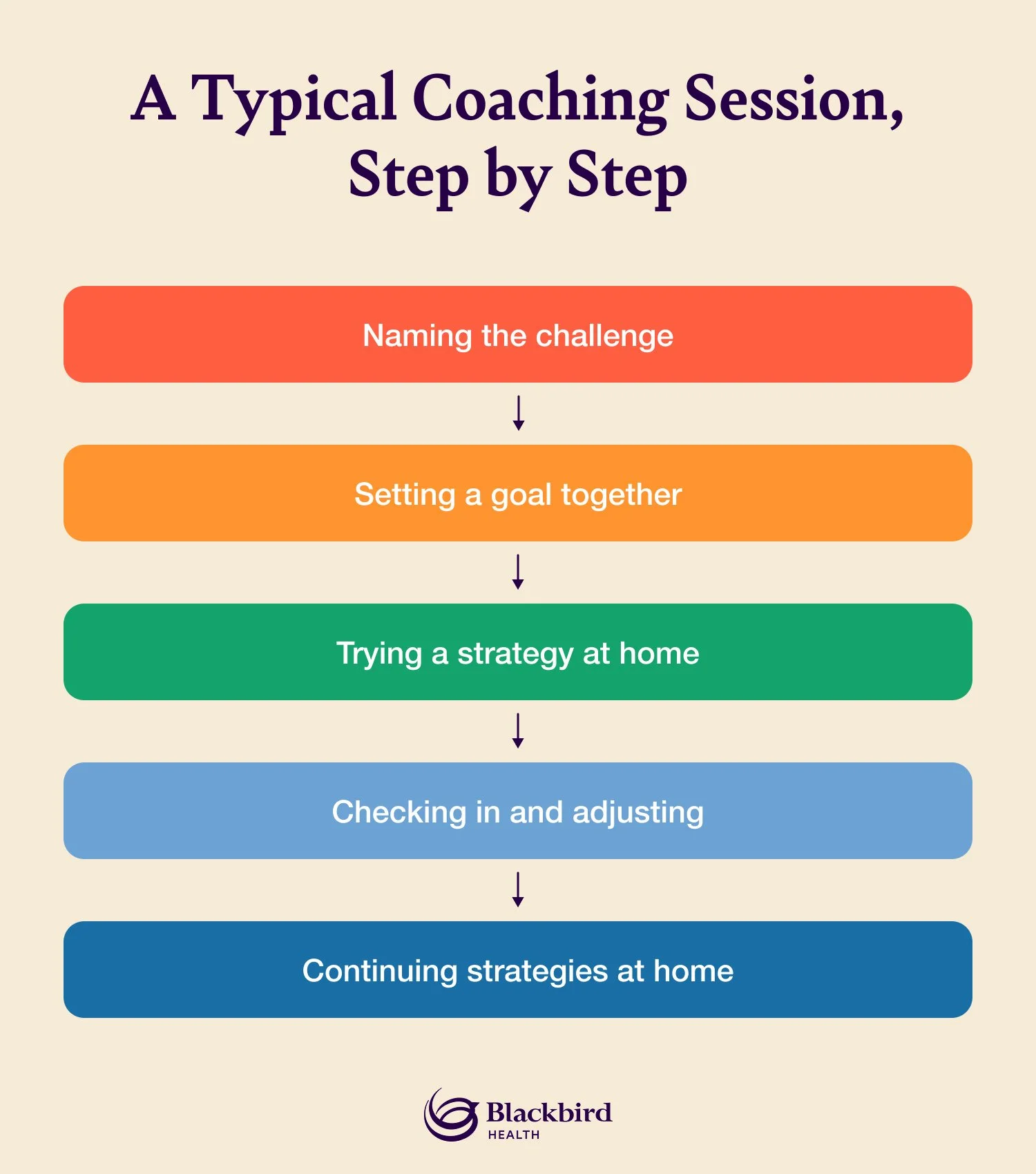
Again, every coaching session is tailored to your specific child and family’s needs. As a result, there will be variation between what you and another parent may experience. However, there is a general framework to expect.
Your first session
The first session involves an assessment. “I want to understand not only the behaviors concerning the parent, but also when they are happening, what tends to happen before and afterward, the child's developmental needs, family dynamics, and what the parent has already tried,” Negron says.
During this time, a parent coach will try to identify the strengths of your family. “Parents often come into sessions feeling exhausted or believing that nothing they are doing is working,” Negron explains.
From there, you and the parent coach can identify specific goals and lay out teaching strategies that will work for you and your family.
Ongoing sessions
After the groundwork is laid in the first session, subsequent parent coaching meetings become focused on practice and refinement. “We look at what happened during the week, what worked, what did not work,” Negron says. Parents and caregivers may practice skills with a therapist observing and receive immediate feedback. That can mean role-playing with how you’d react to certain situations, such as homework struggles or refusing to clean up.
“This allows parents to feel confident with using their skills in various scenarios,” Negron says. “The goal is to help parents become more intentional, predictable, and confident in how they respond to their child's needs and behaviors.”
Even with a clear picture of the process, it’s still normal to feel unsure if you need parent coaching at all. Here are a few things to keep in mind as you consider if it’s right for you.
Asking for help is not a sign of failure
It’s a common—and understandable—worry that you’ve somehow failed as a parent if you’re looking for external help. That’s simply not true. “Seeking parent coaching is not an admission of failure but is an acknowledgement that parenting is complicated and that sometimes we need additional tools and support,” Negron says.
It’s not expected for parents to automatically know how to react to every developmental, emotional, behavioral, or neurodevelopmental challenge your child may experience. “There is no handbook provided at birth,” Negron points out.
If your child has an underlying condition such as ADHD, anxiety, trauma, developmental differences, or significant emotional dysregulation, you may need parenting strategies that look very different from what may have worked for other children, including your own kids.
Using coaching also isn’t a sign that therapy or medication isn’t working. It’s just another layer of help to create a more cohesive household. “Through coaching, parents are able to identify communication and response patterns that open up new pathways and circuits that ultimately create a regulated home,” Negron says.
How parent coaching fits with therapy and medication management
For a child with a diagnosed condition, parent coaching commonly works best as one part of a broader care picture, alongside therapy and medication management. It’s not designed to be a replacement for either. Instead, it ensures that things at home are working as smoothly as possible to support your child’s wider treatment.
“Parent coaching can complement a child’s therapy by helping parents reinforce coping skills and treatment goals in everyday family life,” Munro says. “For example, if a child is working on emotional regulation in therapy, coaching can help parents learn how to model regulation, respond calmly, name emotions, and practice the same coping strategies at home.”
Parent coaching can also help parents notice changes in behavior, mood, functioning, or possible medication effects that may be important to share with the child’s therapist and medication provider, Munro points out.
“Coaching, therapy, and medication management each serve a different purpose, but together they can create a coordinated and consistent system of support for the child and family,” she says.
If you're looking to integrate parent coaching into a broader care plan for your child, Blackbird Health offers comprehensive evaluations for children and teens. You’ll receive an assessment and treatment plan tailored to their specific needs. Parents with kids receiving care at Blackbird Health get their first parent coaching session covered by insurance.
The bottom line
Parent coaching offers specific strategies to help you work through daily struggles with your child. The goal of parent coaching is to give you actionable advice you can use that’s tailored to your family, with the aim of minimizing household disruptions and frustrations in the future. Parent coaching is not designed to replace therapy or medication management—instead, it’s a complementary support.
Frequently Asked Questions (FAQs)
-
ChatGPT and other AI tools can help you to brainstorm solutions to parenting challenges. However, this should not be the only tool you rely on, or even the main one.
Parenting difficulties—including the dynamics between co-parents and any misalignments—are often more detailed and nuanced than what AI can decipher, making it important to have a human touch that’s backed by clinical training and tailored to your specific situation.
AI also tends to be affirmative, even of potentially harmful tactics, and avoids giving critical feedback.
-
Parent coaching is available for a wide range of ages. The goal of parent coaching is to help you find the skills you need to navigate challenges as a parent, which can surface any time.
-
Parent coaching needs can vary. However, coaching sessions typically last for 60 minutes. During that time, you’ll connect with a parent coach about challenges you’ve faced at home, strategies you’ve tried, what has and hasn’t worked, and role-play to make you more confident when addressing future issues. Parent coaching can go on for as long as you’d like. However, many people will find that six to 12 sessions are helpful for supporting their needs.
-
Parent coaching typically costs between $100 to $200 for a one-hour session, though prices can vary widely depending on the format (group vs. individual) and provider’s experience.
While parent coaching isn’t covered by insurance as it’s considered educational and not a medical necessity, parents with kids already receiving care at Blackbird Health get their first parent coaching session covered by insurance. After that, 60-minute sessions cost $150 and can be scheduled as needed.
-
It can be frustrating if your co-parent doesn’t want to participate in parent coaching when you do, but even if only one parent participates, this can still be an effective strategy for your family.
Through parent coaching, you can still learn tools to navigate behavioral issues with your child and lay the framework for more seamless days ahead. The changes in your individual approach can have a positive impact on your overall family dynamic. You may also be able to share the new tools you learn with your co-parent, if they’re receptive to them.
How can Blackbird help?
Our goal is to initiate the right course of treatment as quickly and as smoothly as possible, so “how it works” can be a little different for everyone. We customize your treatment plan to meet your unique needs, on a timeline that works for you. Click here to get started today.