By Sarene Leeds
Medically reviewed by Michael Tang, MD
Key takeaways
While obsessive-compulsive disorder (OCD) in kids and teens is commonly categorized into patterns such as contamination, checking and harm, symmetry and ordering, and intrusive thoughts, these are descriptive symptom themes rather than official diagnostic “types” or subsets.
Three key factors help to differentiate between normal childhood habits and OCD: The behavior is time consuming, causes significant distress, and impairs daily functioning.
Children often expend enormous energy suppressing their rituals at school, leading teachers to see a high-achieving student while parents witness the resulting exhaustion, anxiety, and meltdowns at home.
Exposure and response prevention (ERP)—a specialized form of cognitive behavioral therapy—is the primary first-line treatment, sometimes paired with SSRI medications when appropriate.
Since family members frequently participate in a child’s rituals to reduce immediate distress, parental involvement and specialized programs (such as SPACE) can be important for breaking the OCD cycle.
A child having routines, superstitions, or even strong preferences is completely normal behavior—but what happens when those routines and preferences overtake your daily life? Perhaps your child is regularly late for school because they can’t leave the house until they line up their stuffed animals on the bed in a specific order. Or they have a meltdown because instead of going to the park as usual on Thursdays, they have a dentist appointment.
These behaviors may be linked to two key cycles of obsessive-compulsive disorder (OCD), which affects about 1.5 million to 2.2 million children in the United States: The first cycle, according to the International OCD Foundation, is obsessions, which are unwanted, intrusive thoughts, images, or urges that trigger intensely distressing feelings. These worries can cause the need for a routine, such as arranging one’s stuffed animals in a particular way. The second cycle is compulsions, or the actual physical or mental behaviors that present in rigid routines (engaging in repetitive physical actions or thinking of a word repeatedly).
Because OCD doesn’t have one fixed presentation, this article will help you identify four common patterns, or informal obsessive-compulsive disorder types, that appear in kids and teens. After reading, you will also be able to better tell OCD apart from normal childhood behavior and understand when it’s time to talk to a professional.
What are the different types of OCD?
First off, it’s important to remember that there are actually no official, diagnostic OCD “types.” Instead, symptoms are often grouped into similar themes. Below are four of the common patterns that can be considered different types of OCD.
Contamination
What it is: The fear of coming into contact with perceived contaminated substances, objects, or illness (dirt, germs, garbage, etc.). Per a 2013 article published in the Journal of Obsessive-Compulsive and Related Disorders, contamination is one of the more common types of OCD among youths.
A fear of getting sick or making someone else sick
Worry over “dirty” objects or surfaces
Common compulsions
Checking and Harm
What it is: The fear of acting on an impulse to harm oneself or others.
Common obsessions
Extreme, intrusive thoughts or fears about hurting someone or oneself
Worry about whether something was locked or turned off
Repeated checking that everything is all right
Mentally replaying violent events
Symmetry and Ordering
What it is: A need for order and repetition; for things to feel “just right”
Discomfort when things are uneven, asymmetrical, or out of sequence
Need for things to be perfect
Arranging items
Counting
Intrusive Thoughts
What it is: Unwanted, distressing thoughts, often of a violent, sexual, or religious nature. This category, especially the religious thoughts, is sometimes referred to as “scrupulosity,” or the fear of sin when there is none, according to a 2025 article published in Children. The literature is limited regarding scrupulosity in children, however.
Keep in mind that these thoughts, while disturbing, don’t reflect the child’s character and don’t predict their future behavior.
Common obsessions
Disturbing sexual, violent, or religious thoughts that cause shame, embarrassment, anxiety, or fear.
Worry that there’s something wrong with them for having these thoughts
Common compulsions
Engaging in rituals to neutralize or eliminate the thoughts
A quick note: Readers who were hoping to learn more about hoarding may be surprised it’s not listed here as one of the main types of OCD. This is because even though hoarding was long-considered a subset of OCD, it was reclassified as its own diagnosis in 2013, with the publication of the Diagnostic and Statistical Manual of Mental Disorders, Fifth Edition. This is why content about hoarding that was published before 2013 will likely not match the information in this article.
The 4 Types of OCD Compared
| Type | What it is | You might notice |
|---|---|---|
| Contamination | The fear of coming into contact with perceived contaminated substances, objects, or illness (dirt, germs, garbage, etc.). | Your child repeatedly showering or changing their clothes. |
| Checking and Harm | The fear of acting on an impulse to harm oneself or others. Or the fear that something hasn’t been locked or turned off. | Your child checking that everyone is safe in bed. |
| Symmetry and Ordering | A need for order and repetition; for things to feel “just right” | Your child meticulously organizing their clothes and toys. |
| Intrusive Thoughts | Unwanted, distressing thoughts, often of a violent, sexual, or religious nature. | Your child is distressed by intrusive thoughts and working to not act on those thoughts. |
Identifying which of these patterns you may be seeing in your child can be useful, but it doesn’t automatically mean it’s OCD. In the next section, we’ll address how to tell the difference between potential OCD and what’s normal for your child’s age.
Is it OCD or is this normal for their age?
Many kids exhibit compulsion-type behaviors such as lining things up, repeating their bedtime routine, or going through superstition phases. But those behaviors don’t necessarily mean your child has OCD.
“The distinction comes down to flexibility, distress, and impact,” explains Chrystal Gray, a pediatric neuropsychologist and Lead Neuropsychologist at Blackbird Health. “Normal childhood rituals bring comfort, fun, or a sense of order, and kids can adapt if the routine changes. OCD, however, is driven by intense anxiety or dread.
One area you may consider observing is whether your child is exhibiting magical thinking, a typical behavior among younger children (roughly five to eight years old). Magical thinking is the belief that your thoughts or actions can influence events, often in an unrealistic way.
By ages eight and older, children have usually outgrown magical thinking. So if they continue to strongly exhibit these types of thoughts, it may be a signal of OCD.
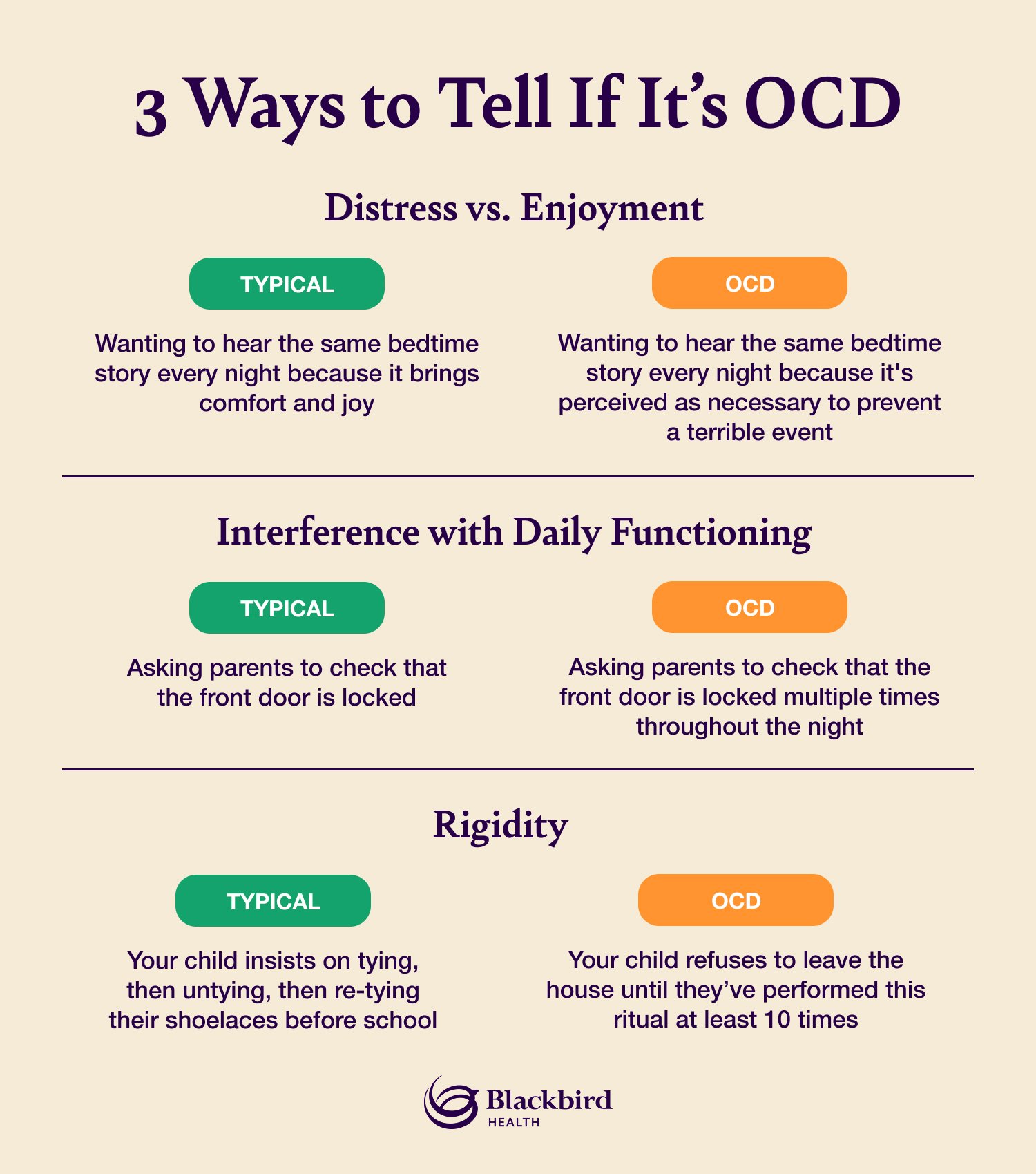
Additional possible differentiators are as follows.
Distress vs. enjoyment: “Kids normally go through phases of wanting things a certain way, asking lots of questions, repeating favorite activities,” explains Liz Lowe, a licensed professional counselor and psychotherapist at Blackbird Health. But with OCD, “this is typically driven by anxiety, discomfort, and doubt.” The child then “feels they need to perform a compulsion to make the uncomfortable feelings go away.”
Interference with daily functioning: If you find your daily schedule is planned around your child’s rituals, it may be time to seek professional help. “When behaviors start consuming significant time or interfering with daily life, it moves beyond normal childhood behavior,” says Gray.
Rigidity: Gray recommends looking for rituals that “feel rigid and driven by ‘musts’ rather than preferences, distress that escalates if a routine is interrupted, or fears that seem wildly out of proportion to real life.” If any of those examples sound familiar, you may be looking at a case of OCD.
Why OCD can look different at school than at home
According to a 2022 study published in the Journal of Child and Family Studies, evidence about the effects of OCD on school functioning is limited. Still, experts note that a child’s OCD can look different at school than at home for several reasons. This isn’t the school or the parents misreading the situation—they’re just seeing different pieces at a time.
For example, some kids may suppress their rituals at school and then release that emotional load once they get home. “Home is a child’s safe harbor,” says Dr. Gray. “Kids naturally hold back their struggles in public settings where social stakes are high, but feel secure enough with parents to let their guard down and reveal the full weight of their anxiety.”
She goes on to explain that when kids are at home, they’re more likely to “feel secure enough to show their raw distress, often turning to family members to perform rituals or provide endless reassurance that they managed to go without all day.” This can present as “severe meltdowns” or “outbursts” because the child has spent “tremendous energy” at school hiding their true selves to fit in with their peers and succeed academically.
When kids mask at school (e.g., suppress their rituals), Lowe observes, “this can look like a high-achieving or gifted student academically [to teachers and fellow students],” even though the same child may be either “struggling” or experiencing “burnout” at home.
Lowe also notes that sometimes a child’s compulsions can follow them home from school, through rereading, rewriting, triple-checking, and overstudying. This “can look like a driven child but is actually an exhausted child stuck in the OCD cycle.”
When to seek a professional evaluation
The same three factors that separate OCD from a phase (distress, interference, and rigidity, as discussed above) can help you determine if it’s time to seek professional support.
“Parents should seek a professional evaluation for OCD when they notice their child’s worries, rituals, and avoidance are frequent and distressing,” says Lowe. “And when [the parents] disrupt or change routines to prevent anxiety.”
Below, Gray offers more concrete examples of when it’s time to seek support using the three main differentiators of OCD.
Interference: When fears or rituals delay bedtime by an hour, turn morning routines into a high-stakes ordeal, or prevent a child from attending playdates, joining sports, or doing homework, OCD is actively shrinking their world.
Distress: Take note of disproportionate meltdowns, tearfulness, or explosive anger over seemingly minor shifts, such as a door left cracked or a word misspoken.
Rigidity: Notice if the entire household is bending around the child’s anxiety. Parents often find themselves walking on eggshells—offering endless reassurance, avoiding specific words, repeating exact phrases on command, or altering family routines just to prevent a meltdown.
Considering some of this behavior is normal for younger children, it makes sense that parents may want to wait things out. But seeking a formal evaluation, which will look at what’s happening at home and at school, doesn’t mean you’ve already arrived at an answer. It means that you want—and deserve—clarity about your child.
Blackbird Health’s comprehensive evaluation will help you better understand what’s actually going on with your child, paired with a tailored treatment plan on how to best support them.
How OCD is treated in kids and teens
Exposure and response prevention (ERP), a specialized form of cognitive behavioral therapy (CBT), is the first-line, evidence-based treatment across all forms of OCD because it targets the obsession-compulsion cycle itself.
“ERP gently helps kids face their feared thoughts or triggers without engaging in compulsions,” explains Gray. “This teaches the brain that anxiety naturally peaks and fades on its own, and that uncomfortable feelings are manageable.”
In some cases—usually “moderate-to-severe,” says Gray—medication is combined with ERP. Primarily prescribed in the form of Selective Serotonin Re-uptake Inhibitors (SSRIs), medication support “acts like a ‘volume knob,’ turning down the intensity of the anxiety so kids can participate more effectively in therapy.”
During ERP therapy sessions, under a clinician’s guidance, kids practice confronting the thoughts, images, objects, and situations that provoke their obsessions (exposure component). Then, the therapist will help them choose not to engage in a compulsion once the anxiety or obsessions have been triggered (response prevention component).
“This treatment can sound scary for kids and teens,” says Lowe, “but it is highly collaborative and individualized,” especially when administered by an experienced provider. In addition to offering comprehensive child and teen assessments, Blackbird Health provides personalized therapy for OCD.
And the child likely won’t undergo treatment alone: “Parents are a vital part of the treatment because OCD often involves the entire family,” says Lowe.
“Parents can find themselves participating in OCD rituals to help reduce their child’s distress,” she continues. “However, this is a short-term fix that actually strengthens the OCD and pulls the family further into accommodations.” By “accommodations,” Lowe is referring to how family members will adjust their behavior or routines to avoid anxiety-provoking situations for their child.
While parents are encouraged to attend therapy sessions to learn alongside their child, it’s not always possible. If direct participation in their child’s ERP therapy is either difficult or inaccessible, Lowe recommends parent-based approaches such as the SPACE (Supportive Parenting for Anxious Childhood Emotions) program, which is offered by Blackbird Health. “[This option] is appropriate and helpful in changing parent behavior to affect change in their child.”
The bottom line
Although there are no official, diagnostic types of OCD, the common patterns that appear in kids and teens can be categorized as contamination, checking and harm, symmetry and ordering, and intrusive thoughts. Many children exhibit compulsion-type behaviors, but when they cause distress, interfere with daily life, and are driven by rigidity, it’s worth seeking a formal assessment and, possibly, professional support. OCD affects the entire family: The sooner you are able to obtain clarity about your child’s behavior, the sooner you can all receive the help you deserve.
Frequently asked questions (FAQs)
-
Some common obsessions in people with OCD can include:
Contamination-related fears, such as getting sick or making someone else sick, or worries over “dirty” objects and surfaces.
Extreme, intrusive thoughts or fears about hurting someone or oneself.
Worrying if something was locked or turned off.
Discomfort if objects are uneven, asymmetrical, or out of sequence, or an incessant need for things to be perfect.
Disturbing sexual, violent, or religious thoughts that cause shame or embarrassment.
-
Other sources may cite more types of OCD because there is no official diagnostic list of OCD types. There are some common OCD symptom-related patterns, such as Contamination, Checking and Harm, or Symmetry and Ordering, but they can vary by source. Other sources may also include hoarding as an OCD subset. This was more common prior to 2013, when hoarding was reclassified as its own diagnosis.
-
No, just because your child has scary thoughts about hurting someone, that doesn’t mean they will act on those thoughts. It is completely natural to have scary or violent thoughts, but if these thoughts intensify and are causing your child severe anxiety and compulsions, then they might be a sign of Harm-related OCD.
-
Yes, OCD can be treated without medication. The typical first-line treatment for OCD is exposure-response therapy (ERP). But medication is sometimes prescribed, usually Selective Serotonin Reuptake Inhibitors (SSRIs), for more severe cases.
How can Blackbird help?
Our goal is to initiate the right course of treatment as quickly and as smoothly as possible, so “how it works” can be a little different for everyone. We customize your treatment plan to meet your unique needs, on a timeline that works for you. Click here to get started today.