SPACE Therapy: Helping Children With Anxiety—By Helping Parents First
By Dahlia Rimmon
Medically reviewed by Michael Tang, MD
Key takeaways
SPACE is a parent-based therapy for childhood anxiety and OCD. It teaches parents how to respond to their child’s anxiety with empathy, while gradually reducing accommodations that may perpetuate anxiety.
Parental accommodation occurs when parents alter their behavior, routines, or rules in order to help their anxious child avoid distress. While well-intentioned, it only provides short-term relief and can worsen anxiety over time.
SPACE teaches parents how to replace accommodation with other supportive responses to help their child build confidence in their ability to tolerate discomfort.
SPACE is as effective as CBT in reducing a child’s anxiety, family accommodation, and parenting stress, so it’s a helpful option for families when children are unable or unwilling to attend one-on-one therapy sessions.
What if helping your anxious child starts with changing how you respond to their anxiety? That was a pretty mind-blowing realization for me. My daughter is highly anxious and if I’m being honest, so am I. I know firsthand how tempting it is to want to make those uncomfortable feelings disappear when your child is scared, worried, or overwhelmed—your instinct is to jump in and make it better.
So when I started hearing chatter about SPACE therapy (which stands for Supportive Parenting for Anxious Childhood Emotions) in my mom groups, I was immediately intrigued. What really caught my attention was that my daughter didn't have to attend a single therapy session. Instead, I would learn how to support her anxiety, and in the process, learn how to better parent an anxious child.
But what exactly is SPACE, and how does it help anxious children? In this article, we’ll break down everything you need to know about SPACE treatment, when it’s a good fit for a family, why the way parents respond to anxiety matters, and how you can support your child without letting anxiety run the show.
What is SPACE therapy?
SPACE is a parent-based therapy that helps children with anxiety and other anxiety-related emotions and disorders, including obsessive compulsive disorder (OCD). It was developed by Dr. Eli Lebowitz at the Yale Child Study Center and takes a unique approach to therapy: parents, not children, attend the treatment sessions.
In a recent TED talk, Dr. Lebowitz explained how parents get “sucked into their child’s anxiety.” All you want to do is reassure them, try to solve the problem for them, or change the situation so they don’t feel uncomfortable. The tricky part is that these well-intentioned responses can actually reinforce anxiety, according to a meta-analysis in the Expert Review of Neurotherapeutics.
Since parents are the most consistent sources of influence in a child’s emotional life, the way they respond to their child’s anxiety matters. SPACE was intentionally designed around this premise. “The expectation is not that parents force the child to change, but rather parents change the behaviors within their control,” explains Liz Lowe, a licensed professional counselor and psychotherapist at Blackbird Health. In turn, this “can support changes in the child’s symptoms.”
Why does SPACE work?
Let’s say your child feels extremely anxious about school drop-off. They might cry, cling to your legs, or completely avoid getting in the car or on the bus. As a parent, it’s hard to watch, so you try to make drop-off easier, however you can. Maybe you let them arrive a little later to avoid the morning rush, walk them all the way to their classroom, or stay outside the classroom door until they feel settled. These are examples of accommodations—things parents do to help their child avoid uncomfortable feelings.
While parental accommodations come from a loving place, they provide temporary comfort and don’t give your child the chance to work through uncomfortable feelings on their own. In fact, they can reinforce the very anxiety you’re trying to protect them from. Accommodations maintain a child’s reliance on their parents rather than helping children develop coping skills to face their fears. Over time, it becomes harder for your child to build confidence in their ability to tolerate discomfort.
SPACE for anxiety and OCD
Research supports this approach. A study in the Journal of the American Academy of Child & Adolescent Psychiatry found that SPACE was as effective as the child directly receiving cognitive behavioral therapy (CBT) in reducing anxiety, family accommodation, and parenting stress. SPACE can also be helpful for children with OCD, a condition that involves repetitive behaviors or actions, uncontrollable and recurring thoughts, or both.
According to Lowe, OCD has a way of “recruiting the whole family.” And once OCD starts calling the shots, parents and siblings may find themselves changing their routines, often without realizing it. For example, families might:
Provide reassurance over and over again
Answer the same question repeatedly
Participate in excessive handwashing
Check that the doors are locked multiple times
Change family routines to accommodate OCD
Over time, engaging in OCD rituals keeps the cycle going. This is known as family accommodation, and it’s common in families of children with OCD. SPACE helps parents recognize the ways OCD may have pulled them into this cycle and teaches them how to step back without accommodation, while providing support and empathy.
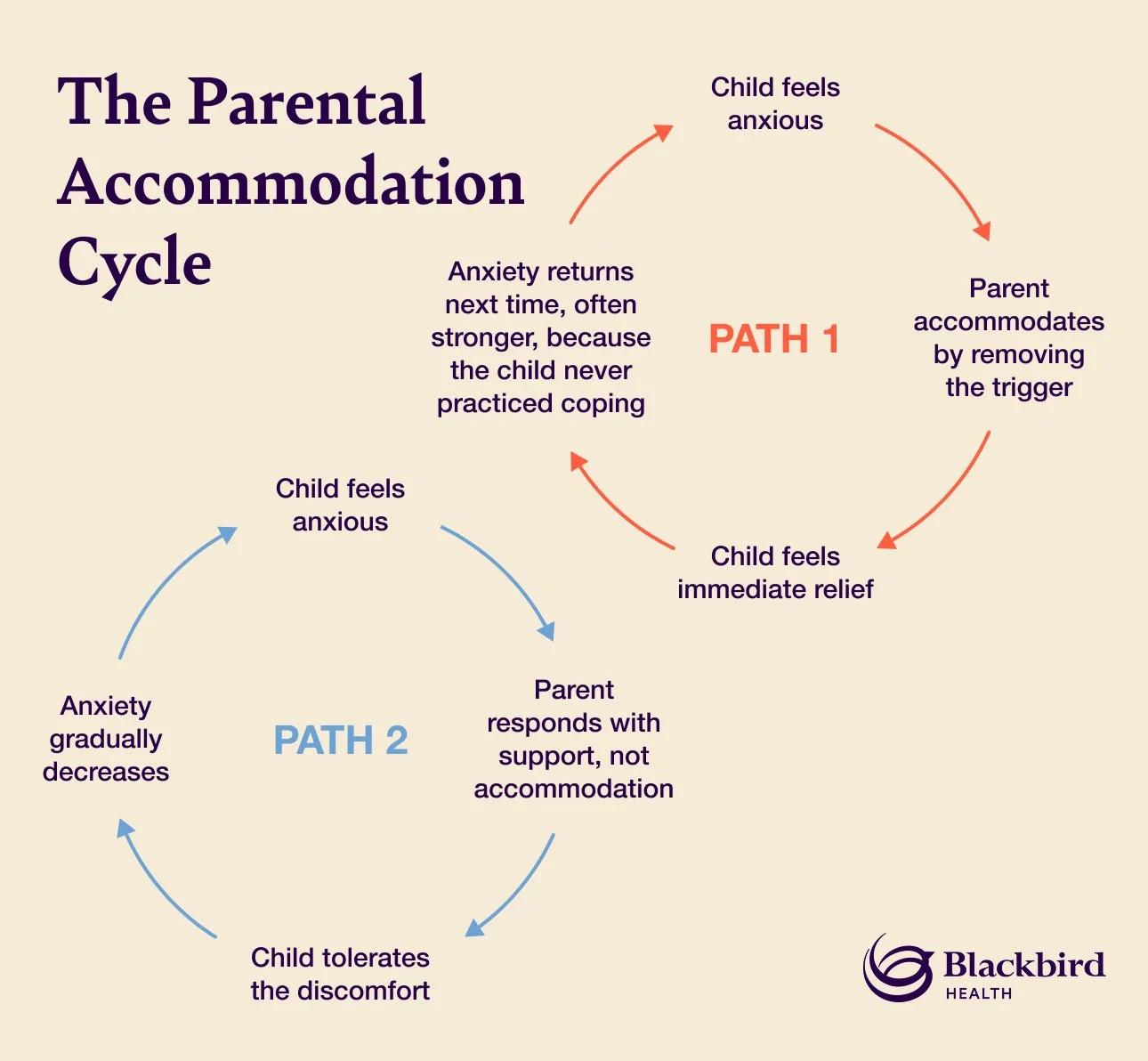
What does accommodation actually look like?
Accommodation is very common, with estimates as high as 95 to 97 percent of parents with an anxious child engaging in the behavior. And there's a good reason for that. As Dr. Lebowitz explains in a TEDxWrigleyville talk, as mammals, we aren’t born with the skills to protect ourselves. We rely on caregivers to keep us safe. Similarly, parents are born with the instinct to notice when our child is uncomfortable and to make those feelings disappear.
When it comes to accommodations, context matters. Some of them may be completely appropriate depending on your child’s age and needs (for example, accompanying a toddler to a new after-school activity). The more helpful question to ask is whether you’re responding to a reasonable need or altering your behavior just to placate your child.
Replacing accommodation with supportive response
SPACE therapy helps parents learn how to replace accommodations with supportive responses, which validate the child’s feelings without trying to fix their problem.
“In SPACE, a supportive response communicates two messages at the same time: I understand how difficult this feels for you, and I believe you can handle it,” says Micah Munro, a licensed clinical social worker and psychotherapist at Blackbird Health.
Here are a few examples of this in practice.
Parental accommodations and supportive alternatives
| Situation | Example of Parental Accomodation | Supportive Response Scripts |
|---|---|---|
| School anxiety | Allowing your child to stay home from school because they feel anxious | “I know going to school feels really hard today, and I believe you can get through the day.” |
| Sleeping independently | Sleeping in the same room as a child who is afraid of the dark | “I know sleeping on your own feels scary right now. I also know you can practice doing this, and I’ll see you in the morning.” |
| Seeking constant reassurance | Repeatedly reassuring your child that everything is okay | “I can tell you’re really worried. I know it’s uncomfortable not to have certainty, and I believe you can handle that feeling.” |
| Social anxiety | Allowing your child to skip social gatherings because of their social anxiety | “I know talking to someone new makes you nervous. You don’t have to feel comfortable before you try it. I believe you can do it even while you’re nervous.” |
| Contamination fears (OCD) | Washing your hands multiple times for a child who has OCD-related fears about contamination | “I understand you're worried about germs right now. It can feel uncomfortable to feel like you’re dirty, but I believe you can handle that feeling.” |
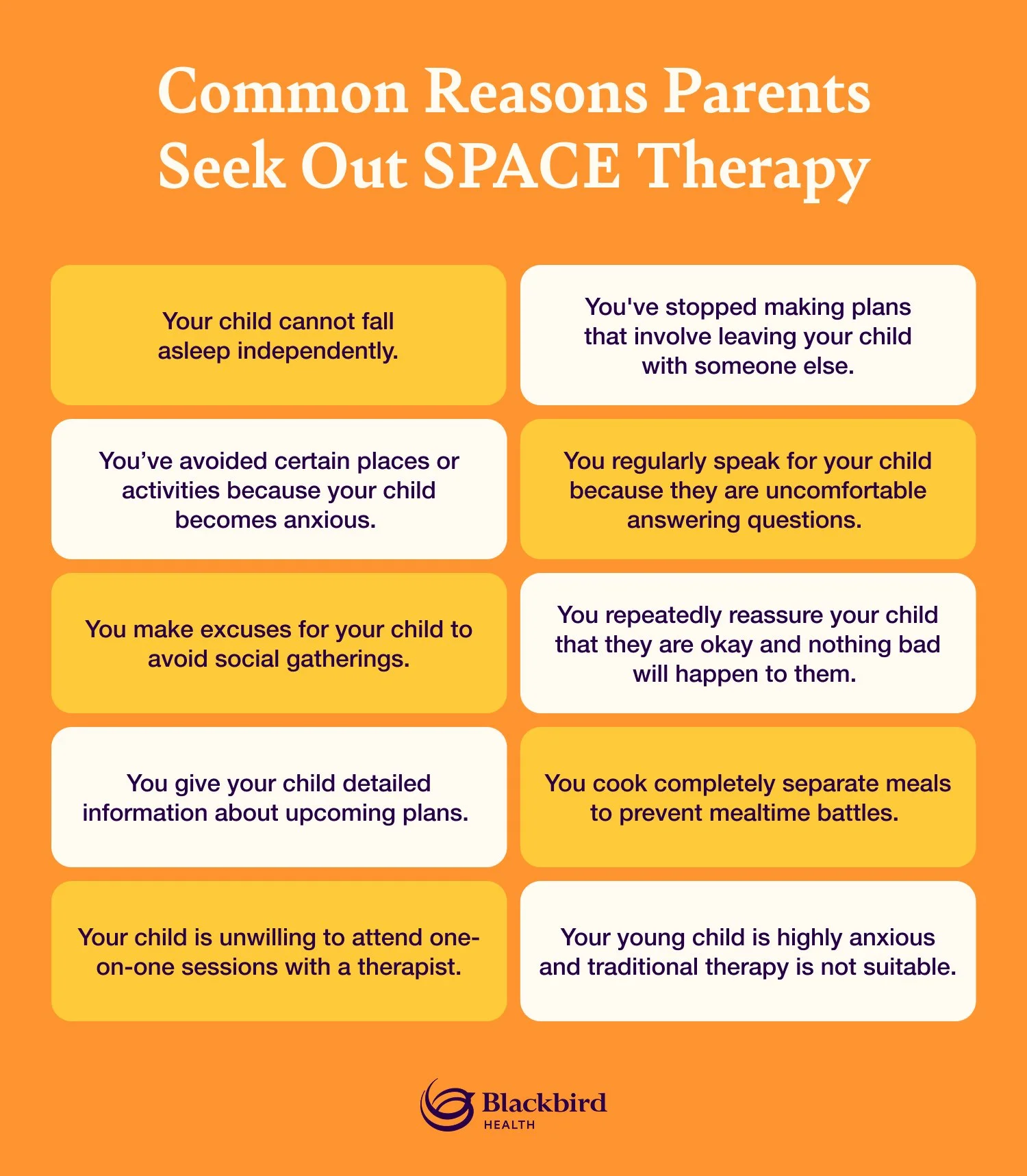
Who is SPACE for?
In SPACE, parents participate in treatment, but the goal is to help the child. It can be a good fit when a child is unable or unwilling to participate in traditional therapy, when parents recognize they're doing a lot of accommodating, or when a child has tried a different form of therapy (CBT, exposure therapy) without improvement. SPACE is also helpful for younger children since parents have a more active role in their daily life.
Research on SPACE is strongest for anxiety and OCD, but studies are also exploring whether it can help other concerns, such as picky eating, chronic somatic symptoms, and anxiety in children with autism.
A separate, related adaptation called SPACE-FTL has also been explored as an approach for highly dependent adult children who show a failure to launch pattern: adults who aren’t working, studying, or living independently, and do not have a diagnosed disability.
When SPACE isn’t the right first step
Depending on your child’s needs, your clinician can help you decide the best next steps for your family, such as combining SPACE with another form of therapy, medication, or other types of support.
There are also situations when reducing accommodations isn’t the first priority. If your child’s anxiety occurs alongside depression, self-harm, or suicidal thoughts, their safety comes first, and SPACE may not be the best fit.
If you’re concerned about your child’s safety, reach out to your clinician right away, and call “988” for the suicide and crisis lifeline or emergency services if they are in immediate danger.
What happens in a course of SPACE treatment
You’ll work with a SPACE-trained clinician who will help you understand how your current responses may be unintentionally accommodating anxiety. You’ll also learn why and how changing those responses can support your child long-term.
Depending on your clinician, sessions may take place in-person or virtually. When possible, it’s helpful if both parents participate so treatment is consistent at home. The number and frequency of sessions depends on your family’s needs and the provider, but typically consists of 12 weekly sessions. You and your clinician can come up with a treatment plan that supports your family and adjust it based on your child’s progress.
In fact, clinicians usually see a meaningful shift in parents from the first session. “Simply normalizing their experience and reminding them that accommodations develop from love and not from bad parenting can create some much-needed breathing room” says Lowe. “Parents who arrive feeling overwhelmed or ashamed leave with greater hope and a clearer understanding of how change can begin.”
During the second and third sessions, the discussion gets more personal and specific. Parents map out how anxiety affects their day and how they accommodate it, also known as accommodation mapping. Then, parents choose one specific accommodation to reduce, guided by their clinician. By the fourth and fifth sessions, parents work on troubleshooting, whether accommodations are decreasing, and recognizing improvements in confidence in both parents and children.
Changes in a child’s anxiety don’t happen overnight. “Some children initially protest when a familiar pattern changes,” says Lowe. “Many families discover that the rules anxiety created have simply become habits and that those habits can change.” Progress looks different for every child, and sometimes it happens in small steps. Those steps might look like:
Tolerating reassurance only once instead of asking repeatedly
Staying at school even when anxiety feels uncomfortable
Falling asleep with less parental involvement
Recovering faster after an anxious episode
Munro adds that sometimes anxious behaviors get worse before they get better. “[There’s a] possibility that anxiety or resistance may initially increase when a familiar accommodation changes,” she says. So if your child pushes back, try not to panic—this is a normal part of the process.
SPACE treatment at Blackbird Health
If you’re considering SPACE training for anxiety at Blackbird Health, the process starts with a New Patient Evaluation. During this initial appointment, you’ll meet with a nurse practitioner or other evaluator to talk about your child’s anxiety and/or OCD. From there, your clinician will determine whether SPACE is the right fit for your family.
Blackbird Health’s SPACE program includes six weekly, 60-minute virtual sessions, with the option to extend by one or two sessions if needed. It’s helpful for both parents to join sessions, so that everyone’s on the same page.
Cost of SPACE at Blackbird Health
The full cost of six sessions is $900. Any additional sessions beyond the first six are $175 per session.
The bottom line
Helping a child with anxiety isn’t about eliminating the source of discomfort. Instead, it’s about teaching them that they can tolerate difficult feelings, while knowing they’re understood and supported. SPACE gives parents a framework for doing just that, and in the process, helps their child build the confidence to move through it.
Frequently asked questions (FAQs)
-
No, children do not attend sessions. SPACE therapy is for parents to help their children with anxiety, OCD, or other anxiety-related emotions. The goal is to help parents understand how their responses can unintentionally reinforce behaviors, as well as how to shift responses in ways that are supportive and empowering.
-
The number and frequency of SPACE therapy sessions depends on your family’s needs, but typically involves 12 weekly sessions. You and your clinician will develop a treatment plan that supports your child’s needs and can adjust it as your child progresses. At Blackbird Health, the SPACE program includes six weekly, 60-minute virtual sessions. If additional support is needed, families have the option to extend by one or two sessions.
-
There isn’t a standard price for SPACE therapy, and the cost depends on several factors, such as the clinician’s credentials, location, and session length and type (individual or group). Typically, individual SPACE sessions range from $150 to $300 per session, and group sessions range from $60 to $149 per session. Blackbird Health’s SPACE program for anxiety costs $900 for six sessions, and additional sessions are $175 per session.
-
SPACE is a parent-based therapy that helps families reduce parental and family accommodation to reduce symptoms of childhood anxiety and OCD. Parents work directly with a clinician to learn new ways to respond to their child’s anxiety.
Cognitive behavioral therapy (CBT) is a more traditional form of talk therapy, in which children work directly with a clinician. A clinician can help a child understand how their thoughts and emotions affect their behavior, and work with them to develop strategies for managing difficult feelings.
How can Blackbird help?
Our goal is to initiate the right course of treatment as quickly and as smoothly as possible, so “how it works” can be a little different for everyone. We customize your treatment plan to meet your unique needs, on a timeline that works for you. Click here to get started today.