What Qualifies for a 504 Plan? Eligibility Requirements and How to Get One

PARENT GUIDE
What Qualifies for a 504 Plan: A Parent's Guide & Next Steps
By Sarene Leeds
Medically reviewed by Michael Tang, MD
Key takeaways
Eligibility for a Section 504 plan generally requires that a student have a physical or mental impairment that substantially limits one or more major life activities, such as learning, reading or communicating.
A diagnosis, whether it’s autism, anxiety, ADHD, or another condition, does not guarantee 504 plan eligibility.
Public schools must provide 504 plan evaluations for free under Section 504 of the Rehabilitation Act of 1973. Private schools operate under different systems and may not be required to provide accommodations.
Preparation and patience are key for the 504 plan process. Comprehensive documentation, including medical evaluations, teacher observations, and specific examples of challenges the child faces at school, is integral for a successful outcome.
Navigating the world of 504 plans can be an intimidating experience for any parent. Whether you’re already knee-deep in figuring out how to get the best accommodations for your child, or a teacher or a school counselor used the term “504 plan” with you for the first time, your confusion and stress are perfectly valid. As someone who was thrust into this process immediately after receiving my daughter’s ADHD diagnosis, I know how it feels to operate without a roadmap.
So let’s start with the basics: According to the U.S. Department of Education, a 504 plan is a formal school plan that provides accommodations for students with disabilities under Section 504 of the Rehabilitation Act of 1973, a federal civil rights law. Accommodations vary by individual and their needs, but they can include anything from a child’s desk being closer to the teacher to extra testing time to the use of noise-canceling headphones.
After reading this article, readers will have a better understanding of what qualifies for a 504 plan, how to request an evaluation (including what's free vs. what a private evaluation adds), what to do if a school pushes back, and how Blackbird Health can potentially help guide you through the process.
What qualifies a child for a 504 plan
This is the exact question most readers have when they begin their 504 plan journey. The truth is, the answer doesn’t include a list of requirements. Instead, a legal test determines 504 eligibility.
The actual legal standard: Per the U.S. Department of Education, in order to be protected under Section 504, a student must be determined to:
Have a physical or mental impairment that substantially limits one or more major life activities; or
Have a record of such an impairment; or
Be regarded as having such an impairment.
While meeting all three prongs isn’t required, for public elementary and secondary students, merely having a record of an impairment or being regarded as having an impairment does not, by itself, trigger the right to a 504 plan.
There's no official list of conditions: Rachel Astor, a licensed clinical social worker and clinical diagnostician at Blackbird Health, clarifies that 504 plan requirements don’t simply focus on “whether the child has a diagnosis.” Instead, “it’s how that disability affects their ability to access and participate in school.” What needs to be considered is whether certain core life activities, such as learning, reading, concentrating, thinking, communicating, walking, eating, sleeping, or a child caring for themself, are being affected by a named condition or disability.
Conditions that can qualify: While conditions such as attention-deficit hyperactivity disorder (ADHD), anxiety, autism, and learning differences including dyslexia can influence a child’s qualifications for a 504 plan, “a diagnosis by itself doesn’t automatically make a child eligible,” reiterates Astor.
Who actually decides: Eligibility is determined by the school's own 504 team. Ideally, says Astor, the child’s school “should look at information from a variety of sources, including teacher observations, evaluations, medical documentation, school records, and input from the family, to understand how the student functions throughout the school day.”
What doesn’t need to be true: There are a lot of common assumptions (and misconceptions) about what’s needed in order to qualify for a 504 plan. In order to be eligible, your child does not need to:
Be failing classes
Have poor grades
Have a private evaluation
Have a formal medical diagnosis
It’s also important to distinguish between 504 plans and individualized education programs (IEPs) at the outset. While a 504 plan provides access to the existing curriculum, an IEP (which falls under a different special education law) can require specialized instruction and includes funding for the resources in the plan.
If your child is in private school
If you’re curious about how to get a 504 plan, and your child is in private school, you’ll want to keep reading, because this article primarily describes how the process works in the public school system. In public schools, children are guaranteed a free evaluation and do not require a diagnosis. But private schools operate under very different systems.
The only way Section 504 can apply to a private school is if it receives federal funding—and many private schools don’t receive federal funding.
Astor recommends that families talk with their private school about their child’s support options. “Private schools don’t have the same legal responsibilities as public schools,” she explains, “so the process can look different from one school to another.” Even though some private institutions may not provide formal 504 plans, they may offer accommodations through their own policies instead.
She encourages families to “share specific examples of the challenges their child is experiencing, and ask what supports the school can put in place.” Since private schools are not required to evaluate a child themselves (unlike in public schools), obtaining an outside evaluation may be a family’s best option for documentation when seeking accommodations.
“If parents aren’t sure what their rights or options are, they can also contact their local public school district or speak with an educational advocate for guidance,” says Astor.
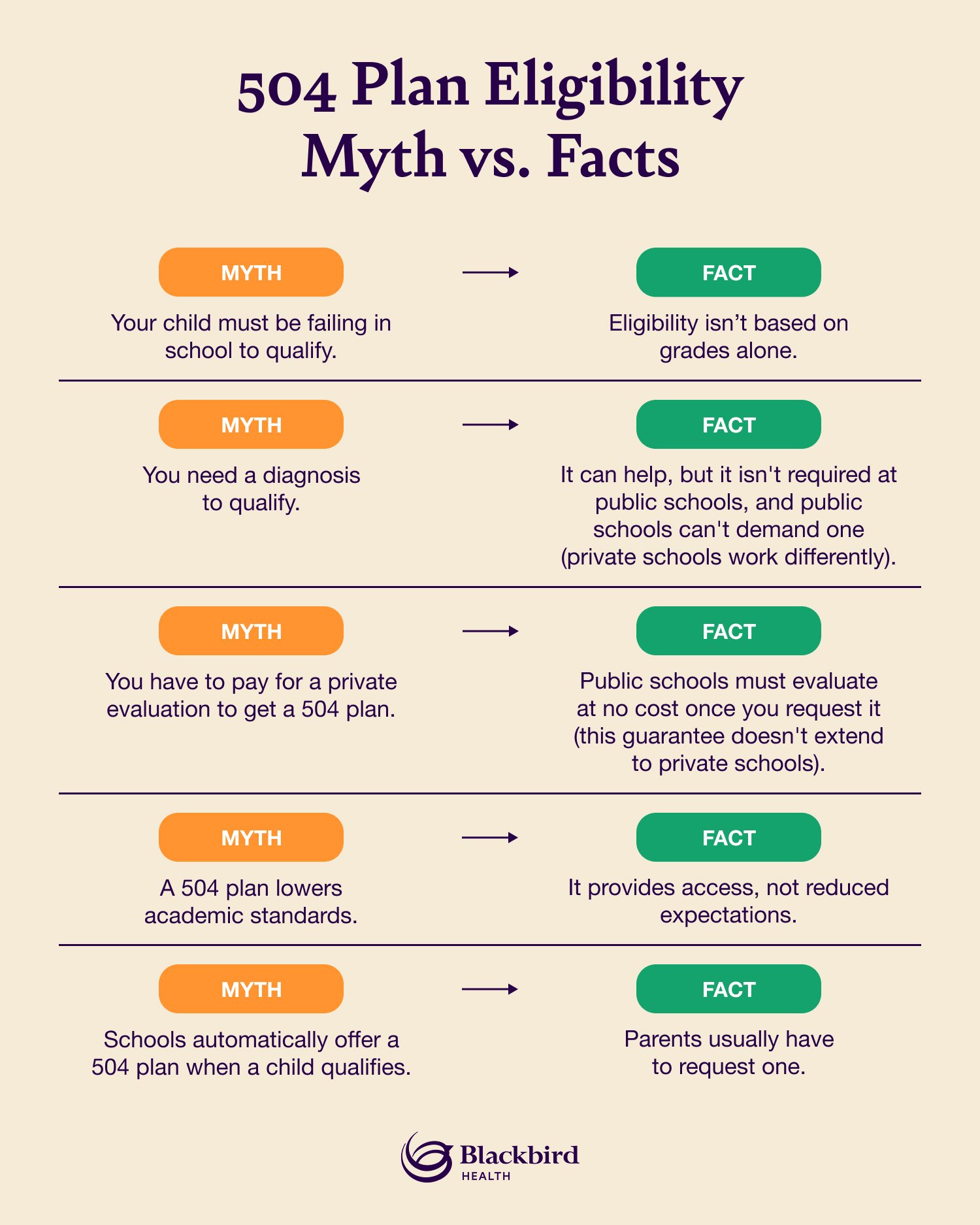
Common myths about 504 eligibility
Despite a definitive legal standard for what qualifies for a 504 plan, plenty of misinformation continues to circulate.
One of the biggest myths that Astor has observed in her line of work is that a child must be failing in school to qualify for a 504 plan. “That’s simply not true,” she says, emphasizing that eligibility isn’t based on grades alone. “I’ve worked with students who earn good grades but are working much harder than their classmates or come home completely exhausted because of the extra effort it takes to manage their disability.”
Two other high-stakes myths are that having a diagnosis automatically qualifies a child for a 504 plan, and that you must pay for a private evaluation.
“A diagnosis is important,” says Astor, “but schools also have to consider how that condition affects the student’s ability to access and participate in school.” The consequences of these prevalent myths are the (false) beliefs that you (a) may end up spending money unnecessarily on an expensive private evaluation, and (b) your 504 plan evaluation request could be delayed for months while you’re waiting for a doctor’s appointment, just to obtain a diagnosis.
How to request a 504 plan
Now that we’ve debunked most of the myths, it’s time to answer the question, “How do I get a 504 plan for my child?” Be aware that the process “is not fast,” warns Jessica Estes, a psychiatric mental health nurse practitioner and the vice president of Medical Services at Blackbird Health. “It could take months, up to a whole school year to complete.” So the more prepared you are at the outset, the better equipped you’ll be to navigate every phase.
Here is the process, broken down into sequential steps:
1. Submit a written request for a 504 plan to the school. In most cases, this is either your child’s principal, school counselor, the 504 plan coordinator, or the district’s special education department. Make sure you keep copies of all your correspondence for your records. Here’s a request letter template you can use.
Subject: Request for Section 504 Evaluation for [Child’s Name]
[Date]
Dear 504 Coordinator or Principal:
I am writing to formally request a meeting to discuss the development of a 504 Plan for my child, [Child’s Full Name], who is in [grade] at [School Name].
I am concerned that [Child’s Name] may have a physical or mental impairment that is substantially limiting their ability to [learn, read, write, communicate, manage daily school activities or other relevant examples].
At school, we have become aware of the following concerns:
Specific example of how the concern affects your child’s school functioning
Specific example with frequency or circumstances
Specific example of how your child is impacted as compared with typical expectations for their age/grade
Please provide me with three possible meeting dates/times when you can have all of the appropriate individuals in attendance. Thank you in advance for your support.
Kind regards,
[Your Full Name]
2. Include supporting documentation, if available. While a diagnosis is helpful, the key here is clear, cohesive documentation that demonstrates how your child’s condition affects their in-school experience. These should be examples that support the legal standard required for 504 plan eligibility.
“My biggest piece of advice is to come into the process prepared,” says Astor. “Before the meeting, take some time to consider specific challenges your child is experiencing at school.” She recommends keeping notes (including examples of what you’re observing at home), and gathering evaluations and/or medical documentation. “The more specific you can be, the easier it is for the school team to understand your child’s needs.”
3. The school conducts an evaluation. This process will likely vary by school or district. It may include: reviewing your child’s medical records, evaluation reports, schoolwork, report cards, and other relevant data. An evaluation may also include observing your child in a classroom, as well as interviews with you and your child’s teacher.
4. Attend the 504 meeting. If your child qualifies for a 504 plan, this is when the plan will be created. Astor advises being ready to “collaborate” with the team to ensure success. “Throughout the conversation, don’t be afraid to ask questions,” she says. If an accommodation is suggested, for example, you’re entitled to ask how that will work in the classroom and who will be responsible for implementing it. “A 504 plan is most effective when everyone has a clear understanding of what is being provided and how it will support the student.”
5. Check in with your child and teachers periodically. A 504 plan is meant to be a working document, says Astor, so if something isn’t working or if your child’s needs change, you can request a meeting to review and revise the plan. “A 504 plan should grow and change as your child does.”
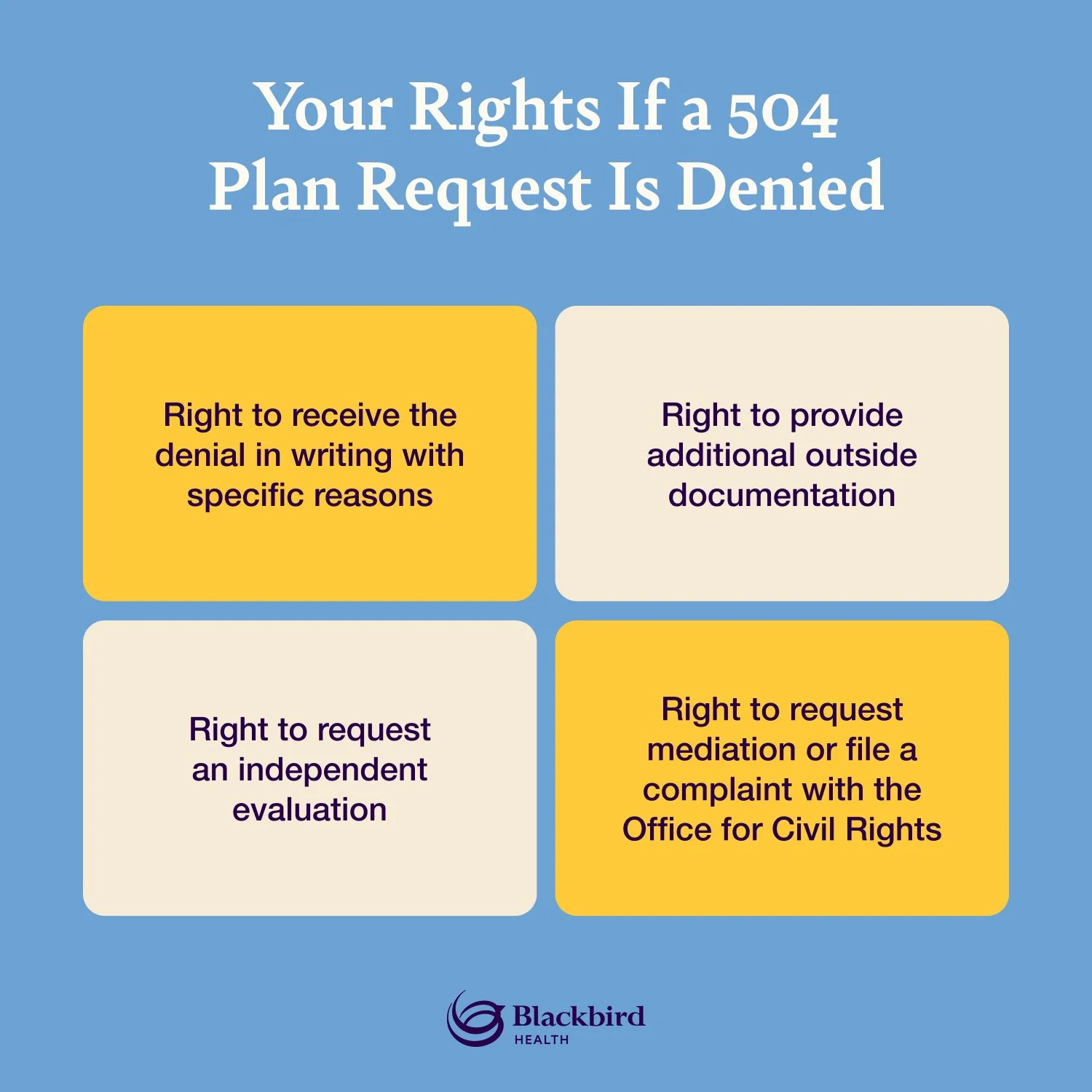
If the school says no
Both Astor and Dr. Estes confirm that a school may deny a 504 plan if they determine that the student doesn’t meet the legal eligibility criteria.
“For example, the school may find that the child doesn’t have a physical or mental impairment that substantially limits a major life activity,” says Astor, “or that the condition is not affecting the child’s ability to access and participate in school in a way that requires accommodations.”
Other reasons Astor offers for denial include a school determining that a student’s needs can be addressed through general classroom support or interventions without a formal 504 plan. Or, the team may decide that additional information, such as medical documentation or evaluation data, is needed before making an eligibility decision.
Having your child’s 504 plan request denied is, understandably, the last thing you want to hear after all the time and effort spent on this process. But that doesn’t mean you’ve reached the end of the line. Since parents have rights, pushing back on this kind of decision is both normal and expected.
“If a school denies a request for a 504 plan, I encourage parents not to view it as the end of the conversation,” says Astor. She advises asking the team to explain how they reached their decision and what information was considered. “The reasoning can help determine whether additional information or documentation might be helpful.” Dr. Estes also recommends engaging an educational advocate, a trained professional who is an expert at navigating special education services on parents’ behalf.
But if you’ve requested explicit reasoning, provided additional documentation and your child still isn’t receiving the accommodations you feel they need, then you may want to consider mediation or an Office for Civil Rights complaint.
Mediation occurs when a neutral third party is brought in to help facilitate specific disputes regarding a child’s 504 plan request. If mediation doesn’t resolve the problem, parents can file a complaint with the Office for Civil Rights stating that the school violated Section 504 by not providing free appropriate public education (FAPE) for their child under the law.
Getting support beyond the school’s evaluation
Even though a school evaluation is free and often enough for many public school families, some families may want to explore their child’s needs further with an outside evaluation. (If your child is in private school, you’ll want to revisit the dedicated section in this article for guidance.)
“School evaluations and outside evaluations have different roles, and both can provide valuable information,” notes Astor. A private evaluation through Blackbird Health, for example, takes a more holistic approach: “We consider their developmental history, communication, social development, behavior, emotional functioning, and how they are functioning across settings,” explains Astor. While it won’t necessarily speed up the school’s process, this dedicated diagnostic assessment can help families “better understand what’s contributing to their child’s challenges and what supports may be helpful,” she continues.
Blackbird’s recommendations also go beyond school. Depending on the child, says Astor, “we may recommend outpatient therapy, medical follow-up, community resources, or strategies families can use at home.”
Keep in mind, however, that a private evaluation doesn’t guarantee that a child will qualify for a 504 plan. “But it can provide additional information that helps families and schools work together to support the child,” says Astor.
It’s also important to remember that a 504 plan only provides accommodations, not treatment. All the school plans in the world can’t address an untreated underlying condition. Blackbird can support both documentation for your 504 plan request and therapy for what’s driving the need for your in-school services.
The bottom line
Obtaining a 504 plan isn’t exactly a quick walk in the park, but the more you know about the process, the better position you’ll be in to advocate for your child—and what they need.
Astor also reiterates that a 504 plan is only one way for parents to support their child: Even if the child doesn’t qualify for 504 accommodations, “they may still benefit from classroom strategies, outpatient therapy, community support, or other interventions.”
At the same time, trust what you’re seeing as a parent: If you feel your child will benefit from a 504 plan, then it will likely help to collect as much documentation as possible before submitting a request to the school: Medical diagnoses and evaluations, teacher observations, and your own notes are essential for the school’s 504 team to understand your child’s needs, and ultimately provide the appropriate accommodations.
Frequently Asked Questions (FAQs)
-
The main difference between a 504 plan and an individualized education program (IEP) is that they fall under two different education laws.
A 504 plan provides access to the existing school curriculum, while an IEP may require specialized instruction. A 504 plan is a formal school plan that provides accommodations for students with disabilities under Section 504 of the Rehabilitation Act of 1973, a federal civil rights law.
An IEP is provided under the Individuals with Disabilities Education Act (IDEA), which ensures special education and related services for eligible children.
-
A school may deny a 504 plan if the evaluation team determines that the student doesn’t meet the legal eligibility criteria. Since a diagnosis (of autism, ADHD, or otherwise) doesn’t guarantee 504 plan eligibility, the school would have to establish that the child’s condition doesn’t substantially limit core life activities like reading, writing, or learning.
A 504 plan may also be denied if the evaluation team requires additional information like medical documentation or evaluation data.
-
An anxiety disorder diagnosis doesn’t automatically qualify someone for a 504 plan. But if this condition substantially limits a person’s major life activities (such as school), then it can be considered a disability—and qualify someone for 504 plan eligibility.
-
Although there is no official qualifying list, conditions like attention-deficit hyperactivity disorder (ADHD), autism, and learning differences can influence a child’s qualifications for a 504 plan, but they are not automatic qualifiers. As with anxiety, these conditions would have to significantly impact a child’s ability to learn in the classroom to qualify for a 504 plan.
-
Yes, good grades do not disqualify a student from a 504 plan. Many high-achieving students can often struggle and need to work harder in order to compensate for a disability such as ADHD, dyslexia and high-functioning autism. A disability can also substantially impact major life activities at school in non-academic areas, such as social-emotional challenges caused by anxiety.
How can Blackbird help?
Our goal is to initiate the right course of treatment as quickly and as smoothly as possible, so “how it works” can be a little different for everyone. We customize your treatment plan to meet your unique needs, on a timeline that works for you. Click here to get started today.