How to Get an IEP for Your Child in Pennsylvania
By Korin Miller
Medically reviewed by Michael Tang, MD
Key takeaways
A Pennsylvania IEP (individualized education plan) is a legally binding document that details supports and accommodations for a student with a disability; IEPs vary by state.
A diagnosis alone does not determine IEP eligibility. A child must both have a qualifying disability under IDEA and need specialized instruction in order to access their education. Conversely, a child does not need a formal diagnosis before a parent can request an evaluation.
The process of obtaining an IEP starts with a written evaluation request to your school district and can take months. It is different in Pennsylvania public schools versus private and parochial schools.
If your child is found to be not eligible for an IEP, parents still have options for securing school support. These can include a 504 plan, an Independent Education Evaluation (IEE), dispute-resolution processes, and potentially compensatory education when delays result in missed services.
It can feel frustrating and even agonizing to see your child struggle—with focus, behavior or learning—in school. While trying to find a better way forward, you’ll likely come across the acronym “IEP” (which stands for individualized education plan) as one possible solution. While federal law provides baseline rules for IEPs, each state creates its own distinct timelines, eligibility criteria, parental consent requirements, and unique paperwork. In this article, we’ll provide a guide on the Pennsylvania IEP process.
The process of advocating for an IEP can be long and sometimes bumpy. I know, because I speak from personal experience. My husband and I felt like we weren’t being heard when we kept flagging issues our child had with grasping and executing school assignments. It took two years of repeatedly saying that something wasn’t right—and of being constantly being brushed off by teachers and even relatives who insisted it was “just a phase”—before he received the accommodations he desperately needed. After that, his grades, state testing scores, and comfort level at school quickly jumped up. If you suspect something is wrong, it’s important to trust your instincts and advocate for your child, even if you don’t initially succeed.
It’s easy to feel overwhelmed navigating this experience, but knowing what to expect can help ease some of the stress. Here’s what you need to know about how to get an IEP in Pennsylvania, from first steps you can take today to a breakdown of the state’s evaluation and eligibility timeline. We’ll also cover how your situation differs if your child is in private or parochial school. Because not every child is found eligible, we’re also breaking down other paths your family can pursue to ensure your student is supported in the best way possible going forward.
What is an IEP?
IEP stands for “individualized education plan.” This is a written, legally binding plan that outlines special education services, supports, and goals for eligible students. According to the Commonwealth of Pennsylvania, in order to qualify for an IEP, a student must require special education and meet one of the 13 disability categories defined by the Individuals with Disabilities Education Act, 2004 (IDEA). Every public school in Pennsylvania must provide an IEP to eligible students.
Getting an IEP is a journey, and it’s important to be aware that things won’t come together overnight. “The process is not immediate, so if parents have concerns, it’s helpful to start the conversation sooner rather than waiting until a child is really struggling,” says Rachel Astor, a licensed clinical social worker and clinical diagnostician at Blackbird Health.
While an IEP is a tool that can guide your child’s education and accommodations, you will typically need to formally request an evaluation to start the process.
How do I request an IEP evaluation in Pennsylvania?
The biggest question that likely brought you here is, “How do you get an IEP?” Formally requesting an evaluation for special education eligibility is often the first step to potentially getting an IEP in PA. There are certain steps in place to follow to get the process started.
Request an evaluation in writing
“To have your child evaluated for an IEP, you should submit a written request,” says Melissa Arsenault, a licensed professional counselor and director of onboarding and training at Blackbird Health. This should be signed by you, the caregiver with educational rights, and dated for the date of delivery, she explains. You will also need to include your child’s name, your name, and your contact information.
“A brief explanation of why the child needs an IEP is helpful, but not required,” Arsenault says. This written request can be physically given to the school’s front office for delivery to the administration. It’s also perfectly acceptable to make this request via email, addressed directly to your school’s principal and the director of special education.
Technically, you can make an oral request. However, a written request—whether it is a physical letter or email—is considered more reliable and creates a dated record that you and educators can reference.
What happens after you send it
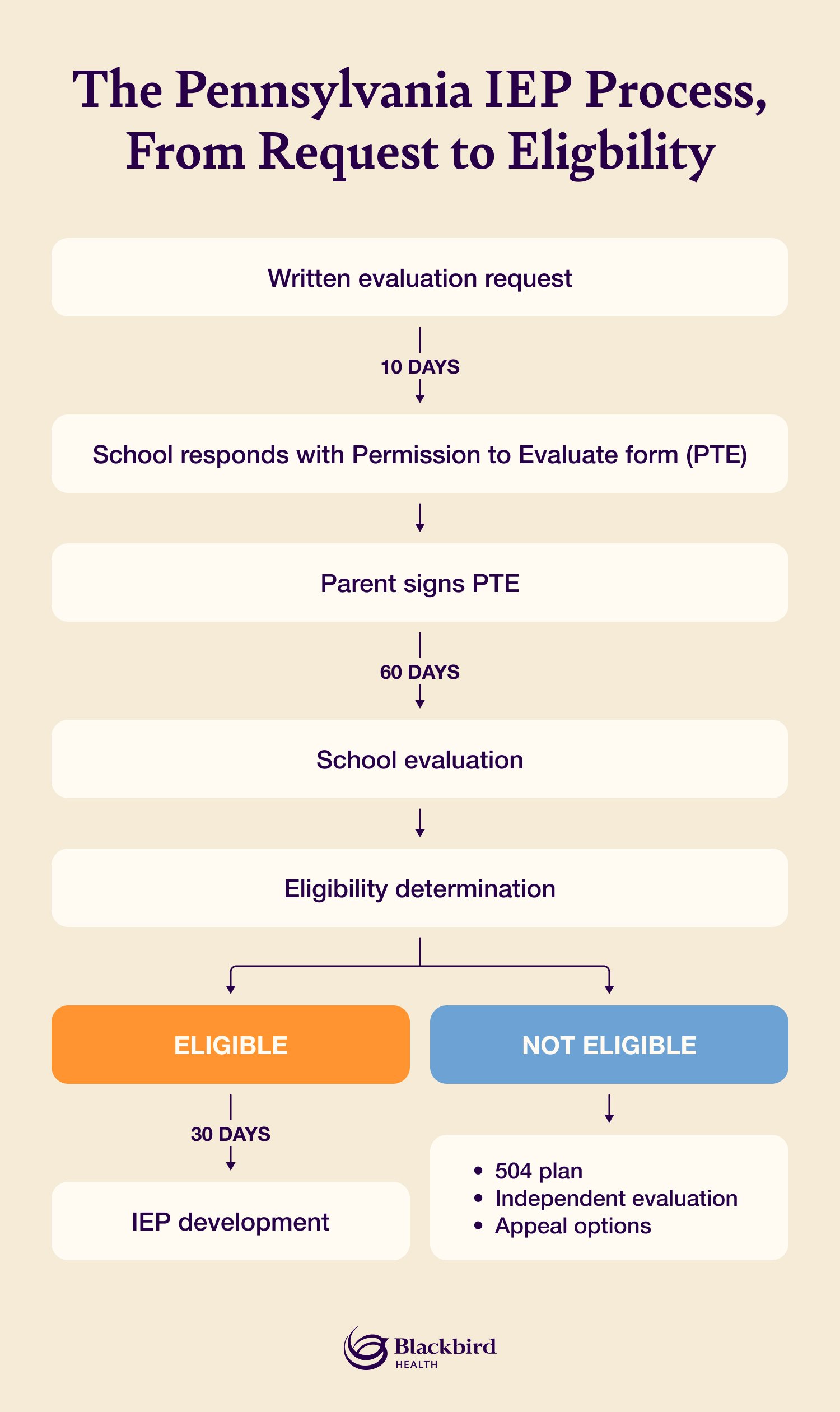
Once you send your dated request, the school has 10 calendar days to respond and provide you with a Permission to Evaluate form (PTE). This is a consent form and must clearly explain the reasons for the evaluation, along with the tests the school will use to evaluate your child. The evaluation will not start until you sign the PTE.
The timeline once you sign
Once you sign the PTE, your child’s school should complete testing and evaluation of your child within 60 calendar days, per the Office for Dispute Resolution. “The summer break is not counted in that timeline,” Astor says. So, if you request that your child be evaluated in late spring, you may not receive the results of your evaluation until the following school year.
If your child is found eligible, an IEP must be developed within 30 days of the evaluation report. “After the family agrees to the proposed program, services should begin promptly according to the IEP,” Astor says. “The exact timeline can vary depending on when the request is made, school breaks, and how quickly consent is received and meetings are scheduled.” While the IEP process may move faster for your family, it cannot take the school more than 60 days to complete, outside of summer break.
If the school proposes the evaluation
In some situations, your child’s school may proactively suggest an IEP for your child. The district has a responsibility under “Child Find” to identify children who are suspected of being eligible for special education services and accommodations. However, the school will still need your consent before evaluating your child—the decision is ultimately yours. There is a narrow exception: If you refuse an IEP evaluation, the school can request a hearing to override that refusal in some situations.
If your school requests the evaluation, you will receive the PTE form, and the 60-day IEP evaluation process will begin after you sign it.
If the district misses the timeline
The district is obligated to evaluate your child within 60 days of the signed PTE form. Your child cannot be put on a waitlist for an evaluation. If the district misses the required deadline and your child is found eligible for an IEP, you can request make-up services for the time your child went without accommodations.
Who qualifies for an IEP in Pennsylvania?
There are two criteria for an IEP, and your child must meet both of them. Those IEP requirements are (1) Your child must have a qualifying disability under IDEA, and (2) must need specialized instruction to access their education. Having a diagnosis alone doesn’t guarantee your child is eligible and not having a diagnosis also doesn’t rule out eligibility.
According to IDEA, the thirteen disability categories are:
Intellectual Disability
Hearing impairment
Speech or language impairment
Visual impairment (including blindness)
Emotional disturbance
Orthopedic impairment
Traumatic brain injury
Other health impairment
Specific learning disability
Deafness
Deaf-blindness
Multiple disabilities
If the school district determines that your child is “thought” to have a disability and possibly in need of special education, the district should move forward with a special education evaluation.
The eligibility meeting will typically involve parents or caregivers, along with the school representatives, including the special education director, occupational therapist, and speech-language pathologist, who participated in your child’s evaluation. For certain disability categories, including autism, emotional disturbance, intellectual disability, and specific learning disabilities, Pennsylvania requires that a licensed school psychologist be a part of the evaluation team.
What if my child doesn’t qualify for an IEP in Pennsylvania?
Not every child who is evaluated for an IEP is found eligible. But it’s important not to view this as a dead end in finding school support for your child. “Even if testing shows the child does not meet the criteria for a full IEP, there are other avenues to seek help and accommodations for your child to ensure that their needs are met,” Arsenault says. Here’s what may happen next if your child is found ineligible for an IEP:
You will receive a NOREP.
Your child’s school must give you a written Notice of Recommended Educational Placement (NOREP) that clearly explains the decision that your child does not qualify for an IEP.
You can ask about a 504 plan.
This is a separate option under federal law that can also provide accommodations, even if your child does not qualify for an IEP. A 504 plan is designed to accommodate a child who has a physical or mental impairment that limits major life activities, such as caring for themselves, walking, seeing, hearing, speaking, learning, and working. Accommodations can be wide-ranging and can include requests for better accessibility, classroom adjustments, and certain supports.
You can request an independent evaluation.
If you disagree with the school’s findings, you can ask in writing for the school to pay for an Independent Educational Evaluation (IEE), per the CHOP Research Institute. From there, the school must either pay for the evaluation or request a due process hearing to defend its own evaluation.
Pennsylvania has specific bodies for disputes.
The Pennsylvania Bureau of Special Education (BSE) handles complaints related to evaluations or concerns, and Pennsylvania’s Office for Dispute Resolution (ODR) handles mediation and due process hearings.
If a delay caused your child to miss services, ask about compensatory education.
Your child may later be found eligible after a delay in evaluation or a disputed eligibility decision. If this happens, you can request make-up services for the time your child went without support.
Can a child at a private school get an IEP in Pennsylvania?
Private and parochial schools have a different process for IEP eligibility, and children who attend these schools are not considered to have the same rights to special education services as children who attend public schools.
If your child attends a private or parochial school, your local school district—not your child’s school—is responsible for evaluating your child at no cost. An intermediate unit is required to meet with administrators of your school to discuss services that the intermediate unit will provide to coordinate Child Find and Equitable Participation services.
If your child is found eligible for an IEP, they are not automatically entitled to an IEP or free appropriate public education (FAPE) at your child’s school. Instead, they may receive Equitable Participation services, which are different from an IEP. The school district must also offer your child a public school placement with a full IEP, which you can accept or decline.
This is different from Act 89 evaluations, which are requested by private or parochial schools to assess a student’s strengths and weaknesses in order to help educate them.
Does my child need a private evaluation first?
The decision to have a private evaluation before beginning the IEP process is ultimately up to you. Here are a few things to consider before seeking one out.
A private evaluation isn’t required for an IEP. Public schools are legally required to provide a free evaluation for any child who is suspected of having a disability that impacts learning. “A school evaluation is focused on whether a child qualifies for special education services and what supports they need in the school setting,” Astor says. “A private evaluation can provide a broader picture of the child, including developmental history, emotional and behavioral functioning, communication, social development and how they are doing across settings.”
A private evaluation can add diagnostic depth. If your main question is about school-based eligibility and support, starting with the school may make sense, according to Astor. But if your family is trying to understand what’s actually driving a struggle—both in the classroom and beyond—a private evaluation, including Blackbird Health’s comprehensive evaluation with neuropsychological testing, can help provide clinical clarity and a roadmap for how to best support your child through therapy or skill-building specialists. School accommodations only provide educational support within the classroom environment and won’t help with homework battles or after-school meltdowns.
A private evaluation carries real but limited weight in getting an IEP. You can submit a private evaluation to your child’s school team. While the school team is required to consider the evaluation, they do not need to adopt its conclusions in determining eligibility.
“In many cases, the two can complement each other,” Astor says of school and private evaluations. If you decide to pursue a private evaluation, Blackbird Health offers evaluations that are covered by most major insurers as well as affordable neuropsychological testing.
What happens once your child is found eligible for an IEP
If your child is found eligible, the IEP is developed within 30 days of the evaluation report. There will also be a meeting to review the findings of the evaluation and proposed supports. “After the family agrees to the proposed program, services should begin promptly according to the IEP,” Astor says. (The school has 10 days to implement the IEP after receiving your consent via the NOREP.)
It’s important to note that Pennsylvania allows for presumed consent. As a result, if you don’t sign the NOREP within 10 calendar days of receiving it, the school may move ahead with the proposed IEP automatically.
The IEP addresses services and accommodations, not treatment. Even with a strong IEP in place, an underlying condition like ADHD or anxiety doesn't go away. It still needs clinical care. That’s where Blackbird Health comes in: by providing an evaluation that helps inform the school process, clarity through diagnosis and identifying any cooccurring conditions, and ongoing treatment for the factors contributing to your child’s struggles.
The bottom line
Getting an IEP in Pennsylvania is a process, and it can take time. But the effort required to obtain an IEP for your child can be worthwhile. “Connecting your child to the necessary support can really turn around their school experience and build their self-esteem,” Arsenault says.
Frequently asked questions (FAQs)
-
No, you do not need a diagnosis before requesting an IEP evaluation in Pennsylvania. Having a diagnosis is not a guarantee that your child is eligible for an IEP, and not having a diagnosis does not prevent your child from being eligible.
-
It can take up to 90 calendar days to receive an IEP in Pennsylvania, from the time you sign the consent for evaluation until the plan is developed, plus an additional 10 school days to put it into action. “A family should expect the IEP process to take a few months from start to finish,” Astor says.
-
Yes, you can bring a private evaluation to your child’s school as part of the IEP process. While the school is required to consider the private evaluation, school administrators do not need to agree with or adopt the conclusions.
-
An IEP is a specialized framework and modified curriculum that is governed by the federal Individuals with Disabilities Education Act (IDEA). A 504 plan is also governed by federal law, under Section 504 of the Rehabilitation Act of 1973. A 504 plan typically provides accommodations and accessibility tools, while an IEP provides specially designed instruction to allow a student to participate in the curriculum.
-
Yes, a parent can request an IEP evaluation in Pennsylvania. This is typically done through the child’s school or, if the child goes to a private or parochial school, through the local school district. The best way to start the IEP evaluation process is to submit a request in writing to your child’s school.
How can Blackbird help?
Our goal is to initiate the right course of treatment as quickly and as smoothly as possible, so “how it works” can be a little different for everyone. We customize your treatment plan to meet your unique needs, on a timeline that works for you. Click here to get started today.