By Korin Miller
Medically reviewed by Michael Tang, MD
Key takeaways
Hyperactivity in autism can be characterized by constant movement, restlessness, impulsivity, and repetitive self-regulating body movements that are driven by sensory processing needs or co-occurring attention-deficit/hyperactivity disorder (ADHD).
Hyperactive behavior is common in children with autism, and is not always linked with an ADHD diagnosis. However, ADHD has been estimated to co-occur in 40% of children with autism.
Autistic hyperactive behaviors are often driven by sensory-seeking, stimming, and emotional dysregulation. Determining the cause of your child’s hyperactive autism behaviors can help tailor strategies to better support your child when they are elevated.
Children with autism have their own unique way of navigating daily life, and you’re likely aware at this point what’s typical for your child. But when your child is in near-constant motion, it’s understandable to be uncertain about what’s driving this.
It’s common for children with autism to also have ADHD. In fact, a 2021 meta-analysis published in Research in Autism Spectrum Disorders found roughly 40% of people with autism also have ADHD. Knowing the drivers of your child’s autism hyperactive behavior can help you support them through high-energy moments at home, along with transitions.
Many children have a lot of energy, and there is a difference between being energetic and having ADHD. Identifying what’s behind these energy bursts and having the right strategies in place to help you navigate them can ultimately create a smoother, less chaotic home environment.
Here we cover what’s behind the link between autism and hyperactivity, along with common factors that prompt hyperactive behavior in children with autism. Because support is so crucial, we’ve identified specific strategies to help navigate your autistic child’s hyperactivity, based on what’s driving it.
How are hyperactivity and autism related?
While autism is not defined by hyperactivity, it’s very common for autistic children to exhibit hyperactive behaviors related to sensory-seeking, “stimming” (repetitive self-regulating body movements), and emotional dysregulation.
Another key factor is that autism often co-occurs with ADHD in a dual-diagnosis that’s colloquially referred to as AuDHD. A 2025 study of 645 children published in the journal European Child & Adolescent Psychiatry found that those who were diagnosed with autism were 3.1 times as likely than other children to have ADHD. Thinking of these two diagnoses together is relatively new; prior to 2013, with the release of the Diagnostic and Statistical Manual of Mental Disorders, 5th Edition (DSM5), autism and ADHD were not permitted to be diagnosed together.
But not all energetic children with autism have ADHD, and there isn’t a uniform presentation for hyperactivity. “One comment that I often hear from caregivers is that their child has an abundance of energy,” says Bethany Barney, a licensed clinical social worker, diagnostician, and director of Clinical Evaluation at Blackbird Health. “All individuals have varying levels of energy, but if the overflow of energy is impacting school or work performance, making it difficult to complete activities of daily living, or contributing to family stress, it can be helpful to take a look at what is driving it so that we can provide the right support.”
Autistic hyperactivity may show up as being unable to slow down and recharge, and difficulty transitioning, according to the American Psychiatric Association (APA). These behaviors can be misread by family members, teachers, and strangers as defiance or having “too much energy,” but they can be symptoms of autistic hyperactivity.
Knowing why this happens—and not just what it looks like—can help you and your child navigate future high-energy moments.
Why might an autistic child seem hyperactive?
There are three main drivers of hyperactivity in an autistic child, according to Barney:
Sensory-seeking, or movement that meets a need for physical input
Stimming, which is repetitive movement that serves a regulating, self-soothing function
Emotional dysregulation, where physical activity is the outward expression of a dysregulated internal emotional state
Every child is different, and some may reflect more than one of these behaviors at once. “Some children are sensory seekers,” Barney says. “They may love movement like jumping, sprinting, and climbing. Engaging in movement can help individuals to feel more regulated.”
Stimming often describes repetitive sounds and language, movements, and other behaviors that individuals may engage in to feel more regulated and calm, Barney explains. “On the surface these behaviors may appear hyperactive, but they are serving an important role for the individual,” she says. “Saying a certain phrase or sound repeatedly could serve as calming when stressed or overwhelmed.” Barney notes that children may also resort to hand flapping or tapping when they feel overwhelmed or excited.
Emotional dysregulation in a child with autism and ADHD can lead to sudden bursts of activity or energy tied to a specific moment. However, this can also be a symptom of autism alone.
Here’s how to identify what may be driving autistic hyperactive behaviors.
What’s Likely Behind Autistic Hyperactive Behaviors
| What's going on | Observable behaviors | Why |
|---|---|---|
| Sensory-seeking | Constant running, jumping, and spinning | Movement can help certain children feel more regulated |
| Stimming | Rocking, hand-flapping, repeating sounds | These outward behaviors may feel soothing to a child |
| Emotional dysregulation | Sudden activity bursts tied to a specific moment | Physical activity helps to release emotional energy |
The causes of hyperactivity in children with autism often overlap, and your child may not neatly fit into a box—that’s okay. But recognizing that your child is experiencing one driver more than another can help determine the right strategy to manage the behavior.
Is it autism, ADHD, or both?
Some symptoms of autism and ADHD can overlap. When you couple that with data from a 2021 meta-analysis published in Research in Autism Spectrum Disorders that found about 40% of people with autism also have ADHD, it’s fair to wonder what could be driving your child’s high-energy behavior.
In general, autism-related hyperactivity is often sensory- or regulation-driven. Hyperactivity related to ADHD is typically tied to difficulty paying attention or impulsivity. Consider this AuDHD resource for more detail and a clearer picture on what hyperactivity can look like when both autism and ADHD co-occur.
How to support your hyperactive autistic child
It may take trial and error to find the best support strategies for how to calm down a hyper autistic child. However, once you identify the potential driver of your child’s hyperactivity, it can point in the direction of certain supports.
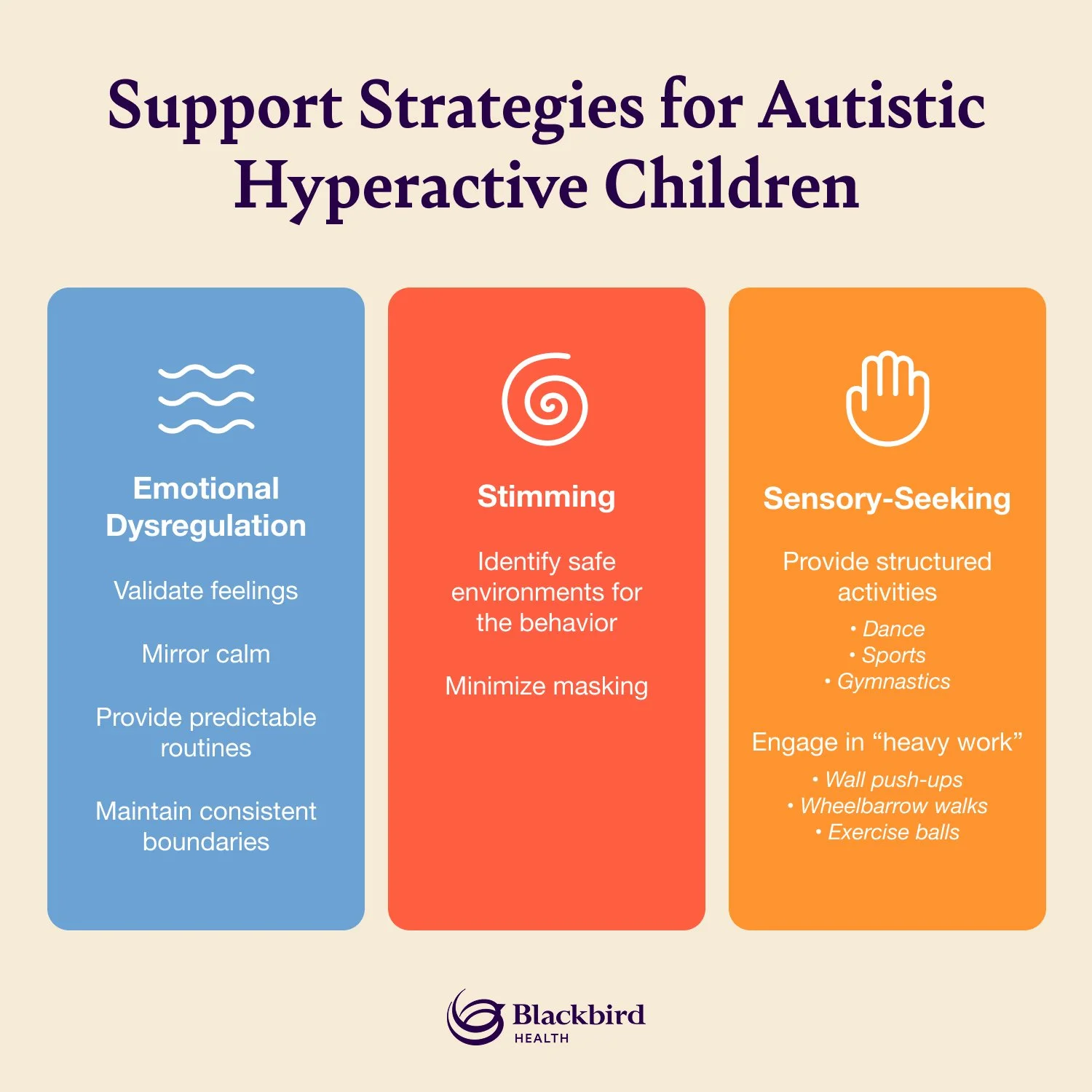
For sensory-seeking, “the best approach is to give them a healthy way to get that energy out,” says Kate Hunter, a licensed professional counselor and Behavioral Health Department Manager at Blackbird Health. If your child doesn’t have a good outlet, they may end up acting out or getting aggressive to get the sensory input they’re craving, Hunter explains.
“For kids who are constantly bouncing off the walls or crashing into furniture, ‘heavy work’ usually does the trick,” Hunter says. “Things like using exercise balls, doing wall push-ups, jumping on a trampoline, or doing wheelbarrow walks can really help them regulate.”
These children tend to do better when they’re allowed to move more during the day, even while they’re learning, per Hunter. “Trying to force them to sit still usually just adds stress, so it’s much better to channel that energy into structured activities like sports, dance, or gymnastics,” she says.
With stimming, it’s typically recommended that you allow your child to continue with the behaviors unless they are a safety concern. “Should an intervention be necessary, it is best to provide a replacement behavior that offers an equivalent level of sensory regulation,” Hunter says. “We place a strong emphasis on minimizing masking, as the pressure to conceal one’s natural tendencies can significantly negatively impact a child's self-esteem.”
Children who are encouraged to hide stimming behaviors or to conform to neurotypical norms often have higher rates of anxiety and depression, according to research from the National Autistic Society. “Therefore, assisting a child in identifying a safe time and environment for stimming is a critical component of effective support,” notes Hunter.
For emotional dysregulation, “it is essential that children feel their emotions are acknowledged and validated,” Hunter says. Even when your child’s behavior is not ideal, acknowledging and validating how they’re feeling can help your child feel that they are being heard. “Once a child feels genuinely understood, they are much more receptive to intervention and de-escalation,” Hunter says.
She also suggests trying to maintain an outwardly calm presence, to encourage your child to mirror your stability and regain their composure. “If a caregiver loses their own composure, it becomes significantly more difficult for the child to regulate their response,” Hunter says. “Ultimately, children require a secure environment in which to process their experiences, supported by consistent boundaries and a predictable routine.”
Of course, you can only help to manage the behaviors that happen in your presence. If your child’s school has raised a concern, management may look slightly different.
If your child’s school has raised concerns
Hearing from a teacher that your child has difficulty sitting still or is showing high levels of energy during the school day is very different from witnessing it at home. This behavior could reflect ADHD, autism, or both.
If you’re in this scenario, it’s important to have a conversation with the school to learn more about your child’s behaviors. While a formal evaluation can help determine whether school accommodations such as an IEP or 504 plan would be appropriate, gathering information on what is happening at school is an important first step.
But if you’ve already heard from the school and are still unsure about how to proceed, Blackbird Health’s virtual New Patient Evaluation can give you a fuller picture of what may be driving your child’s behavior so you can seek tailored support for your child’s specific needs.
The bottom line
Hyperactivity is common in children with autism, and is often driven by sensory-seeking, stimming and emotional dysregulation. ADHD and autism can also occur in the same child, making it difficult at times to know what’s driving certain behaviors and what to do next. Trying to figure out the source of your child’s hyperactivity can help guide future supports, but you don’t need to navigate this on your own. Having formal diagnoses for your child can go a long way toward having the appropriate strategies in your back pocket for the next energy outburst.
Frequently asked questions (FAQs)
-
It can. “Autistic kids might seem to grow out of being hyperactive, but it’s usually more about them learning how to mask or finding better ways to channel that extra energy,” Hunter says. When recommended by a medical provider, medication can help with self-regulation, too. “It’s worth keeping in mind that the underlying hyperactivity usually doesn't just go away on its own,” Hunter says.
-
It depends on how your child’s hyperactivity is impacting daily life. “Parents might want to reach out for extra support if a child is struggling with social cues, communication, or focus,” Hunter says. “It’s also a good idea to check in with a professional if hyperactivity is making day-to-day life tough or if you're just looking for some help managing things better.”
-
There are a few reasons why children with autism may be hyperactive at night. “There could be unmet sensory needs, and the child is seeking some movement to feel calm and regulated before bedtime,” Barney says.
Your child may also be feeling anxious about something that happened that day or an event they are anticipating. That may cause them to appear hyperactive, since this could manifest as excessive talking, a desire to move, or difficulty staying in bed, Barney says.
“I would also encourage looking at diet and any medications that your child may be taking with the pediatrician to determine if there may be any additional factors contributing to hyperactivity at night,” she adds. Some neurodivergent children also struggle to recognize the feeling of fatigue in their bodies, which can explain excess energy at bedtime.
-
Hyperactivity is not a core diagnostic trait of autism, and there’s no such thing as autism hyperactivity disorder. However, it’s common for children with autism to have a co-occurrence of ADHD. As high as 50% to 70% of people with autism spectrum disorder also have ADHD according to a data summary published in Frontiers in Psychology.