Could It Be AuDHD? Recognizing the Signs of Autism and ADHD Together in Children and Teens
By Sarene Leeds
Medically reviewed by Michael Tang, MD
Key takeaways
AuDHD is an informal term used to describe someone with both an autism diagnosis and an ADHD diagnosis. These conditions frequently co-occur; approximately one in eight children diagnosed with ADHD were also diagnosed with autism.
Identifying AuDHD can be challenging due to overlapping and contradictory traits, such as someone having both a desire for routine and a need for novelty.
Comprehensive evaluations must assess both conditions separately through different diagnostic tools.
Coordinated, whole-child support that integrates tailored therapies, school accommodations, and careful medication management (when appropriate) is vital for effective AuDHD care.
Once my daughter received an attention-deficit/hyperactivity disorder (ADHD) diagnosis toward the end of kindergarten, I thought the hard part was over. Now that we had an explanation for her behavioral differences—along with a 504 plan for school—everything would run much more smoothly, both at home and at school. Or so I thought.
As it turned out, that ADHD diagnosis only explained some of what we were experiencing. Even though I spent the next two years insisting to everyone around me (family, teachers) that my daughter’s continued behavioral issues were “just ADHD,” I knew deep down we didn’t have the full picture. And those gut instincts are often the first sign of AuDHD, which is when someone has both autism spectrum disorder (ASD) and ADHD.
By the time my daughter finished second grade, we had not only an autism diagnosis in hand, but also an IEP, and, most importantly, full recognition and validation of her identity as both an autistic and ADHD child.
While autism and ADHD are common comorbidities, they are also two distinctive diagnoses that deserve equal attention. If appropriate, it’s important to diagnose both since this can shape the child’s treatment and, ultimately, their mental health outcomes. This article will help readers recognize what AuDHD looks like in a child or teen, understand why it's often missed or delayed, and know what a thorough evaluation and coordinated support actually involves.
What is AuDHD?
AuDHD is an informal term used to describe someone who has both an autism diagnosis and an ADHD diagnosis.
AuDHD is not an official diagnosis in the Diagnostic and Statistical Manual of Mental Disorders, Fifth Edition (DSM-5); autism and ADHD are diagnosed separately. Interestingly enough, autism and ADHD couldn’t even be diagnosed together until the publication of the DSM-5 in 2013. Still, AuDHD is a widely used term within the neurodivergent community because it reflects a real, well-documented clinical overlap.
Since the availability of both autism and ADHD diagnoses has only existed for a little more than a decade, readers may be wondering whether a concept like AuDHD is even something to take seriously.
The answer to that question is a resounding “yes,” primarily because of how often autism and ADHD co-occur. One 2022 study stated that, according to clinical literature, about 50% to 70% of autistic people also meet the criteria for ADHD, while another in 2017 found that approximately one in eight children (12.5%) diagnosed with ADHD were also diagnosed with autism.
Now that you know what AuDHD is, the next useful step is understanding what AuDHD looks like day to day—because a definition only goes so far when it comes to helping your child. Knowing what to look for is critical at this stage.
Signs of AuDHD in children and teens
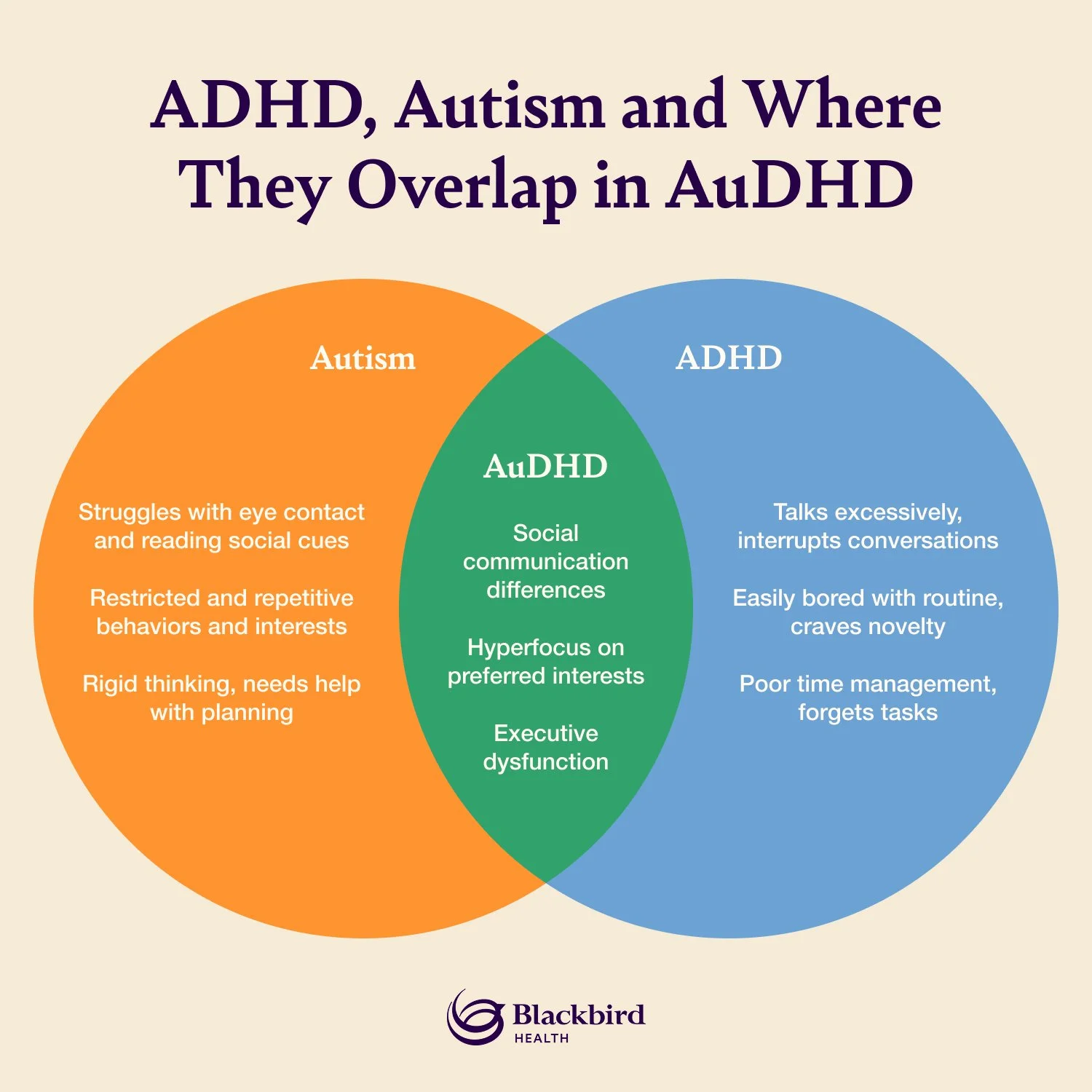
Spotting the signs of AuDHD can be tricky because even though autism and ADHD are separate diagnoses with distinct criteria, some of the defining traits in both conditions not only overlap, but also contradict one another.
Autism and ADHD are neurodevelopmental disorders that affect brain function. This can lead to challenges with attention, focus, and impulsivity, as well as social communication and executive functioning differences.
In the sections below, we break down the overlapping and contradictory ADHD and autistic traits in greater detail.
Attention and focus
Attention and focus can present differently in autism and ADHD, which can cause significant contradictory challenges in an AuDHD child.
Autism: Attention differences in autism can include hyperfocus on personal or special interests. This intense focus can also cause the person to resist shifting away from a preferred activity.
These traits can manifest in the following behaviors:
Losing track of time during a preferred activity
Visible and audible frustration when interrupted mid-focus
ADHD: People with ADHD may experience challenges sustaining their focus on something that isn’t personally interesting—and also because they are easily distracted.
These traits can manifest in the following behaviors:
Needing multiple reminders to begin or finish a task
Forgetting instructions almost immediately
How this can present in AuDHD children: The combination of autism with ADHD may cause a child to refuse to stop engaging in a beloved activity. But shortly thereafter, they may also be unable to concentrate on another activity, especially if it doesn’t interest them.
Sensory experience
There is a lot of overlap in this category, mainly because people with autism and/or ADHD can experience similar sensory sensitivities. The differences can lie in the root causes of these sensitivities, which usually depend on whether it’s autism or ADHD (or both).
Autism: A person with autism may process sensations more intensely, which can manifest in hypersensitivity (light, sounds, textures, and crowds cause overwhelm) or hyposensitivity (sensory input doesn’t have the desired effect, leading to sensory-seeking behaviors).
ADHD: People with ADHD can also experience hypersensitivity and hyposensitivity, but potentially for reasons different from autism. ADHD can make it hard to filter sensory input; either everything feels overstimulating, or everything feels understimulating.
So even though the reasons why may be different (or simultaneous), AuDHD children can still exhibit any of the following sensory-related behaviors:
Covering ears in loud environments
Voicing discomfort with certain clothing textures or tags
Becoming dysregulated in crowded or chaotic spaces like a school cafeteria or an assembly
Engaging in sensory-seeking activities like spinning, jumping, or fidgeting
Emotional regulation
Emotional regulation (or dysregulation) is another trait that has a considerable amount of overlap between autism and ADHD. Similar to sensory experience, the difference boils down to the reasons behind the behavior—which, of course, is more challenging to identify in AuDHD because multiple causes are likely present.
Autism: Emotional dysregulation is common in autistic people due to differences in information and sensory processing, as well as differences in social communication. Therefore, to an outside observer, autistic children may exhibit a disproportionate reaction to sensory or social overwhelm.
ADHD: For people with ADHD, the reasons behind emotional dysregulation can include differences in impulse control and the ability to filter emotions.
Even though the causes may be different, here are some examples of emotional dysregulation behaviors common among AuDHD children:
Meltdowns, shutdowns, or irritability that come out of nowhere
Difficulty naming or recognizing emotions
Lower frustration tolerance than that of their peers
Social connection
Social connection challenges can present differently in autism and ADHD, which can create compounded struggles for AuDHD children who want to connect with their peers.
Autism: Reading and understanding social cues can be challenging for some autistic people. While they may desire real connection with their peers, their different communication styles—preferring not to make eye contact, not picking up on nonverbal cues—aren’t always understood.
These traits can manifest in the following behaviors:
Misunderstanding social cues, like a friend losing interest or wanting to change the subject
Needing extra recovery time after socializing, even if you enjoyed yourself
ADHD: For people with ADHD, differences in impulsivity, inattention, and hyperactivity can affect social interactions, possibly leading to social rejection and tension. These challenges may cause those with ADHD to interrupt conversations or possibly jump in before there’s a natural pause in the discussion.
These traits can manifest in the following behaviors:
Interrupting or talking over others, even though you’re genuinely interested in what they have to say
Saying something blunt without thinking it through first
How this can present in AuDHD children: When autism-based and ADHD-based social connection challenges manifest in AuDHD children, there is a compounding effect that causes increased difficulty in overall social capabilities.
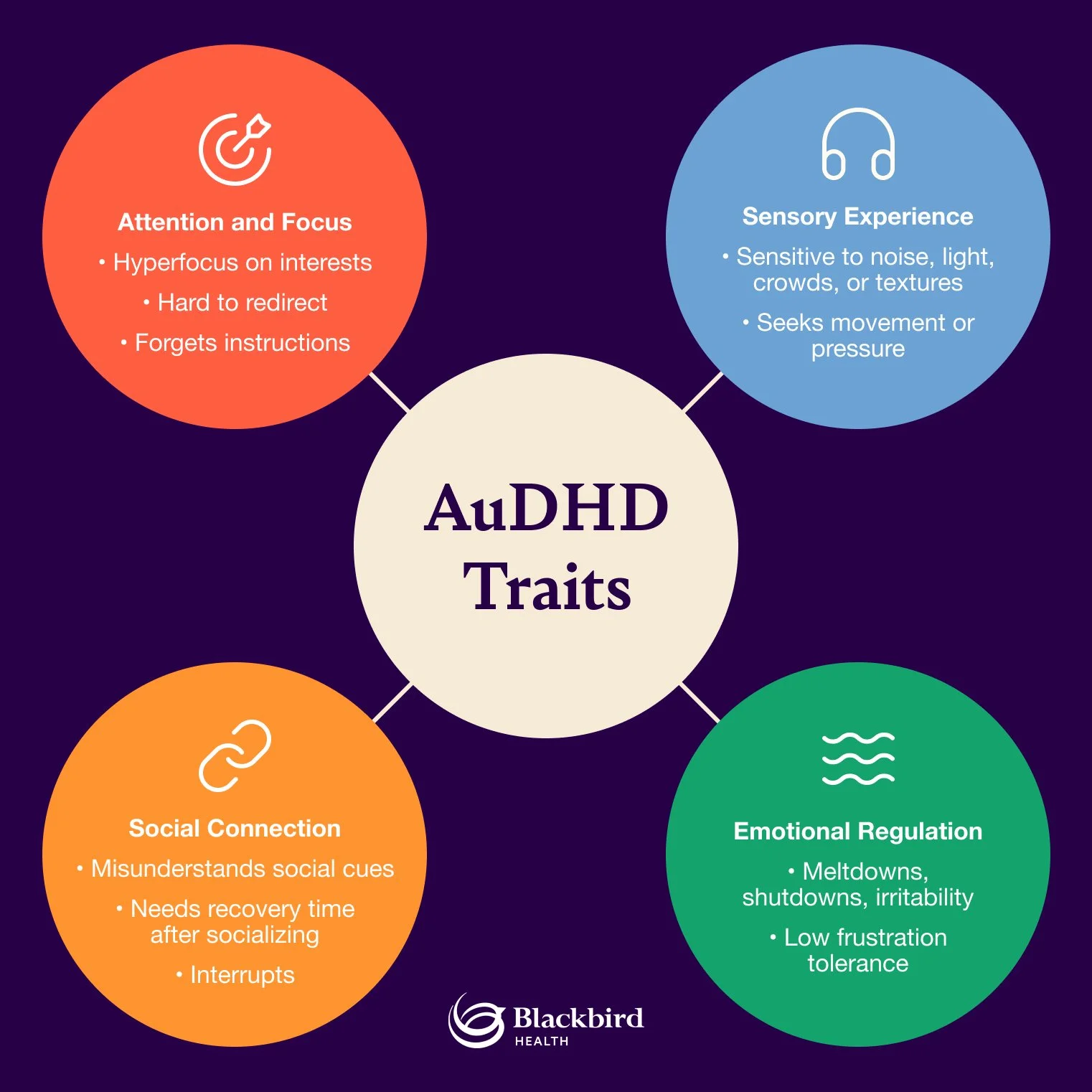
Although there are specific AuDHD symptoms to look out for, one factor that can make AuDHD so hard to recognize—and confusing for the child—is how autistic and ADHD traits pull in opposite directions.
For example, a common autistic trait is predictability and routine, while a common ADHD trait is a need for new experiences and stimulation. When a child exhibits both traits, it can cause inner turmoil and frustration.
At the same time, AuDHD traits often show up as real strengths as well, which may make them easier to pinpoint: Autistic traits such as hyperfocus, creative problem-solving, and a deep knowledge of their special interests can be incredibly useful in certain situations.
The same goes for ADHD traits such as adventurousness, a desire for exploration, and courage.
How AuDHD looks different in younger children vs. teens
Once a parent can recognize AuDHD traits in general, it’s important to remember that the appearance of those traits shifts with age.
In younger children
Since younger children don’t have as developed capacity to manage their neurological differences, or even an awareness of expected social behaviors, AuDHD traits tend to be more visible.
AuDHD children may display any of the following behaviors:
Speech and language delays (autism-based)
Poor eye contact (autism-based)
Sensory issues (autism-based)
Repetitive or restrictive behaviors (autism-based)
Difficulty paying attention to details, following directions, staying focused on tasks (ADHD-based)
Easily distracted (ADHD-based)
Fidgety or restless (ADHD-based)
Acting impulsively (ADHD-based)
In teens
By the teenage years, masking—the deliberate suppression of autistic and/or ADHD traits—has likely become more commonplace because adolescents are more aware of their social obligations. However, this can delay diagnosis in some cases.
AuDHD teens may display any of the following behaviors:
Learned social cues—such as saying hello to friends or neighbors—even if it doesn’t feel natural (autism-based)
Continued social-communication struggles (autism-based)
Intense interests and consistent routines (autism-based)
Poor time management and organizational skills (ADHD-based)
Difficulty prioritizing tasks and completing assignments on time (ADHD-based)
Trouble managing emotions and dealing with frustration (ADHD-based)
Risky or impulsive behaviors, such as substance use or unprotected sex (ADHD-based)
Why one diagnosis often comes first
When it comes to AuDHD, one condition is often identified well before the other. Rest assured that this is quite common, and not a parenting failure or clinician oversight—AuDHD traits are indeed easy to miss or misread.
When ADHD is diagnosed first: “The outer behaviors of ADHD often overshadow the more subtle traits of autism spectrum disorder,” explains Chrystal Gray, a pediatric neuropsychologist and Lead Neuropsychologist at Blackbird Health. Typical ADHD traits, such as impulsivity or emotional dysregulation, she continues, are “visually loud in early childhood and tend to draw immediate clinical focus.”
In addition, once a child receives an initial ADHD diagnosis, Dr. Gray observes, “clinicians and educators tend to view all future challenges through that single lens.” This can create further misunderstandings because social friction or intense sensory meltdowns are often misinterpreted as “ADHD impulsivity.” When that happens, it potentially leaves “the child's underlying autistic needs completely unaddressed.”
When autism is diagnosed first: On the flip side, when an AuDHD child receives an autism diagnosis first, “the intense special interests, sensory overload, or social communication differences of ASD often dominate the clinical picture,” notes Dr. Gray. In this case, clinicians may attribute a child’s ADHD-rooted restlessness, distractibility, or disorganization entirely to their autistic profile, “assuming these traits stem solely from sensory seeking or repetitive behaviors.”
Why autism can be missed or delayed, especially in girls: “Autistic traits—especially in young girls—can be masked by strong verbal skills or internal coping mechanisms,” explains Dr. Gray. These traits may remain hidden “until social and academic demands increase around middle school.”
No matter which condition is diagnosed first, understanding why the full AuDHD picture matters is what’s most important for your child.
Why understanding AuDHD matters
Having both an autism diagnosis and an ADHD diagnosis in hand is critical for several reasons. First of all, it can shape their targeted treatments. Secondly, since there is ongoing research as to whether or not children with AuDHD face a higher risk of anxiety and depression (compared to those with either autism or ADHD), establishing support early on may help prevent severe mental health challenges down the line.
“Understanding the co-occurring conditions of autism and ADHD fundamentally changes how we support young people,” says Gray.
Below, she unpacks essential help for AuDHD options, including targeted treatment approaches and school accommodations:
Targeted therapeutic approaches: Standard ADHD behavioral therapies often emphasize rapid exposure and compliance, which can cause severe distress or burnout for an autistic child dealing with sensory overload. Recognizing AuDHD ensures therapy respects sensory limits while targeting executive functioning skills.
Accurate medication management: Stimulant medications typically prescribed for ADHD can heighten sensory sensitivities or anxiety in autistic children. Knowing both profiles allows clinicians to fine-tune dosages and monitor side effects effectively.
Tailored school accommodations (IEP/504): An ADHD-only plan usually focuses on movement breaks and time extensions. An AuDHD plan adds vital supports such as predictable daily schedules, quiet sensory decompression spaces, and explicit social-communication scaffolding.
Home routine and environmental adjustments: Dual recognition helps parents structure the home environment to balance conflicting needs—such as the ADHD drive for novelty and movement with the autistic need for predictability, routine, and sensory downtime.
“Ultimately, identifying both autism and ADHD isn’t about adding another label,” assures Dr. Gray. “It’s about replacing guesswork with clarity so families, educators, and clinicians can provide holistic support that truly honors how a child thinks, feels, and thrives.”
Blackbird Health’s whole-child evaluation is the first step in that process. The comprehensive assessment provides a complete picture that can not only help parents and educators, but also help a child make sense of their own experiences.
What does an AuDHD evaluation involve?
Since the AuDHD meaning reflects an autism diagnosis and an ADHD diagnosis, a thorough evaluation must assess for both conditions, albeit separately, using different diagnostic tools.
The general qualities of a thorough evaluation are as follows:
Input from multiple settings: Both autism and ADHD require symptoms present in more than one environment, which means interviews from parents, as well as teachers and other adults in your child’s life, are critical.
A full developmental history: This can include when autistic and ADHD signs first appeared, how they've changed over time, your child’s early social and language development, and your family’s history. All of this information can help clinicians identify patterns in your child’s life.
Attention to co-occurring factors: Co-occurring factors such as anxiety, depression, and sensory processing differences should be taken into consideration when evaluating autism and ADHD.
What the autism evaluation looks for
An autism evaluation focuses on gathering detailed information regarding communication skills, social and play skills, social and emotional reciprocity, repetitive behaviors, sensory needs, rigid behaviors, and unusual or preoccupying interests, explains Bethany Barney, a licensed clinical social worker, diagnostician and Director of Clinical Evaluation at Blackbird Health.
“We are looking for patterns of these behaviors that have been present over time, starting in the early developmental period,” she says. “Clinicians evaluate the impact of these behaviors on the individual’s daily functioning.”
Autism evaluations usually include a thorough developmental history, a semi-structured observation, a review of parent and teacher rating scales, as well as a review of any previous testing completed. “We may also need to integrate data from additional evaluations such as speech and language and occupational therapy,” notes Barney.
What the ADHD evaluation looks for
ADHD evaluations also involve parent and teacher rating scales, as well as a review of the child’s developmental and medical history. But in this case, clinicians are looking for “patterns of hyperactivity, impulsivity, and attentional regulation differences,” says Barney. “Evaluations explore how the difficulty in these areas impacts your daily functioning.” ADHD evaluations may also include executive functioning assessments, working memory, and IQ and achievement testing “to help guide support that the individual may need in an educational setting.”
Since both autism and ADHD evaluations are two different lenses looking for two different diagnoses, a single assessment may not provide all of the answers. If your child already has one diagnosis, and you suspect you still don’t have a full picture of your child’s situation, it’s worth asking your clinician for an assessment of the other condition.
What support and treatment can help?
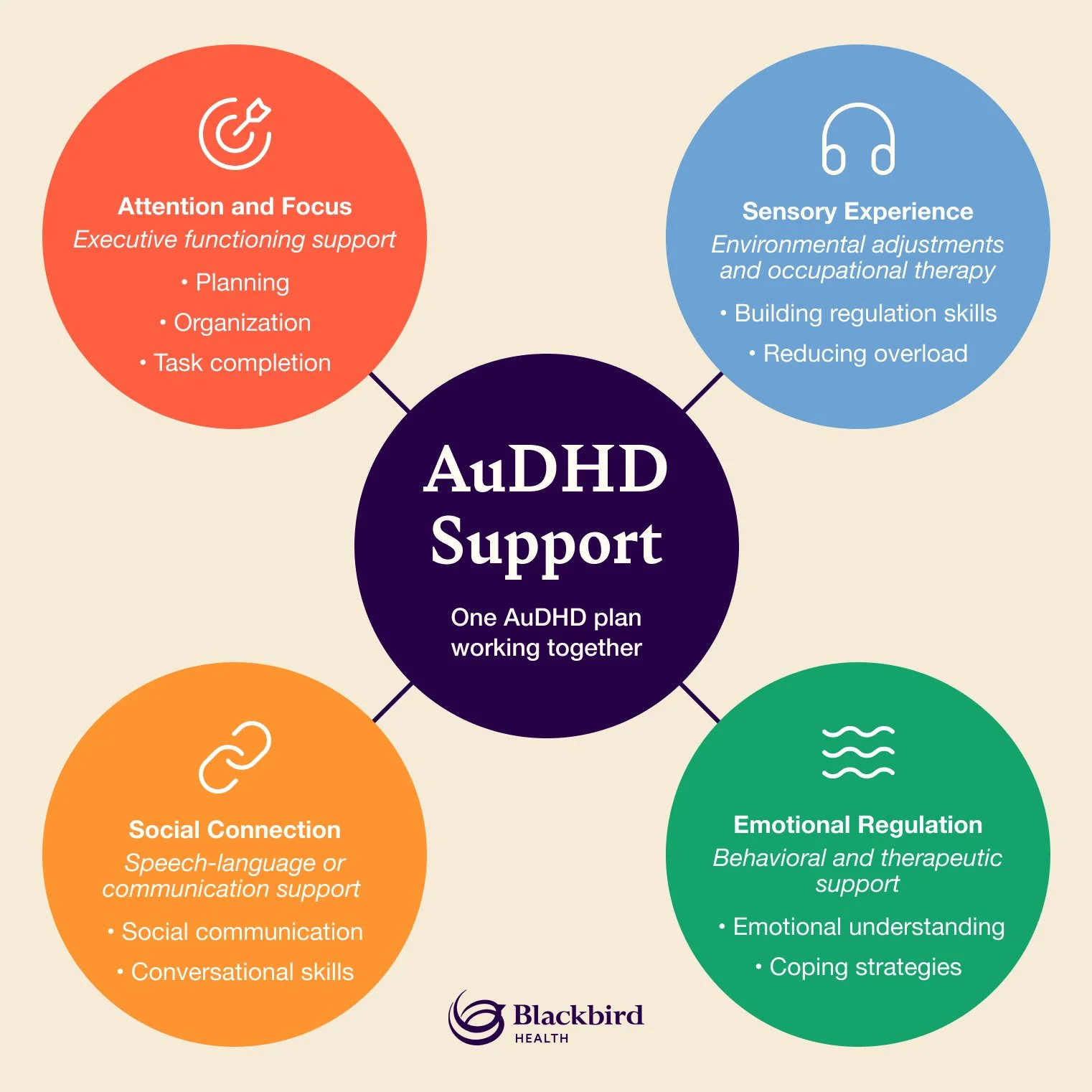
The following structure represents what AuDHD support can look like. A coordinated treatment effort is the most effective.
Behavioral and therapeutic support: Therapy to help children develop emotional regulation, social understanding, and coping strategies.
Executive functioning support: Teaching children how to build skills relating to planning, organization, and task completion.
Environmental adjustments: Providing strategies for reducing sensory overload and encouraging structured routines.
Medication management: Applicable when appropriate to support attention or emotional regulation.
Speech-language or communication support: Addressing social communication differences when needed.
“Support is tailored towards the individual’s unique needs,” explains Barney, “and each treatment plan will be developed accordingly.”
What makes Blackbird Health stand out here is its integrated care model for AuDHD support, because treatment works best when it’s coordinated across providers, rather than managed in isolation.
Blackbird Health’s patient portal allows you to connect with your child’s providers in one place: “You do not need to manage care through multiple organizations or worry about having your child’s medical records sent between providers,” says Barney. This structure also allows your child’s providers to easily consult on treatment and outcomes, “and keep each other informed of any changes that may impact your child,” she notes.
Blackbird Health’s clinicians also have access to speciality evaluations for autism, speech and language, and occupational needs. “So there is no need to spend time trying to find a different provider for these assessments; we prioritize being able to access these evaluations quickly,” says Barney.
In addition to the shared treatment plan, Blackbird Health provides regular treatment plan reviews—typically quarterly, and more frequently when medication is new or being adjusted. For children on a controlled substance, monthly visits are common even when things are stable. These aren't just administrative touch points—they're how the team stays current and responds to a child as they change.
Getting the right support
Good, coordinated AuDHD care means interconnected providers who are on the same page regarding your child’s treatment.
“At Blackbird Health, we utilize a whole-child approach to ensure every aspect of a child's unique profile is uncovered,” says Dr. Gray, “leading to more accurate diagnoses, better targeted accommodations, and comprehensive care.”
That kind of comprehensive care is built around a team, not a single provider. A nurse practitioner typically leads as the primary clinician and the keeper of the overall treatment plan—but they work closely with therapists, occupational therapist evaluators, and speech-language specialist evaluators.
All clinicians share access to the same treatment plan, which means when an occupational therapy (OT) evaluation happens, those findings are already integrated into the next medical visit. When a therapist notices something new, the NP can hear about it quickly. That kind of real-time communication across disciplines isn't available everywhere, and it changes what's possible in terms of care.
Families in Maryland, Pennsylvania, Virginia, and New Jersey can typically access evaluations at Blackbird Health within two to six weeks. You can fill out this brief form to get started.
The bottom line
Learning to spot the signs of AuDHD can initially feel intimidating, but knowing what to look for will help your child in the long run. Having both an autism diagnosis and an ADHD diagnosis in hand brings you closer to the kind of tailor-made support that will allow your child to thrive—both at home and at school.
Frequently asked questions (FAQs)
-
No, AuDHD is not an official diagnosis in the Diagnostic and Statistical Manual of Mental Disorders, Fifth Edition (DSM-5). It is instead a widely used informal term within the neurodivergent community to refer to someone who has both autism and ADHD diagnoses.
-
If your child already has one diagnosis but you still don’t feel you received all the answers, it’s worth asking your clinician to evaluate your child for the other condition. Unless your first evaluation clearly states that your child was diagnosed with one condition but didn’t fit the criteria for the other, they may not have been assessed for both autism and ADHD.
-
Yes, both autism and ADHD are highly heritable neurodevelopmental disorders. But, if a parent has autism or ADHD (or is AuDHD), that does not guarantee their child will have any of those conditions. Heritability just means there is a greater chance that the child will have autism, ADHD—or both.
-
The AuDHD vs. ADHD difference sounds confusing, but is in fact pretty simple: “AuDHD” is an informal term used to describe someone who has both an autism diagnosis and an ADHD diagnosis. ADHD just means a person has a single diagnosis, not both. Both autism and ADHD are neurodevelopmental conditions that affect how the brain processes information.
How can Blackbird help?
Our goal is to initiate the right course of treatment as quickly and as smoothly as possible, so “how it works” can be a little different for everyone. We customize your treatment plan to meet your unique needs, on a timeline that works for you. Click here to get started today.