Neuropsychological Testing For ADHD, Autism, and School Accommodations: What Parents Should Know
By Dahlia Rimmon
Medically reviewed by Michael Tang, MD
Key takeaways
Neuropsychological testing gives you a closer look into how your child’s brain processes information. Once you know how your child learns, you can identify their strengths and challenges to better support them.
Neuropsychological testing is different from psychological testing, which is more focused on emotional, behavioral, or psychiatric challenges.
Testing results can provide parents with a roadmap of what to do next. Parents receive a detailed report that can be shared with specialists for targeted support (such as therapy and OT) and school to help make the case for accommodations, including a 504 plan or IEP.
A neuropsychological test does not directly provide a diagnosis. Instead, it provides detailed cognitive data clinicians use to diagnose and manage a condition.
Neuropsychological testing sounds like a mouthful. And if you don’t know what’s going on with your child, it can feel pretty intimidating. Will testing slap a label on them? Put them in a box? Make them feel different? My best friend had all of these questions before having her child tested. Afterwards, she realized it was one of the most helpful things she could do as a parent.
You may recognize some of what my best friend was going through. Her child had a hard time making friends, struggled to follow directions from teachers, and would completely shut down in class. Small frustrations would escalate from zero to 60, and regulating emotions was a constant struggle. As the challenges piled up, so did the questions. Why is this so hard? What am I doing wrong? Am I a good parent?
Neuropsychological testing gave her a whole new way of understanding her child. Instead of focusing on what was going wrong, she understood why. She could better comprehend how her child’s brain worked and where he was getting stuck. For my friend, that understanding was a turning point, and it can be for other families too. In this article, we’ll break down what neuropsychological testing is, what it involves, how it’s different from psychological testing, and when it makes sense to pursue. We’ll also explain how testing results guide school accommodations and academic support, including a 504 plan or IEP.
What is neuropsychological testing?
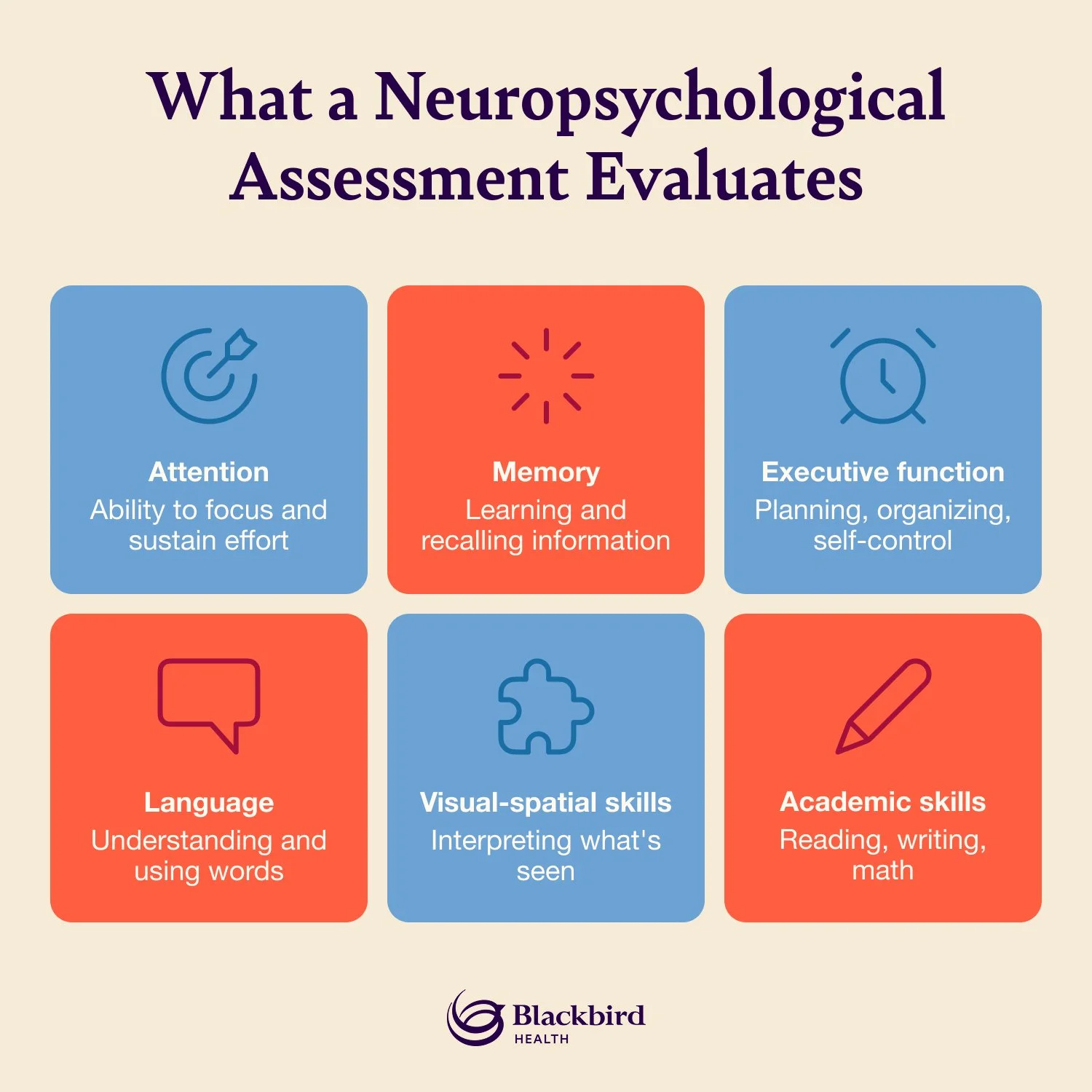
Neuropsychological testing is a detailed evaluation of how your brain works by assessing attention, executive functioning, memory, language, visual-spatial skills, and processing speed through a series of tasks, puzzles and questions.
“Neuropsychological testing breaks down the brain's construction into distinct aspects to pinpoint the exact 'wiring' responsible for the struggle,” explains Chrystal Gray, PhD, a pediatric neuropsychologist and Lead Neuropsychologist at Blackbird Health.
Neuropsychological testing gives a complete picture of what’s happening in a child’s mind, which helps identify exactly where they excel and where they may be struggling. “Instead of guessing, we can hand parents and teachers an exact instruction manual for how to support that specific child,” she says.
While neuropsychological testing doesn’t directly provide a diagnosis, it can lead to one. Testing results supply the objective data healthcare providers use to diagnose and manage a condition. A neuropsychological test’s results can help a clinician determine whether conditions such as ADHD, specific learning disorders, or autism-related neurodevelopmental differences are at play. It can also help identify overlapping conditions that may affect learning and functioning.
How does neuropsychological testing help identify ADHD or autism?
ADHD and autism are complex neurodevelopmental conditions, and symptoms don’t fit neatly into a checklist or screening tool. “For example, for ADHD, attention is made up of about five different components, executive functioning includes roughly eight separate skills, and impulsivity/hyperactivity spans several areas, from motor and verbal restlessness to emotional and cognitive impulse control,” explains Meyya Muthu, a speech-language pathologist and Senior Director of Specialty Services at Blackbird Health.
That’s where neuropsychological testing can help. Rather than looking at broad categories, neuropsychological testing breaks skills into measurable components using standardized, hands-on tasks and computerized tests. “[Neuropsychological testing] determines whether both profiles are present so parents receive a complete roadmap for targeted interventions at home and school,” says Muthu.
This can help clarify what’s really going on when symptoms overlap, such as distinguishing between ADHD and autism. Lastly, neuropsychological testing for autism can help both clinicians and parents understand if a child needs additional neurodevelopmental support.
Neuropsychological testing vs. psychological testing
If you’re confused on how neuropsychological testing differs from psychological testing, you’re hardly alone—providers often use the terms loosely. The main difference is that neuropsychological testing measures cognitive functions such as attention, memory, executive function, processing speed and learning, while psychological testing looks at a different piece of the puzzle, focusing more on emotional, behavioral, or psychiatric needs.
Although they’re technically different evaluations, the two can overlap quite a bit. “The line between them isn't rigid,” explains Gray. “A primary reason for this overlap is because our cognition and emotions influence each other directly.”
Think about what happens when you’re stressed or anxious. It’s probably safe to say you weren't firing on all cylinders. Maybe you couldn’t concentrate on a simple task or just felt like your brain was completely scrambled. Children are no different. When they’re anxious, overwhelmed, or having big emotions, it affects how they think, learn, and act.
The two types of testing also share some of the same assessment tools, which adds to the overlap. “Most diagnostic conditions are multi-faceted, just like the people who experience them,” Gray explains. For example, a child with attention deficit hyperactivity disorder (ADHD) may have challenges with cognitive processing while also experiencing emotional or mental health concerns. Neuropsychological testing for ADHD can provide clinicians the information they need to formally diagnose a child with the condition or determine if something else is at play.
How do you know which type of testing is right for your child? Here’s a quick guide:
| Your Concern | Better Fit | Why |
|---|---|---|
| My child is struggling to make friends at school and has low self-esteem | Psychological testing | Uncovers why your child is having social and emotional difficulties |
| My child has trouble focusing in math class and doodles instead | Neuropsychological testing | Evaluates cognitive abilities to understand why schoolwork is challenging |
| My child is bright, has ADHD, is on medication, but still struggles to keep up in school | Neuropsychological testing | Identifies how your child learns and where they could be getting stuck |
| My child has started experiencing anxiety before bed | Psychological testing | Explores what’s driving anxiety and how it’s affecting your child emotionally |
| My child avoids certain textures and sensory-intense activities | Neuropsychological testing | Explores neurodevelopmental profiles and possible overlapping conditions with autism |
| My child has trouble recognizing letters | Neuropsychological testing | Uncovers why age-appropriate academics are difficult and potential learning differences |
| My child needs accommodation in school | Neuropsychological testing | Identifies learning challenges and how to improve academic performance |
Of course, children don’t fit neatly into one box. A child who is having difficulty focusing in class can also be highly anxious. However, if your main concern is how your child learns and can keep up academically, neuropsychological testing is a good starting point—especially if school accommodations are a goal.
When neuropsychological testing might help your child
There are many reasons why your child might benefit from neuropsychological testing. Here are some common reasons why parents consider testing:
You suspect ADHD or autism: Your child has trouble staying focused, following directions, or tunes out when someone is talking to them and you want to understand why. A neuropsychological test can help unravel complex or overlapping neurological conditions in a way that a more straightforward diagnostic exam can’t. “One of its biggest strengths is resolving diagnostic confusion when symptoms overlap,” notes Muthu.
Your child already has a diagnosis but school still isn’t providing support: A diagnosis names the condition, but having one doesn’t guarantee eligibility for school accommodations. Neuropsychological testing produces concrete evidence that can help advocate for formal school supports, such as a 504 plan or IEP.
Your child has a diagnosis but treatment isn’t working: If you’re not seeing enough improvement despite trying medication or therapy, a co-occurring condition could be at play. Neuropsychological testing captures if more than one thing is going on.
Your child is struggling in school and it’s unclear why: They’re falling behind, having a hard time completing homework on their own, or experiencing behavioral struggles and you’re unsure what to do. “Neuropsychological testing can clarify the core issue, which can help us find a targeted intervention that actually addresses the root cause rather than relying on guesswork,” explains Muthu.
Your child is bright but still struggling in school: Muthu points to “high ability or gifted children who have underlying weaknesses; their challenges are often masked by their intelligence during early grade levels.” She notes that “testing can reveal their high cognitive potential, but also hidden vulnerabilities before the student even begins to struggle.”
In other words, neuropsychological testing isn't only for children who are falling behind academically. It can also help you figure out why a child isn't performing to their full potential and what kind of support can get them there.
What to expect from the testing process
The testing process usually feels less intimidating once you know what to expect. Here's a quick look at what happens during the testing process:
A conversation about your child's history: The neuropsychologist will review your child's medical, developmental, and educational history and talk with you (and your child) about concerns, strengths, and challenges.
Input from teachers and other providers: If needed, the neuropsychologist will interview your child’s teachers, therapists, or counselors, and have them complete questionnaires.
Behavioral observations: Throughout the evaluation, the neuropsychologist will observe how your child responds to tasks, communicates, and manages their emotions.
Age-appropriate activities and tests: Your child will complete a variety of standardized tasks that may include answering questions, solving puzzles, working with blocks, completing paper-and-pencil activities, or completing activities on a computer.
Results and recommendations: After the evaluation, you'll receive a detailed report with the results and next steps. The neuropsychologist will review the findings with you and recommend specific therapies, school accommodations, learning strategies, and other support.
Neuropsychological testing at Blackbird Health
Neuropsychological testing at Blackbird Health is done virtually, so your child can complete the evaluation on a computer or tablet from the comfort of home—no sitting in a waiting room or driving back and forth for multiple appointments. The virtual evaluation is not only more convenient but also completed faster than in-person appointments, which are typically spread out over the course of three to six weeks (versus a streamlined process that requires less than eight hours of family time).
During the evaluation, a Blackbird Health clinician works one-on-one with your child for about three hours, though evaluations can take anywhere from two to six hours. The specific activities depend on your child’s age and what’s being assessed.
Testing may include:
Visual puzzles
Interactive tasks
Reasoning activities
Written and verbal questionnaires
Games
Parents are asked to help their children with the initial setup (like getting the computer started) or help their child switch between tasks. Once testing begins, parents step out of the room (or sit somewhere out of their child’s direct line of sight), so that the child can work independently with their clinician.
And yes, while testing is a long time for a child to stay focused, Blackbird Health uses dynamic pacing, switching between different tasks every 10 to 20 minutes and building in breaks when needed.
How to prepare children for neuropsychological testing
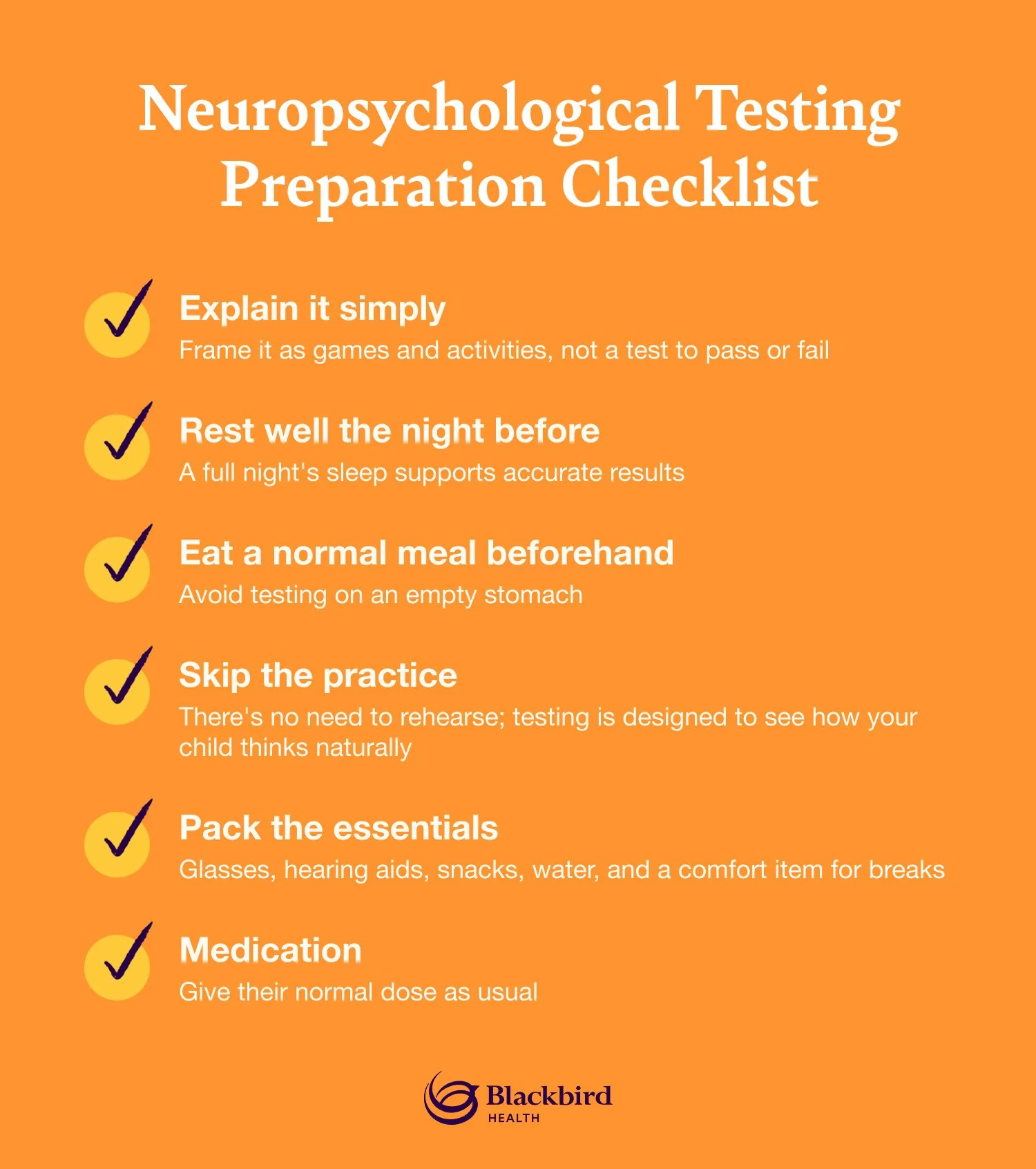
Prepping ahead of time can make the testing experience more comfortable for your child. Here are some ideas:
Create a quiet testing space: Find a comfortable spot with few distractions (no TV, video games, pets, exciting toys) so your child can focus
Make sure the computer or tablet is ready to go: Check that all tech is working properly and fully charged.
Have necessary supplies within reach: Keep the supplies your child needs nearby so you’re not scrambling at the last minute. Think: pencils, paper, glasses, hearing aids, etc.
Prepare snacks and a water bottle: Testing can take several hours, so have yummy snacks and water ready for refueling.
Aim for an early bedtime: Feeling well rested on testing day can help with energy and focus.
Start the day with a nutritious breakfast: A balanced breakfast with protein and fiber-rich carbohydrates will keep your child full and fueled for testing.
Provide a comfort item: If your child has a favorite stuffy or fidget toy, it can help them remain at ease during testing.
Don’t forget medication: If your child normally takes medication, give their normal dose as usual (unless your clinician says otherwise).
And most importantly, keep the lines of communication open. Allow your child to ask questions about testing and be honest about what they can expect (without making it seem like a big scary event). Reassure them that there are no right or wrong answers and they are not being graded.
Instead, explain that testing is a series of games and activities to help the clinician understand how their brain works. The less pressure they feel, the more comfortable they’ll be during testing.
How results connect to school accommodations
You’ve made it through testing—now what? Your clinician will provide a detailed neuropsychological evaluation report, outlining your child’s strengths, weaknesses, how they learn, and specific recommendations. What happens next will depend on why your child was evaluated in the first place, but the report is particularly helpful when working with their school.
“I would suggest parents share the evaluation with their child’s school, so that their child's accommodations can be updated given the new testing results,” says Muthu. The report can give parents something more concrete to bring to the table when advocating for support and school accommodations.
If your child does not already have accommodations or a formal support plan in place, you’ll generally need to submit a written request to the school to begin the eligibility process. Putting the request in writing is important because it starts the legally mandated timeline for the school district to respond.
School doesn't have to be the only place where you share your results. “Parents may also want to share the results with their child’s support system, which might include private therapists, medical providers, family members, and more,” says Muthu. The goal is to make sure your neuropsychological evaluation report is in the hands of all people supporting your child.
How testing results support a 504 plan or IEP
Depending on your child’s needs and the results of their testing, they may be eligible for a 504 plan or Individualized Education Program (IEP). Both are ways schools can provide extra support for your child.
Here’s a quick breakdown of each one:
504 plan: Provides accommodations to students who have a physical or mental disability that significantly limits their ability to perform in school. Children on a 504 plan may get extra time on tests, movement breaks throughout the day, preferred or alternate classroom seating, or changes to how certain assignments are completed.
IEP: This plan provides a roadmap of specialized instructions, accommodations, and support services to succeed in school. It may include smaller group instruction, classroom accommodations, or additional supportive services, such as speech therapy or counseling.
A neuropsychological assessment can help uncover why a child is having a hard time at school and pinpoint areas in need of support. The test’s detailed results serve as the documentation schools use to build or support a 504 plan or IEP (though it doesn’t determine eligibility). “Reports tailor recommendations directly to a child’s unique learning profile,” explains Gray. “Because the evaluation is multidimensional and comprehensive, it uncovers the true ‘why’ behind a child’s struggles.”
Eligibility for a 504 plan or IEP is different depending on whether your child goes to a public, private, or parochial (religious) school. Public schools are required to follow the applicable federal laws (Section 504, IDEA), whereas private and parochial schools have more discretion in how they evaluate students and how they choose to implement accommodations (or not). Either way, Blackbird Health can provide detailed documentation and recommendations to help parents advocate for the support their child needs.
Finding additional support
A neuropsychological evaluation provides recommendations beyond school accommodations. This may include therapy for emotional or behavioral needs, skill-building specialists (like occupational therapy or executive function coaching), or support for families navigating a new diagnosis or set of results.
Once you receive the report, you’re often responsible for coordinating the next steps, like finding clinicians and making sure they’ve read and understood the report. At Blackbird Health, testing is integrated into care, so the results can be shared with their internal team to inform treatment.
What testing costs and how insurance factors in
Testing comes at a cost, but for many families, the information it provides has lasting benefits. Most private evaluations cost between $3,000 and $7,000. Blackbird Health offers the same core cognitive and academic assessment for $1,500—a more affordable option for families. If the price tag still feels steep, think about the insight you gain from understanding how your child thinks and learns.
Since testing is usually seen as educational, it’s unfortunately not typically covered by health insurance and instead will be an out-of-pocket expense.
Getting started
If you’re reading to begin a neuropsych evaluation, the first step is gathering information. Start by talking to your child’s teachers to get a clear understanding of concerns, challenges, and strengths.
Questions to ask:
What patterns have you noticed in my child’s learning or behavior?
When does their attention begin to wander?
When is my child most focused?
When do you notice a change in their mood?
How do they interact with their friends?
How do they communicate with teachers and other students?
How well do they problem solve or work independently?
Are there particular subjects they’re struggling with?
Next, gather any existing records, evaluations, report cards, or feedback from teachers or school counselors. From there, you can look for a qualified provider who offers neuropsychological testing. Blackbird Health, for example, handles the process from finding clinicians and specialists to getting care (with the added convenience of virtual testing). When choosing a provider, ask what the evaluation includes, how much it costs, whether insurance covers it, and how the process works once you receive results.
The bottom line
The main benefit of neuropsychological testing is understanding how your child’s brain works, and in turn, how you can support them through the report’s detailed recommendations. “I encourage parents to become an expert on their child,” says Muthu. Testing highlights their strengths, identifies areas where they may be struggling, and gives you a better understanding of your child as a whole.
Neuropsychological testing is especially helpful if your goal is securing school or testing board accommodations, capturing whether a co-occurring condition is at play, or understanding the root cause of a cognitive struggle so that you can address it with a targeted intervention.
It can be that ‘aha’ moment that makes sense of academic challenges, difficult behavior, or why your child’s focus seems to be at an all-time low. Ultimately, the goal is to use those insights to help your child thrive at home, in school, and beyond.
Frequently Asked Questions (FAQs)
-
Neuropsych testing can be done in children as young as two years olds. For younger children, evaluations focus on speech, language, motor skills, and play. Around age five, testing can provide a more comprehensive picture of a child’s brain. Gray explains that at this age, clinicians can better assess IQ, learning disabilities, ADHD/executive dysfunction, and complex mood and behavioral challenges.
-
Timing for neuropsychological evaluations varies by age and a specific child’s needs. On average, a full neuropsychological evaluation could take six to eight hours spread over multiple in-person sessions. Since Blackbird Health’s neuropsychological evaluations are done virtually, this process is streamlined and typically takes two to six hours for much faster results.
-
Not usually. Insurance coverage depends on medical necessity, and testing primarily for school accommodations are not typically covered. This is because public school districts are federally required to offer free educational testing for eligible students.
-
School testing typically focuses on learning differences, academic performance, and how a child can benefit from educational support. Neuropsychological testing has a broader scope and takes a closer look into how a child’s brain operates and why they’re struggling in school or at home.
How can Blackbird help?
Our goal is to initiate the right course of treatment as quickly and as smoothly as possible, so “how it works” can be a little different for everyone. We customize your treatment plan to meet your unique needs, on a timeline that works for you. Click here to get started today.