School Refusal and Anxiety Treatment: Signs Your Child Needs Help and How to Get Support
By Sarene Leeds
Medically reviewed by Michael Tang, MD
Key takeaways
School refusal is typically treated through outpatient therapy. Cognitive Behavioral Therapy (CBT) and Exposure Therapy are two common, evidence-based, first-line treatments.
School refusal is not the same as truancy (“playing hooky”). School refusal is an involuntary psychological response characterized by anxiety-driven emotional or physical distress (headaches, stomachaches).
Early intervention is critical for school refusal treatment. School avoidance worsens over time if left unaddressed.
School avoidance is often the result of either an underlying mental health diagnosis (autism, ADHD, anxiety), or an environmental stressor like bullying or academic pressure.
School refusal treatment usually requires a partnership between school staff, parents, children, and in certain cases outside mental health professionals.
Most parents expect before-school jitters as a rite of passage: Perhaps there are some nervous butterflies and a few tears now and then. But for some parents, a typical morning may involve full-on sobbing, tantrums, and complaints of stomachaches or headaches, all because your child doesn’t want to go to school.
This level of school refusal may feel insurmountable, whether you’re a parent who is just noticing your child’s patterns or one whose school has already raised concerns about your child’s poor attendance. Either way, you’re not alone: Although chronic school absenteeism has improved since COVID, the average rate is still about 23%—higher than before the pandemic—according to a 2026 study conducted by the American Enterprise Institute.
Rest assured, a fear of school is common, and above all, it’s not a parenting failure. After reading this article, parents and caregivers will be able to tell whether what they’re seeing is indeed school refusal and understand why it's happening (including whether there’s an underlying issue). This article also offers guidance depending on whether the school has already gotten involved, and helps readers understand what real treatment looks like.
What is school refusal, and how is it different from truancy?
You’re probably wondering if what you’re witnessing is school refusal, ordinary reluctance, or something else entirely. The first thing to understand is that “school refusal” is a behavioral term that goes well beyond just “skipping school.”
What counts as school refusal?
School refusal is an anxiety-driven distress about attending school. Specifically, it is a type of situational anxiety—a psychological response that presents in stressful or unfamiliar settings. Although school refusal is not a diagnosis in the Diagnostic and Statistical Manual of Mental Disorders, Fifth Edition (DSM-5), it is a very real condition that appears in children between ages five and 17.
This is not the same as ordinary reluctance (those occasional bad mornings when maybe your child woke up from a nightmare), or truancy, which is “playing hooky” from school to hang out with friends or engage in non-academic activities such as going to the movies without a valid excuse.
School refusal is also not a sign of defiance or laziness. According to StatPearls, distinguishing school refusal from reluctance or truancy depends on the following criteria:
School refusal
Severe emotional distress about attending school manifests as anxiousness, temper tantrums, depression, or somatic symptoms
Parents are aware of absence; the child often tries to persuade parents to allow them to stay home
Antisocial behaviors such as juvenile delinquency are not present
Children usually stay home during school hours
Truancy
Excessive anxiousness or fear about attending school is not commonly seen; rather, the child often tries to conceal absence from parents
Antisocial behavior such as delinquent and disruptive acts (lying, stealing) are frequent in the company of antisocial peers
The child does not stay home during school hours
Even though there are distinctive criteria for establishing school refusal, this type of situational anxiety exists on a spectrum. Meaning, a child may exhibit signs of school refusal while still attending school. These signs can include partial-attendance struggles like dawdling, tardiness, early pickup requests, and frequent nurse visits.
The child’s visible distress is a more discerning factor of school refusal than whether or not they’re physically present at school most days.
Truancy vs. School Refusal
| Dimension | Truancy | School Refusal Anxiety |
|---|---|---|
| Communication patterns | School absences are hidden from parents | Parents are aware of the school absences |
| What the child desires | Child seeks rewards outside school (friends, entertainment) | Child prefers to stay home, often with a parent |
| Emotional patterns | Little to no emotional distress | Significant anxiety, fear, or panic |
| Source of school absences | Behavioral/motivational issue | Anxiety-based mental health concern |
| Additional signs to watch for | Antisocial behaviors such as lying or stealing | Child wants to please parents but cannot cope |
How school refusal looks different by age
According to the American Academy of Child and Adolescent Psychiatry, school refusal is usually prominent around ages five to seven, and again around ages 11 to 14. Younger children, who don’t have the independent ability to stay home from school, are more prone to meltdowns, clinging to their parents, and/or physical resistance at drop-off.
Older children and teenagers, who have more autonomy than younger children, exhibit school refusal through signs of anxiety or depression, according to a 2024 study published in Behavior Modification. Other signs can include refusing to get out of bed or get dressed, or leaving school after being dropped off.
School refusal signs and symptoms to watch for
School refusal starts subtly, so it’s a good idea to be aware of what to look for before things escalate to an untenable situation.
Some common early warning signs can include:
Sunday evening anxiety: “My stomach hurts” or “Can I stay home tomorrow?”
Monday morning physical complaints that improve by the afternoon or over weekends
Difficulty sleeping the night before school days
Excessive clinginess in the morning or extreme distress at drop-off
Frequent requests to call home or leave school early
Visits to the school nurse becoming routine
Dawdling or resistance in the morning routine that results in missed buses and tardiness
Physical complaints are also a real symptom of school refusal, even though anxiety is often the underlying cause. So if your child says they have a headache or a stomachache, they may not be faking or exaggerating—these ailments can be manifestations of the child’s anxiety. A good way to know if these physical ailments are stress- or anxiety-related is if they improve or disappear on weekends and school breaks.
Some common physical symptoms that often accompany school refusal include:
Stomachaches and gastrointestinal distress
Headaches
Nausea or vomiting in the morning
Fatigue or excessive tiredness
Dizziness
Muscle tension or body aches
Why school refusal happens
Although learning how to recognize school avoidance is a critical step, it’s only half the picture. Understanding why this is happening is vital for obtaining the right kind of help.
If there isn’t an underlying diagnosis for the child (autism, ADHD, anxiety, etc.), school refusal “tends to be more socially or environmentally driven,” says Travis O’Brien, a board-certified psychiatric mental health nurse practitioner and Director of Medical Training and Onboarding at Blackbird Health. “They might be having significant bullying or peer conflict issues, or it may be a learning environment that is not suited to the child’s needs.”
There are actually two different, albeit complementary, ways of understanding why school refusal happens:
The “trigger,” or the “why now?”: This is either a specific event or an accumulation of stressors that causes the school refusal.
The “function,” or the “why it continues”: This is the underlying reason why school refusal continues once it begins.
One example of a “trigger” could be a bullying incident, which may lead a child to avoid school specifically to escape the possibility of further bullying (the “function”).
In addition to bullying incidents or ongoing peer conflicts, common triggers of school avoidance can include:
Academic struggles or failing grades
Major school transitions: starting elementary, middle, or high school; changing schools; new teachers
Family stress (divorce, illness, financial hardship)
Extended absences (illness, family vacations, death in the family) that make returning to school overwhelming
Undiagnosed conditions (learning disabilities, autism, ADHD, sensory processing differences)
Most of these common triggers can point to one of four functions—the underlying mechanisms—of prolonged school refusal. Understanding these functions, and which one may be driving your child’s school avoidance, is imperative for determining the right kind of school refusal treatment.
Avoiding school-related stress: Some children may experience sensory overwhelm from sitting on the school bus, eating in the lunchroom, or even being on the playground among lots of kids. Some may also feel academic pressure from teachers or their peers due to a fear of not being able to keep up, possibly because of a learning difference.
Escaping social or evaluative situations: If a child has experienced bullying at school, they may want to stay home to avoid a repeat occurrence. This can also extend to the classroom, where a child may want to avoid taking a test, reading out loud to the class, or even just speaking in front of their peers.
Seeking attention or connection from caregivers: This behavior can manifest in separation anxiety, where a child demonstrates a fear of being separated from their family, or that something bad might happen to a family member.
Pursuing tangible rewards outside school: A child may prefer to engage in activities at home like video games or sleeping because they offer comfort or control. The same goes for avoiding school to socialize with non-school friends. When this function dominates school refusal without evidence of accompanying distress, however, you may be looking at a truancy situation—which will likely require a different approach.
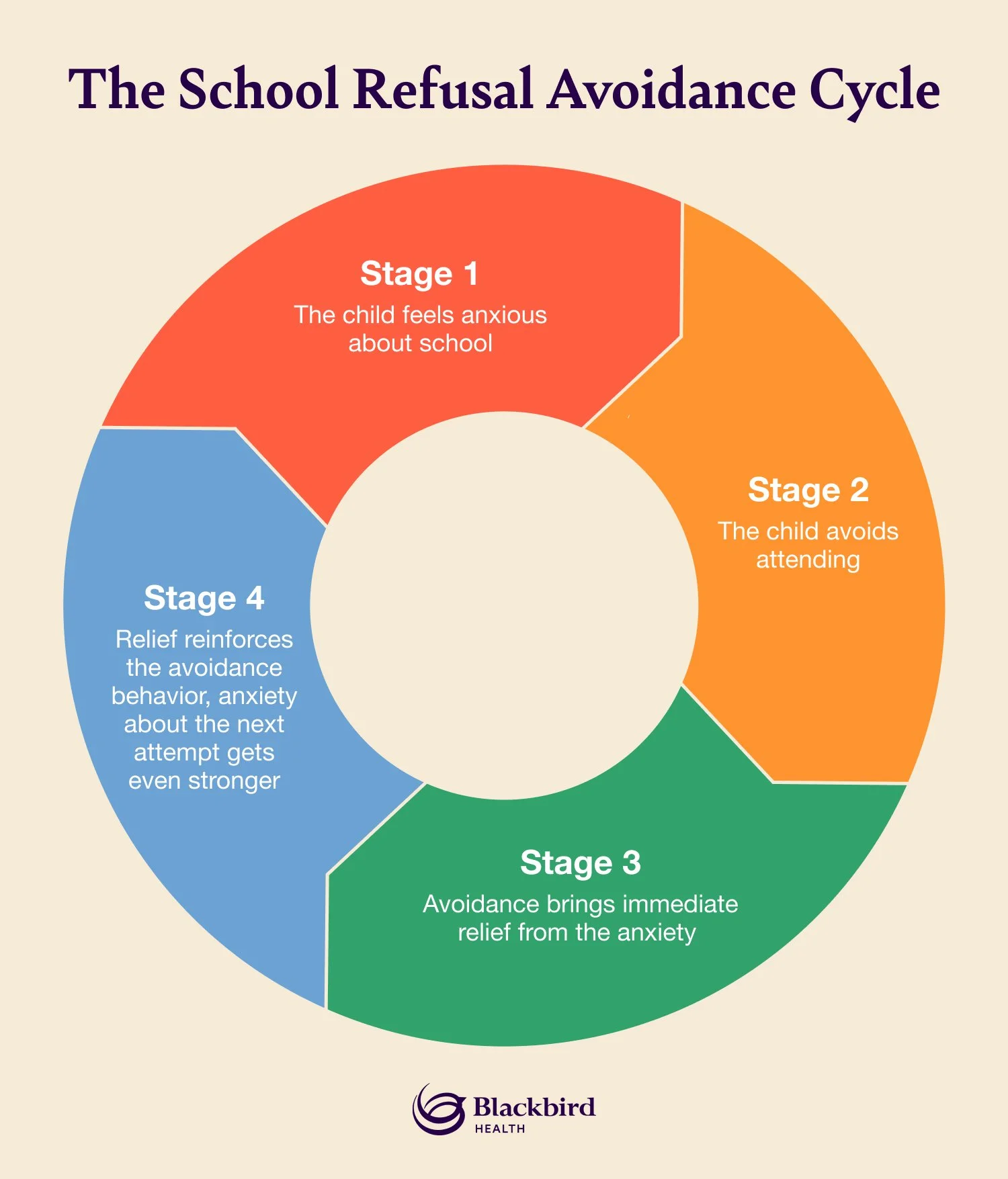
Staying home from school may provide immediate relief for your child’s anxiety, but it only reinforces the avoidance. This is why school refusal tends to worsen over time rather than resolve on its own.
“The most important thing I tell parents is this,” says Meghan Baron, PMHNP and Director of Medical Services at Blackbird Health. “The longer they stay home, the harder it gets to go back.” Yes, it's important to remain empathetic to your child, she emphasizes, “but it’s just as important to keep clear, firm expectations about attendance.”
And it’s why school refusal treatment is essential.
When to seek school refusal treatment
Even if your child is exhibiting signs of school anxiety, it’s natural to feel hesitation toward seeking school refusal treatment. You may still feel like you’re overreacting, or you may think it’s better to wait in case the problem resolves on its own.
As previously mentioned, the longer you wait, the more difficult it will be to break the school avoidance cycle. Therefore, consider seeking professional school refusal treatment when your child’s avoidance lasts for more than a few days—or if they show severe physical and emotional distress.
At the same time, it is perfectly reasonable to seek support even if your child’s school anxiety appears mild. You know your child best! Keep in mind that the standard approach is outpatient therapy, not residential or inpatient care.
Understanding what’s driving your child’s school refusal, which may also include identifying an underlying condition, is the next useful step in this process.
When school refusal shows up alongside an existing diagnosis
For many families, school refusal isn’t a standalone issue: It’s a new or worsening symptom compounded with one or more co-occurring conditions.
“Existing diagnoses absolutely have an impact on school refusal and can make it more challenging to treat the school refusal,” says O’Brien.
ADHD: “For students with ADHD, schoolwork can be so frustrating that avoiding it feels like the only option,” observes Baron. “Plus, if they’re constantly getting corrected for impulsive or hyperactive behavior, they might feel embarrassed and just want to stay away.” Baron also adds that school refusal can emerge from the shame and exhaustion of repeatedly falling behind academically or socially, “especially when the ADHD itself hasn't been fully addressed.”
Autism: “Kids on the autism spectrum often face sensory issues,” says Baron, “like noise or busy environments, and can find it hard to be flexible when routines shift.” O’Brien adds that autism has a spectrum of presentations, “but there are often common [instances] of social communication difficulties that can make it hard for children to interact with their teachers and peers.”
An existing anxiety disorder: “For kids with anxiety, school can feel like a dangerous place, emotionally or physically,” says Baron. “Avoiding it feels safer, but that just makes it harder to face school the next time.”
Depression: “Kids with depression often struggle with low energy and feeling ‘down,’” notes Baron, “which makes simple things like getting ready in the morning feel impossible, leading to them falling behind in school and wanting to go even less.”
While Baron and O’Brien do note that school refusal can certainly happen without a formal mental health diagnosis, comprehensive evaluations still matter in these situations. Treating the school avoidance in isolation, without understanding what else may be driving it, often doesn’t hold.
Working with your child’s school
You’re probably reading this article for one of two reasons: Either your child’s school has already reached out about missed days and/or tardiness, or perhaps you’ve noticed your child is exhibiting early signs of school refusal and you hope to proactively involve the school.
If the school has initiated contact about your child’s absences, know that it’s perfectly natural to feel like you’re being blamed. Remember that school refusal is an anxiety-driven mental health signal, not a discipline problem.
This also may be the time to consider obtaining a professional evaluation for your child, because an assessment is one of the best ways to determine how to help with school anxiety. An evaluation will provide the school with documentation and help them form a plan for working with your family, rather than allowing things to negatively escalate.
“Schools are our best partners in [school refusal treatment],” says Baron. “It works best when we all meet—parents, the student, and school staff—to come up with a plan, whether that’s through an official IEP/504 or just an informal strategy.”
What schools can offer
Accommodations: Any in-school accommodations typically come through a 504 Plan or an Individualized Education Program (IEP). While accommodations will vary by student, some examples include a modified school-day schedule, extended time on assignments, and preferential seating to reduce social anxiety triggers.
“Simple things make a huge difference,” says Baron. She recommends having a designated “safe person” the student can talk to (or even just access to a safe space), doing a quick “feelings check-in” in the morning, and making sure the goal is handling any distress at school rather than sending [the child] home early. “Encouraging the student to use their coping tools right there in the building really helps them get back on track,” she says.
School-based support: This can look like regular sessions with a school counselor or psychologist, small group therapy for social skills or anxiety management, and peer buddy systems or mentorship programs. “Involved guidance counselors can make a huge difference,” notes O’Brien, not only as a safe place a child can go to during the school day, “but also as a source of information for the parents.”
O’Brien also recommends that schools obtain any formal assessment documentation from outside mental health providers, while also keeping those clinicians informed of the child’s progress.
Environmental changes: “Schools can help by partnering with parents and outside mental health providers to try and figure out if there are any stressors in the school environment that are contributing to school refusal,” says O’Brien.
Some potential environmental changes can include using a quieter entrance at the beginning and end of the school day, a lower-stress lunch space, and a swift response to bullying (if that’s part of what’s driving school avoidance).
“It is important to make sure that every child is in a learning environment that can fully meet their needs,” says O’Brien.
Evidence-based treatments for school refusal that actually help
Since school refusal treatment will depend on your child’s individual case, it is possible that your child will require professional mental health support. Regardless of what’s driving the school refusal—whether it’s a single trigger like bullying or an underlying condition—know that these treatment approaches are well-established and evidence-based.
Cognitive Behavioral Therapy (CBT)
Cognitive Behavioral Therapy (CBT) is often a first-line treatment for school refusal, with research—including a 2023 study published in Current Approaches in Psychiatry and a 2010 study published in Child Development Perspectives—finding that it’s an effective approach for getting children back in school.
CBT teaches children strategies that challenge their negative thought patterns, which, in turn, helps them learn more productive ways to respond to challenging situations. This can include:
Identifying automatic negative thoughts that fuel anxiety (“Everyone will laugh at me,” “I’m going to blow that test”)
Challenging those thoughts with evidence and logic (“I have a lot of friends who care about me,” “I understand this math unit better than I thought”)
Developing coping statements (“I’ve got this,” “Nobody gets it right all the time”)
Learning anxiety management techniques like deep breathing, progressive muscle relaxation, and mindfulness
Practicing relevant social or problem-solving skills to address challenges like test anxiety or dealing with a bully
CBT Reframe Examples
| Automatic Negative Thought | CBT Challenge | Coping Thought |
|---|---|---|
| "I'll fail the test and everyone will think I'm stupid." | "I studied, and even if I don't do perfectly, one test doesn't define me. My worth isn't based on grades." | "I'm prepared, and I'll do my best. That's what matters." |
| "What if Mom gets hurt while I'm at school?" | "Mom has been safe every other day I've been at school. There's no reason today would be different." | "Mom is safe. I can check in after school." |
| "I’m so scared that bully is going to approach me today." | "It’s okay to be scared, but I deserve to have a good day at school." | "I’ve got two great friends I can stick with today." |
Exposure Therapy
Exposure therapy is another supportive behavioral approach for school refusal treatment, as it helps children confront their fears.
In the case of school refusal, exposure therapy teaches children to stay in a feared situation long enough for the anxiety to decrease naturally. The goal is for the child to learn they can tolerate discomfort—and that they don’t have to avoid school entirely.
A gradual exposure approach is where a clinician helps the child or teen create an exposure fear hierarchy. The sources of fear are then ranked according to difficulty. The steps to this process are broken down further below:
Create a hierarchy of feared school-related situations from least to most anxiety-provoking
Start with the easiest step (e.g. driving past the school)
Practice repeatedly until anxiety decreases significantly
Move to the next step (e.g. sitting in the school parking lot for 10 minutes)
Progress gradually through increasingly challenging exposures
Celebrate each success to build confidence
The success of exposure therapy also depends on the following factors:
Going slowly; rushing through the steps before the child is comfortable may cause progress to backslide
Involving school staff who understand the plan and their role in it
Coordinating with a therapist experienced in exposure therapy
Documenting accommodations in a 504 Plan or IEP if needed
Making home boring during school hours (no screens, games, or fun activities) to incentivize school attendance
Sample School Exposure Hierarchy
| Step | Exposure | Typical Duration |
|---|---|---|
| 1 | Drive past school building | Until comfortable (days-weeks) |
| 2 | Sit in school parking lot for 15 minutes | Until comfortable |
| 3 | Walk through school building after hours | Until comfortable |
| 4 | Visit a safe space (counselor's office) during school for 30 minutes | Until comfortable |
| 5 | Attend one class period with support person nearby | Until comfortable |
| 6 | Attend two class periods | Until comfortable |
| 7 | Attend half day | Until comfortable |
| 8 | Attend full day without support person present | Ongoing |
What school refusal treatment looks like and how long it takes
Now that you’ve decided school refusal treatment is necessary for your child, you’re probably wondering two things:
How long does this actually take?
What does treatment look like?
First, we need to establish if your child is experiencing either acute or chronic school refusal:
Acute school refusal (lasting roughly two weeks or less): This type of school refusal “is often related to a peer situation, bullying incident, or some specific circumstance in the classroom,” explains O’Brien. Acute school refusal tends to resolve quickly with swift intervention and support.
More entrenched or chronic school refusal (extended absences): The first step in treating chronic school refusal should be an assessment. Blackbird Health’s approach begins with a “thorough evaluation to see if things like anxiety, ADHD, or depression are playing a role,” explains Baron. “Chronic school refusal is more often related to a diagnosis like an anxiety or depressive disorder,” adds O’Brien.
The evaluation takes an in-depth look at how a child’s brain, body, and behavior interact, which can help providers identify what’s driving school avoidance, with treatment beginning after the first visit.
“Our goal is always to get the child back to school as quickly as possible,” says Baron. “We usually suggest therapy to help the child learn coping skills and parent coaching to help [caregivers] manage the situation.”
What structured treatment typically includes: Children who need structured school refusal treatment are typically “provided with counseling through a licensed psychotherapist,” says O’Brien. Counseling usually consists of weekly sessions that last an hour. Depending on the case, parent coaching may be an option so they can better support their child.
“If the refusal has been going on for a long time,” says Baron, “we might recommend a more intensive outpatient program where they get support several days a week.”
Medication: Although medication is not recommended as a standalone school refusal treatment, it can benefit some children alongside psychotherapy. “Medications can be an effective option for clients who have school refusal that is being driven by an underlying mental health diagnosis,” O’Brien acknowledges, noting that these options can include SSRIs for anxiety and depression.
Whatever your school refusal treatment strategy looks like, Blackbird Health helps coordinate care across therapists, prescribers, and the family, with everyone working from a shared plan.
The bottom line
School refusal does not mean that you have failed your child, nor is it a sign your child is defiant or lazy. It’s a common issue that needs to be addressed before it gets worse. Fortunately, support systems, like your child’s school and mental health providers such as Blackbird Health, can provide a tailor-made school refusal treatment plan.
Frequently asked questions (FAQs)
-
The first step is to acknowledge that this isn’t a problem that will just go away. Keeping the child home whenever they’re scared to go to school will make it that much harder for them to return.
Instead, it’s important to seek help from both the school and through a professional evaluation. An evaluation can either diagnose or rule out an underlying condition like anxiety, autism, or ADHD. Depending on the evaluation’s results, parents can formulate a school treatment plan in partnership with the school, and, if needed, an outside mental health provider.
-
Children with ADHD may be more prone to school refusal for a few reasons: First, ADHD can make completing schoolwork more challenging. In addition, students with ADHD may feel embarrassed if they’re constantly being corrected for impulsive or hyperactive behavior. School refusal may then emerge from the shame and exhaustion of repeatedly falling behind academically or socially.
-
Some common symptoms of school refusal can include physical complaints such as stomachaches and headaches that improve by the afternoon or over the weekend. Other signs to look out for are difficulty sleeping the night before school days, excessive clinginess in the mornings, extreme distress at drop-off, and frequent requests to visit the school nurse or leave school early. Chronic tardiness can also be a sign of school refusal.
-
Common ages for school refusal are around ages five to seven, and again around ages 11 to 14. Younger children are usually starting school for the first time, which can cause separation anxiety. Older children may experience school refusal because they’re either transitioning from elementary school into middle school or from middle school into high school.
How can Blackbird help?
Our goal is to initiate the right course of treatment as quickly and as smoothly as possible, so “how it works” can be a little different for everyone. We customize your treatment plan to meet your unique needs, on a timeline that works for you. Click here to get started today.