Improving Executive Functioning Skills for Kids: Tips, Strategies, and Resources
By Sabrina Rojas Weiss
Medically reviewed by Michael Tang, MD
Key takeaways
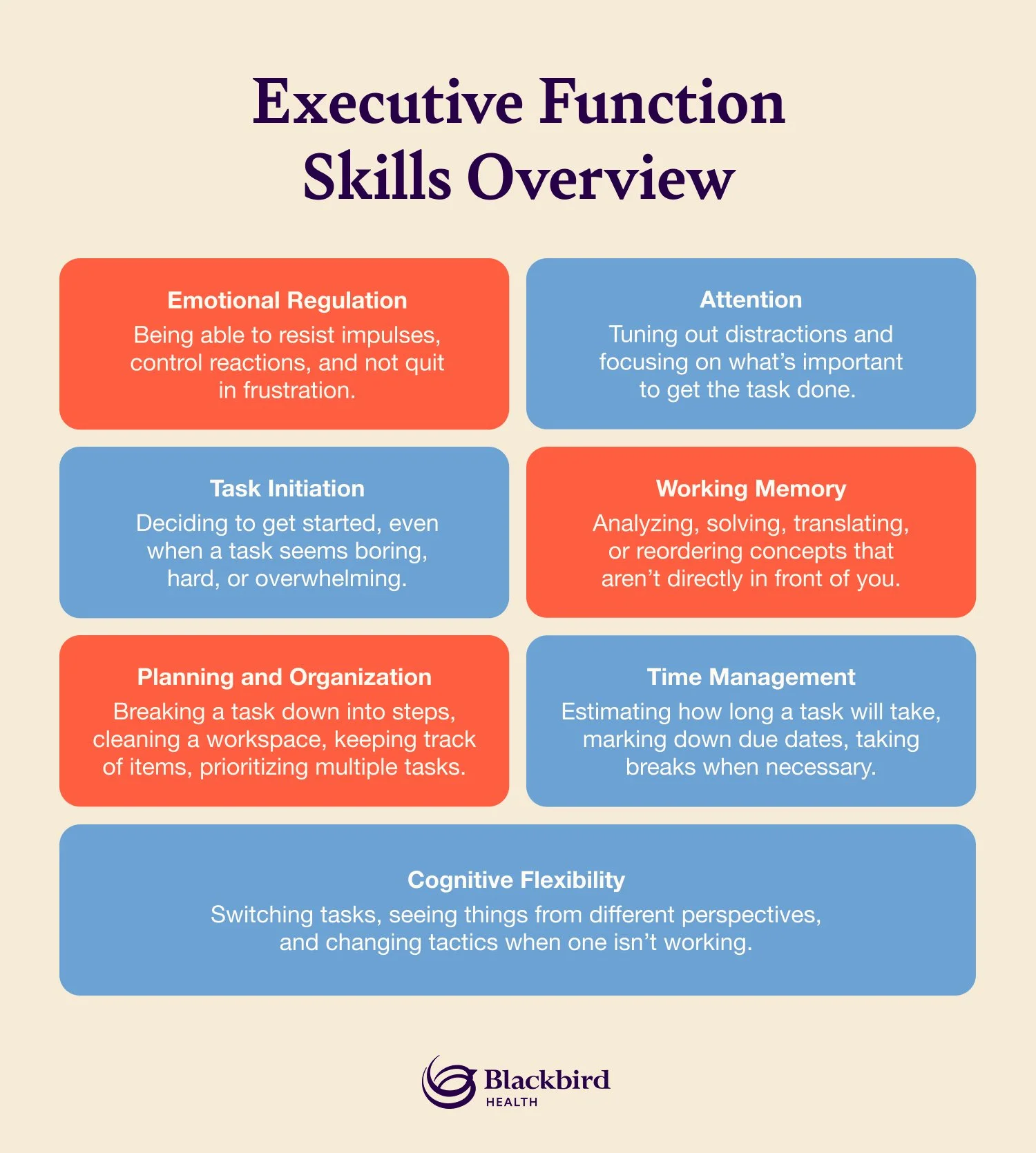
Executive function refers to the brain’s management system that oversees a collection of skills including attention, planning, breaking tasks into steps, managing time, problem-solving, and managing emotions.
Up to 89% of children with ADHD have deficits in at least one area of executive function, but it’s also prevalent in kids with autism, anxiety, learning differences, and those with no other diagnosis.
There’s a lot parents can do at home to teach these skills, but they may also need outside help through executive function coaching.
Report cards were a shock when my son started seventh grade. His test scores were high in every subject, but all his teachers reported missing assignments, bringing those grades down. His backpack and desk at home were full of crumpled papers, but his school-issued planner? Completely blank. His executive functioning was failing him big time.
“I often hear parents say things like, ‘I feel like I have to remind them about everything,’ or ‘If I don’t tell them to do it, it won’t get done,’” says Danielle Short, an occupational therapist and executive function coach at Blackbird Health. “When a parent is providing [all] the structure, reminders, and prompts for homework, routines, organization, and getting things done, it may be a sign that the child needs additional support developing those skills independently.”
Executive functioning problems can show up in young children as well as teenagers, and they may look different for every family—from daily fights with a first grader who can’t seem to get ready for school, to a teen who won’t get out of bed to write the essay that was due last week. Even without a diagnosis such as ADHD, your kid may be struggling to master these skills.
But here’s the good news: You can teach your kids how to improve executive function, and you don’t need to do it alone. After reading this article, you’ll understand why executive functioning challenges happen and whether it connects to an underlying condition (or not), learn strategies you can try at home, and know where to go for additional support.
What are executive functioning skills?
Executive function is the brain’s management system that oversees a collection of skills including attention, planning, working memory, and self-regulation, per Frontiers in Psychology. It’s how you take a new task or goal, decide to get it done, break down the steps to do so, problem-solve if your initial strategy is wrong, and then follow through to complete it.
When a child or teen struggles with executive functioning skills, it can lead to friction at home, poor school performance, and issues with work and daily life in adulthood.
What are signs of executive functioning problems in kids and teens?
From birth all the way into early adulthood, executive functioning develops as our prefrontal cortex grows and matures, a study in Scientific Reports explains. There are plenty of external factors at play here too, including the fact that parents and schools demand less of younger children and usually help them through step-by-step processes.
In younger children
Younger children’s most obvious executive functioning struggles might take place at home. You may need to remind them over and over to brush their teeth, they might have emotional outbursts when they’re overwhelmed by something that takes many steps, and they might have meltdowns during transitions when they have to switch from one task to another. Teachers may report behavioral problems because of these difficulties, too.
Jade Lawson, an occupational therapist and executive function coach at Blackbird Health, recalls a child she coached for executive functioning who was nine years old. “At that age, executive dysfunction usually pops up during simple daily routines like getting ready in the morning or winding down for bed, where multi-step directions can easily overload a kid’s working memory and make starting tasks feel overwhelming.”
In teens
By middle school, teachers shift their focus to academic subjects instead of how and when to do the work, Child Neuropsychology explains. As a parent, you might also decide it’s time to stop cleaning up after your child. Even if you have to set rules about when to do homework and chores, you expect them to do many of these things on their own.
But when teens don’t have great executive functioning skills, their grades may start to slip, their rooms may become disaster zones, and you may be fighting with them daily about these issues. Sometimes, they’ll do great on tests but have poor grades because of missing or incomplete homework.
They’re not being lazy or defiant, and sometimes they know the material they’re being taught just as well as any other students. But they may be so overwhelmed by their tasks that they don’t know where to begin. They may also be physically losing their assignments even when they’re completed.
| Executive Function Skill | Younger Children | Teens |
|---|---|---|
| Task initiation | Brushing teeth, getting dressed, starting schoolwork without multiple reminders | Starting homework, chores, big tasks with minimal prompting |
| Emotional regulation | Controlling reactions, speaking at appropriate times, behaving in school | Doing what’s required before what’s fun, delaying gratification |
| Planning and organization | Cleaning up, following instructions, keeping track of belongings | Breaking down tasks into steps, using planners/calendars, keeping track of belongings |
| Time management | Smooth transitions from home to school, playtime to bedtime, etc | Estimating how long tasks take, meeting due dates, taking breaks when needed, being on time |
How executive functioning struggles connect to ADHD, autism, anxiety, and learning differences
Children and adults with executive function difficulties often (but not always) have an underlying condition. When you understand what’s driving the struggle, you’ll be better equipped to help your child.
What shows up across conditions: ADHD executive function challenges in kids can look very similar to those for kids with autism, anxiety, or learning differences such as dyslexia. But the reasons behind their deficits in emotional regulation, attention, time management, working memory, task initiation, planning, and cognitive flexibility may be very different. For example, while a child with ADHD may not start a homework assignment because they’re overwhelmed, a child with anxiety might not start it because they fear failure. Meanwhile, a child with dyslexia could be having trouble processing or remembering the instructions.
There are different ways to test for executive functioning deficits, so statistics about them vary widely. A study in the Journal of Abnormal Psychology found that 89% of children with ADHD are impaired in at least one executive function skill. The American Speech-Language-Hearing Association reports that 41-78% of people with autism have an executive function issue. And a recent study on children with developmental dyslexia, published in Dyslexia, found that 67% of the participants had an executive function deficit.
Why it doesn’t look the same for every child: As a parent, you know how different kids can be from each other, so you get that the organizational challenges of one kid with ADHD aren’t necessarily the same as another’s. Sometimes they’ve learned masking or coping strategies over time, or their condition simply presents differently. Family, school, and other environmental factors also play a role here.
When conditions compound each other: Children can also have co-occurring conditions, such as autism and ADHD or ADHD and anxiety, and that means their executive functioning difficulties are more complicated, Short explains. While autism may contribute to challenges with flexibility, shifting between tasks, adapting to changes in routines, or managing uncertainty, a co-occurrence of anxiety can add to those issues with task initiation, attention, working memory, decision-making, and follow-through. Additional sensory needs can cause overwhelm, too.
“For children with autism and anxiety, I think it is really important to look at what is behind the behavior rather than simply viewing it as avoidance or refusal,” Short says. “I have worked with a child who understood what they needed to do for an assignment but became very overwhelmed when the assignment was large, or they weren’t sure where to start.” That uncertainty made it next to impossible for the child to start their work until Short was able to teach them how to break down steps, making things more predictable and manageable.
What this doesn’t mean: This is not an exclusive club. Your child may not have a specific diagnosis and still struggle with executive functioning. They can also still get help improving these skills.
If you do suspect that they may have a condition such as anxiety, autism, ADHD, dyslexia, or another learning difference, a diagnosis would help you address more specific issues that are connected to their executive function. It will also help you decide what kind of accommodations and professional help you may need, as well as how to try to work on these skills at home.
How can I improve my child’s executive functioning skills at home?
There’s a lot you can do to start executive function training at home with your child. Many of these are techniques you’ve probably developed yourself (consciously or not) to get your own big tasks done.
Make checklists and visual schedules: Post checklists for everyday activities, such as getting ready for school, and include things that may be obvious to you (i.e. put on socks, brush teeth). For homework, help your kids make to-do lists and schedules that line up with their due date. Keep school and after-school activities on a calendar everyone can see, too.
Build in routine: Kids who have difficulty with transitions or task switching can become upset by unpredictability. To the best of your ability, try to do certain tasks—such as meals, homework time, and bedtime—at the same time, in the same place every day. This may help reduce their anxiety and decision fatigue about what to do next.
Set up their environment: Organization is a challenge, but do what you can to make sure they have a dedicated place to do their homework that’s free from clutter. You may have to make cleaning this space part of their daily routine. Lawson suggests labeled bins to help out with this. A clear task space reduces distraction and makes it easier to find their assignments and school supplies.
Break tasks into smaller steps: Before big projects or new tasks overwhelm your kid, help make them manageable. You do this together at first (and go back to tip #1, make it a visual checklist!), then gradually encourage them to do it on their own.
Give them positive reinforcement: Make sure to praise them for participating in any of these steps, even if they don’t follow through with all of them right away. Incremental progress is still worth something, and they may not know they’re doing the right thing until you tell them.
Make the systems age-appropriate: Meet your kids where they are. Younger children will probably do best with big, visually appealing charts. Teens will require a little more subtlety. Get them to collaborate on the design of their lists or other task tracking methods to be sure you have their buy-in. Do what you can to respect their autonomy while rewarding their progress.
When to consider professional support
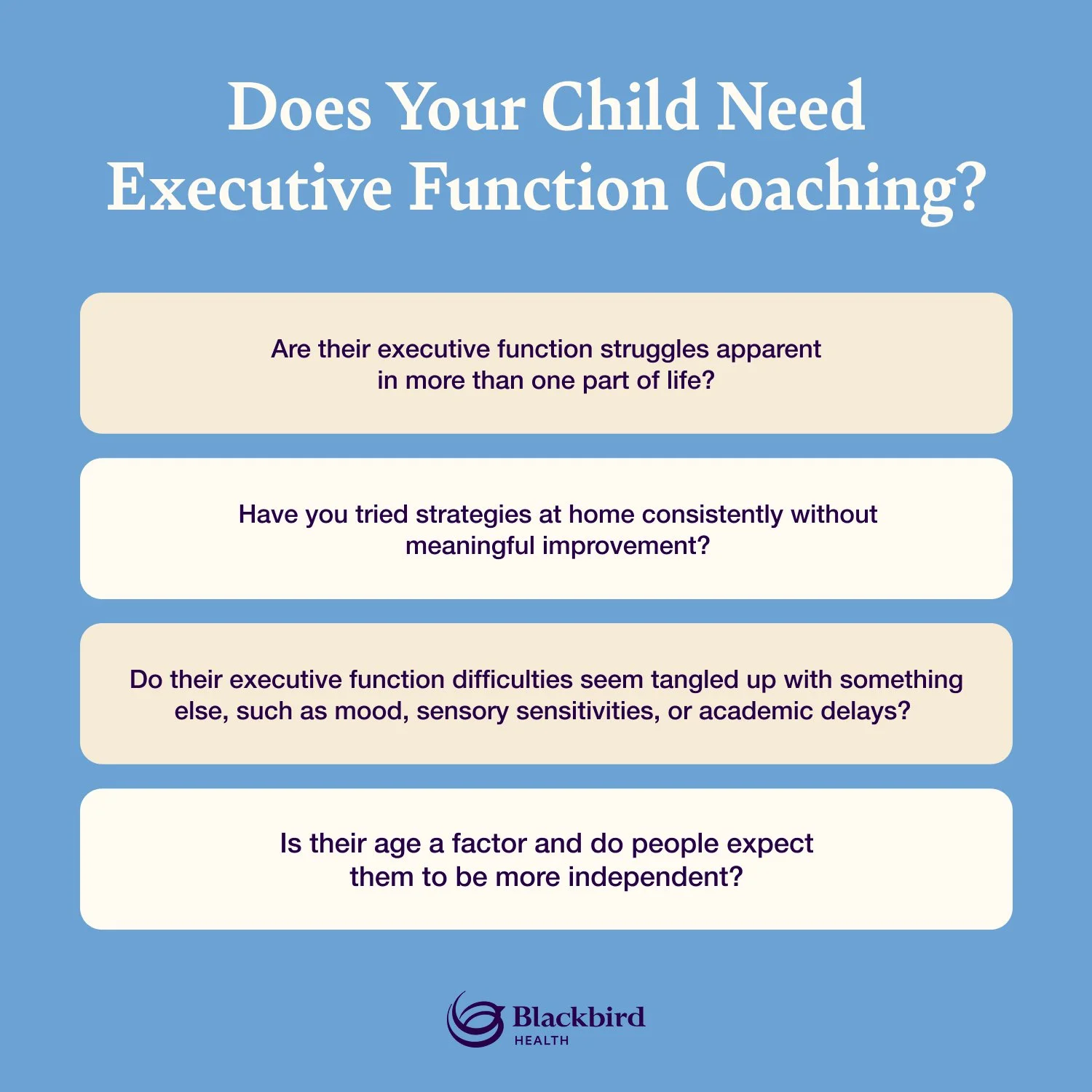
For many kids, working on executive functioning skills at home will be enough. But if they don’t seem to be getting it right away, that doesn’t mean they never will. It certainly doesn’t mean you’ve failed them, either. The questions listed here aren’t a checklist or a prescription, but they may help you decide whether your child could benefit from working with a professional.
Home strategies are likely enough if your child or teen’s struggles seem to be contained to just one aspect of their life (home, school, social situations) or if they’re relatively new—say, after a transition to a new school. If they’re responding to the techniques you’ve been trying, keep it up.
Executive function coaching may help if their struggles continue despite your work at home. You don’t have to do this alone. If they’re having trouble with just one executive functioning skill or all of them, coaching can be what makes things click and helps them get on track. And if they are also dealing with an underlying condition, coaching can be a piece of their overall care.
Even if your child is responding well to other forms of treatment, such as ADHD medication, they may need additional help to resolve their executive functioning difficulties. “Medication can help a child focus, but it doesn't teach them how to organize a backpack, manage their time, or start a task they've been avoiding,” notes Meyya Muthu, a speech-language pathologist and the Senior Director of Specialty Services at Blackbird Health.
Here are just two examples for which coaching could be a good fit:
Your teen aces their tests in middle school, but they’re failing classes because of missing work.
You’re feeling completely burned out as a parent because you’ve been acting as your kid’s “external brain”—tracking their work, reminding them what to do, managing their schedules—and you feel like they should have grown out of this by now.
A fuller evaluation is worth considering if you feel their executive function difficulties affect multiple parts of their life and are tangled up with other issues. Getting a formal diagnosis can be a good first step in getting help.
What executive function coaching looks like
Before you decide to move forward with executive function coaching, let’s take a closer look at what it involves and how to make sure it works for your child.
What coaching is (and isn't): It’s called “executive function coaching” and not “executive functioning therapy” for a reason. Coaching is a practical, skills-based approach to a problem. It’s not therapy, in which a clinician looks for the root causes of an issue while processing the emotions surrounding it. A coach will take real-life scenarios and help your child develop systems through which they can tackle any given problem.
For example, Lawson described how she helped a 13-year-old overcome difficulties with task initiation: “Coaching centered on creating a personalized, structured schedule paired with real-time initiation supports, like body doubling, or having another person present when work needs to be done. Breaking assignments into clear visual steps removed the overwhelm, making big projects feel manageable and much easier to start.”
What to look for in a program: There are a lot of different ways someone can become a “coach”—some more rigorous and evidence-based than others. To ensure the quality of your child’s coach, look for a program that uses coaches who also have formal clinical training, such as occupational therapists.
What coaching is working toward: While a coach can walk through how to use executive function skills to solve problems during a session, that’s not the end goal. Ideally, your child will be able to get to the point of generalization. That means they’ll understand how to apply these skills in any situation that poses a challenge. With good coaching, Lawson says, “Children build the genuine confidence they need to take ownership and follow through, whether they’re at home, at school, or out on their own.”
What coaching looks like at Blackbird Health: To give you an example of an executive function program, Blackbird Health follows a five-week structure. In the first week, the coach will help identify the child’s biggest challenges and choose one or two skills to build. In the second week, they’ll start teaching practical strategies. They’ll test them out in the third, adapting as needed. By the fourth week, the child and the coach will be practicing and troubleshooting. And in the fifth session, they’ll review what progress has been made and make a plan for the child to carry on with these skills.
“The goal is not to give the parent more things to remind their child about, but to help the child develop strategies they can eventually use independently,” says Short.
If Blackbird's executive function coaching seems like the right fit, you can schedule your first 45-minute session now to discuss your goals and create a personalized coaching plan.
The bottom line
If your child or teen struggles with issues like finishing homework, getting places on time, or organizing their things, they might be lacking in executive functioning skills. The good news is it’s very possible to improve executive functioning skills at home or with the help of a coach. The goal of any executive function training for kids and teens is to give them systems and structures they can use on their own to tackle new problems.
Frequently asked questions (FAQs)
-
There are many signs of poor executive function, but a few include:
Disorganization
Procrastination
Trouble starting or finishing big tasks
Difficulty regulating emotions
Struggles with remembering or following direction
Inability to manage time efficiently
Resistance to switching tasks or trying new approaches to a problem
-
While ADHD medication can help, it’s not necessarily going to solve executive functioning issues alone. “It may help a person stay focused, reduce distractibility and impulsivity, and stay engaged with a task,” says Short. “What medication doesn’t necessarily do is teach the actual executive functioning skill, [such as] how to use a planner, organize their backpack, break down a large assignment, estimate how long something will take, or create a routine that works for them. Executive function coaching helps someone actually learn and practice the skills.”
-
Because the prefrontal cortex continues to develop into young adulthood, executive functioning continues to improve, too. Experience and the guidance of adults and peers also helps. Still, many teens and adults continue to have a hard time with many of these skills later in life, leading to problems at work, in day-to-day life, and with relationships.
-
Executive function coaching is not considered medically necessary by insurance companies; therefore it is not covered and is a private-pay service. At Blackbird Health, the first session costs $150 and the remaining four 45-minute sessions cost $185 (there’s also a 30-minute option for parents alone that costs $125 per session).
-
Some people have executive functioning challenges without meeting the criteria for any formal diagnosis of a condition. That also means that coaching to teach these skills is open to anyone who feels they or their children need it.
How can Blackbird help?
Our goal is to initiate the right course of treatment as quickly and as smoothly as possible, so “how it works” can be a little different for everyone. We customize your treatment plan to meet your unique needs, on a timeline that works for you. Click here to get started today.