Looking for a Children’s ADHD Test? Here’s How ADHD Is Really Diagnosed for Kids and Teens
By Sabrina Rojas Weiss
Medically reviewed by Michael Tang, MD
Key takeaways
Attention-deficit/hyperactivity disorder (ADHD) can’t be diagnosed by a blood test, brain scan, quiz or single questionnaire. An accurate diagnosis requires an evaluation that involves multiple sources, from more than one setting, who know the child.
Screening questionnaires are a useful part of the evaluation process, but aren’t enough by themselves. Coupling those with interviews and a full history provides the whole picture.
ADHD commonly occurs alongside other conditions such as anxiety and autism, so many children benefit from a comprehensive psychological evaluation before beginning a treatment plan.
When there are concerns about learning differences or a suspected co-occurring condition, neuropsychological testing may help clarify a child’s cognitive and learning strengths and challenges and guide recommendations for support.
Does my child have ADHD? People talk about the condition so much these days, this is a question many parents consider at some point. And since about 12 percent of children in the U.S. have ADHD, according to the CDC, it’s a valid one, especially if they’re having trouble at home or at school.
It would be great if there were a simple ADHD test for kids, so you could get the answer right away. After all, a diagnosis means you could move on from identifying the issue to finding support that can help. As someone who wasn’t diagnosed with ADHD until my twenties, with a child whose diagnosis didn’t happen until he was 10, I understand the urgency. Unfortunately, an ADHD assessment for children is a bit more complicated than checking off a list or getting a lab result.
“There’s no blood test or brain scan for ADHD, so diagnosis relies on clinical interviews and personal history,” says Nikki Stone, a board-certified psychiatric mental health nurse practitioner and Director of Medical Services at Blackbird Health. In this article, you’ll learn what a more comprehensive ADHD evaluation involves and why. We’ll also explain how to decide whether an evaluation is needed, who can conduct one, how much it costs, and what to do when it’s complete.
What to do when you’re looking for an ADHD test for your child
You may have already gone through an ADHD symptom checklist or taken an online quiz that claims to be a childhood ADHD test. That’s a great place to start. After all, the fifth edition of the Diagnostic and Statistical Manual of Mental Disorders (a.k.a. the DSM-5), used by mental health professionals, has a pretty clear list of criteria you can see for yourself.
But the criteria also state that at least six of the symptoms must have been present for more than six months and in at least two settings (for example, school and home). That’s why many assessments include questionnaires for both parents and teachers.
A questionnaire also won’t be able to tell you whether your child’s symptoms have a cause other than ADHD, such as lack of sleep, trauma, an anxiety or other mood disorder, or other developmental or sensory factors. Your child could also be one of the 78 percent of U.S. children who have ADHD along with another condition (anxiety, depression, autism, learning differences), according to the Journal of Clinical Child and Adolescent Psychology, and it takes a thorough psychological evaluation to find out for sure.
It would be great if there were a test looking for physical markers in the blood or the brain, but the science isn’t there yet for ADHD. “That can make [diagnosis] feel subjective, but that’s a limitation of our testing tools, not a reflection of whether the condition is real,” Stone says. “Think about conditions like chronic pain or migraines. We don’t have a lab test for those either, yet nobody doubts they exist. ADHD is a real, biological issue with how the brain manages focus and regulates executive function.”
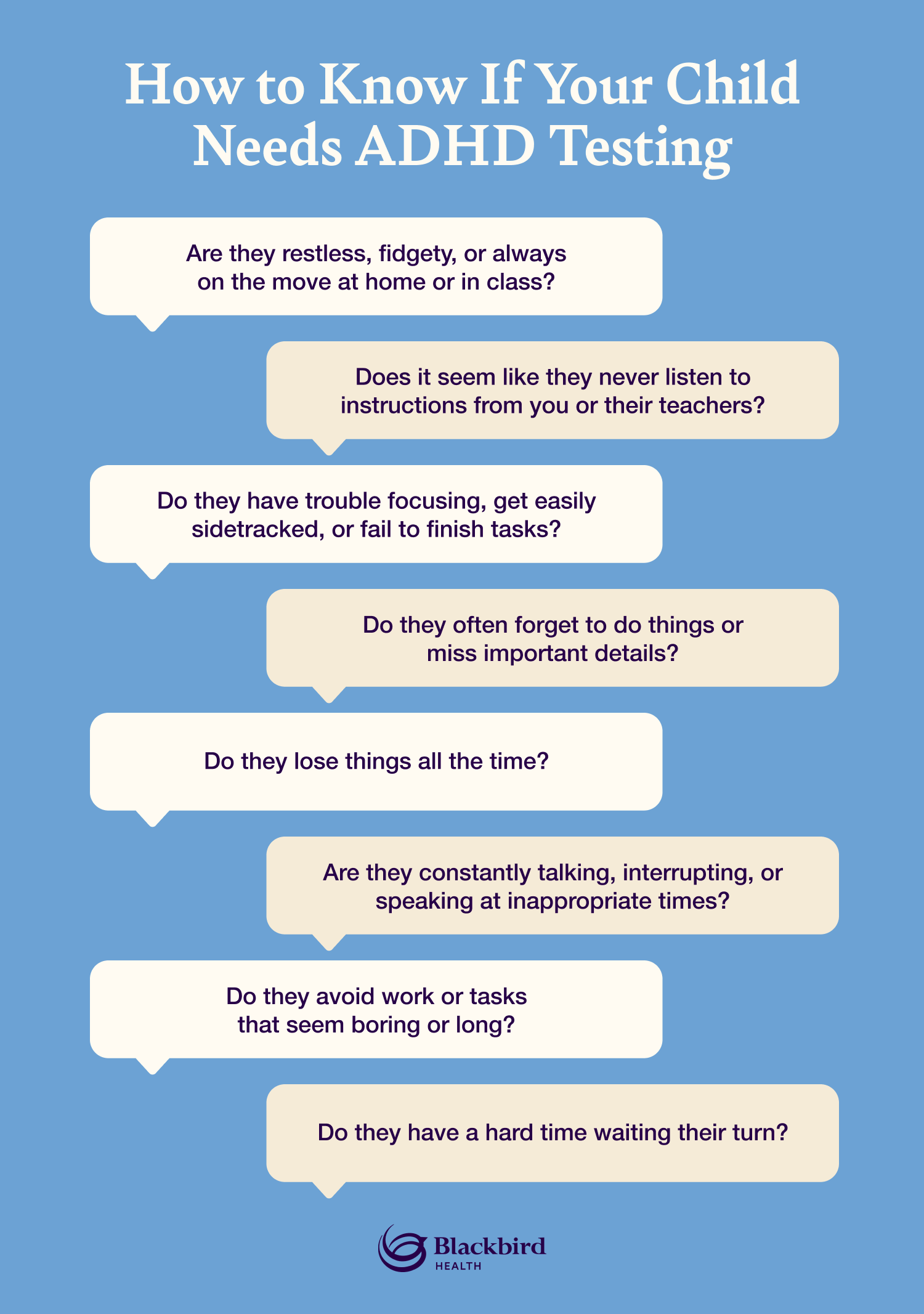
Before you take the next step in getting your child evaluated, consider the following questions. It’s not a checklist, but the answers might be helpful to bring to a healthcare provider.
As you answer these questions, also think about whether any of these challenges are new and whether the child’s teacher might agree with you. If you answered yes to several of these, read on for the next steps you can take.
What actually goes into a full ADHD evaluation
There are a few ways your child can get evaluated for ADHD—including at school and through your pediatrician—but not all of them result in a formal diagnosis, rule out other conditions, or identify co-occurring ones.
Your child’s pediatrician or regular primary care provider can also diagnose ADHD, and that might be a great place for you to start, according to the American Academy of Pediatrics (AAP). They will likely use a simpler process, such as giving a parent and teacher the Vanderbilt ADHD Assessment Scale to fill out. It’s possible that this is all your child needs. But if your child is not improving in the way you or the pediatrician hope, the doctor may refer you to a specialist for a more comprehensive evaluation.
A comprehensive ADHD evaluation for a child or teen includes a psychological evaluation and involves gathering information from more than one source (parents, teachers, the kids themselves) about behavior that occurs in more than one setting (home, school). It will evaluate for other possible factors and/or discover co-occurring conditions contributing to their current challenges. This type of evaluation is usually done by a mental health specialist, such as a psychiatrist, psychologist, or psychiatric nurse practitioner, and involves a combination of interviews and questionnaires.
Types of ADHD Tests
A single rating scale: These questionnaires, such as the Vanderbilt ADHD Assessment Scale or the ADHD Rating Scale (ADHD-RS), ask you to rate the severity of your child’s symptoms, and they are a useful tool in diagnosing ADHD. The questions are based on the symptoms listed in the DSM-5, so they’re a reliable starting point for clinicians, according to the Journal of Clinical Child and Adolescent Psychology.
But going by the criteria of the DSM-5 and the AAP, you need to confirm that a child has displayed those symptoms for at least six months and in two or more settings (such as school and home). That means, ideally, both caregivers and teachers would fill out such a scale. A doctor or other clinician should also evaluate for other causes (medical or otherwise).
A comprehensive evaluation: To get a more complete picture of what conditions a child or teen might have, mental health specialists such as those at Blackbird Health will give the above questionnaires to more than one source. They may also use broader scales, such as the Behavior Assessment System for Children (BASC), which measure other behavioral and emotional issues in addition to ADHD.
They’ll conduct interviews with the parents and with the child, in person or virtually. During this process, they will gather information about the family’s health, dynamics, and genetic history (especially given that ADHD can have a strong genetic element). They will talk about the child’s current symptoms, developmental history, academic performance, and any possible trauma they’ve experienced. They’ll also take into account the child’s physical health, especially their sleep patterns and eating habits.
Neuropsychological testing: Specially trained neuropsychologists conduct what’s commonly known as “neuropsych testing.” This evaluation is best for children and teens who might have more going on than just ADHD. It tests cognitive ability, attention, executive function, memory, language, visual-spatial skills, and academic skills to help uncover learning differences and other conditions that could coexist with ADHD or be the sole cause of their issues.
School evaluations: Because of the federal Individuals with Disabilities Education Act (IDEA), schools are required to evaluate a child for ADHD if parents request it, and the school agrees there is evidence they may have a disability, or if their school thinks it might be necessary and the parents grant permission.
These free evaluations will involve interviews of parents and teachers, as well as an assessment by a professional, such as the school psychologist. While this doesn’t result in a formal medical diagnosis, if this evaluation determines that a child has ADHD and needs specialized instruction or support to access their education, they may then be eligible for an Individualized Education Program (IEP), or more commonly, a Section 504 Plan.
| The Question | Basic Screening | Full Evaluation | Neuropsychological Testing | School Evaluation |
|---|---|---|---|---|
| Who administers the assessment? | Pediatrician/primary care provider or a mental health specialist | Psychiatrist, psychologist, psychiatric nurse practitioner, or other specialist | Neuropsychologist | Team of teachers, parents, and school psychologist (or similar) |
| Does it result in diagnosis? | Yes, in simple cases, but may need follow-up with a specialist | Yes | Not directly, but the results will inform your clinician’s diagnosis | No |
| How long does it take? | 10-15 minutes per test | 90 minutes to several days | 2-8 hours (sometimes spread over 2 sessions) | Within 60 days of parental consent (per federal law) |
How an ADHD evaluation looks different for younger children vs. teens
Just as you wouldn’t expect to use the same literacy test on a first grader as you would on a junior in high school, an ADHD test for teens looks different from one for younger children. In addition to the child’s growing intellectual ability over time, ADHD also shows up differently because of societal expectations, Stone explains.
“In early childhood, the environment is naturally forgiving of poor executive functioning or emotional outbursts,” she says. For this reason, ADHD can go undetected. But while Stone believes finding ADHD early helps prevent kids from developing “maladaptive coping strategies” and internalizing their struggles, there’s no point at which it’s too late to get a diagnosis.
In school-age children
Young kids are famously unreliable narrators, and they’re not about to go into a long monologue about how their executive functioning skills have failed them. So how do they test for ADHD? First, there’s a lot of reliance on input from the parents and teachers, rather than on directly questioning the child. Though younger kids with hyperactive/impulsive-type ADHD may exhibit classic symptoms of restlessness, Stone says she also tries to look for subtle clues.
“Can they follow a two-step directive without needing it repeated, or do they lose the thread immediately?” she asks. “Do daily tasks, like brushing their teeth or sitting down for dinner, feel like a brand-new concept to them every single time? How do they handle moving from a high-dopamine activity, such as watching TV, to a routine task? What do their facial expressions and body language look like during a tedious conversation or an uninteresting task? Is their bedroom or desk organized, or is it pure visual chaos?”
The AAP does not recommend evaluating for ADHD before the age of 4, but speak to your child’s pediatrician if their behavior is concerning to you.
In teens
When Stone sees teens for an evaluation, “The stakes are higher, and the demands are heavier, so the core symptoms are much more obvious to the assessor,” she says. “But the tragedy is that years of unaddressed ADHD usually mean they're now dealing with secondary issues—like severe anxiety or depression—that stem from years of just trying to survive without support.”
The good news about giving an ADHD test to a teenager is that they can understand and answer complex questions about themselves. The bad news is that they have spent years masking their symptoms. A qualified professional will know how to spot when that happens.
What ADHD evaluation typically costs
As you decide where to get tested for ADHD, the cost of this evaluation is probably top of mind. The prices range widely depending on the provider, the type of assessment you need, and insurance coverage. It’s a good idea to call your insurance company before you begin this process to find out what is and isn’t covered, and whether a provider is in network.
Here are some average costs you can expect:
School evaluation: Free, but doesn’t result in diagnosis
Pediatrician/primary care physician: Copay, depends on insurance coverage
Psychological evaluation: Around $500 to $1,200, though insurance often covers a good portion of this
Neuropsychological testing: $1,500 (Blackbird Health’s price) up to $7,000, not usually covered by insurance (since it is considered educational and not medical testing).
What happens after an ADHD test and how to get support
After you find out whether or not your child has ADHD, you’ll have a whole new set of questions about what to do next. Often, a diagnosis comes with a huge sense of relief, because it explains so much, and it means they weren’t just being lazy or defiant. But the work needs to continue after that.
You’ll need to explore whether your child needs extra support or accommodations at school (with an IEP or a 504 plan). Therapy with a psychologist, licensed social worker, counselor, or psychiatric nurse practitioner can help them work through how ADHD challenges make them feel and how to embrace their brain’s superpowers. If you decide to consider medication, you can meet with a psychiatrist or nurse practitioner to explore those options, too.
Executive function coaching can help them tackle obstacles at home and at school with practical lessons on organization and breaking tasks into manageable steps. As a parent, you can also get coaching or therapy that can help you navigate this.
If it turns out that your child does not have ADHD, but they’re still struggling with school, focus, or their emotional regulation, they can still get therapy or coaching.
“Executive function supports benefit everyone who uses them—a child doesn't need a formal diagnosis to deserve structure, scaffolding, and support in areas where they struggle,” Stone says. She recommends looking into changes in their eating habits and sleep routines that could benefit them as well.
What’s really helpful is if you get your child’s evaluation from somewhere that can also treat them. For example, at Blackbird Health, after you fill out a patient intake form online, and typically within about two weeks, you’ll get an appointment for a comprehensive New Patient Evaluation, which takes about 90 minutes. Once the results are ready, you can set up a Treatment Plan Visit and discuss the various options available for you and your child, without having to seek specialists on your own.
The bottom line
Though there’s no one ADHD test teens and children can take, some questionnaires and symptom lists are helpful for anyone wondering why their child has certain challenges. A more complete psychological evaluation will look at whether it’s ADHD, other conditions, or ADHD along with other conditions, and the results will help your child receive the treatment and accommodations they need.
Frequently asked questions (FAQs)
-
Since there is no one test you can take to diagnose ADHD, there’s no free test available. You can read about the symptoms of ADHD and determine whether your child or teen should undergo an evaluation. An evaluation conducted by their school is free, but it will not result in a formal diagnosis.
-
The school evaluation is conducted by a team that includes a qualified professional, such as a school psychologist, but the aim is to determine whether the student needs help or accommodations at school. It is not considered a clinical diagnosis.
-
An ADHD diagnosis can take anywhere from a few days to two months, depending on variables such as how quickly your child’s teacher(s) can fill out questionnaires and the availability of testing providers. Blackbird Health streamlines its evaluation appointments so that they usually happen within two weeks of the initial intake and they take 90 minutes or less.
-
Children can still get mental health and academic help regardless of their diagnoses. Therapy and executive function coaching is available to anyone, although a diagnosis is required to be covered by health insurance. You can also support them at home by establishing routines and checklists, and by ensuring that they get adequate sleep and nutrition.
-
The AAP’s guidelines for evaluating children for ADHD begin at age 4, however they do acknowledge that it may be harder for a clinician to diagnose a 4- or 5-year-old who is not yet in school, because they might not have more than one setting in which they experience symptoms.
It is difficult to evaluate children ages 3 and younger for ADHD because many of the symptoms associated with the condition, such as restlessness and lack of focus, are typical in all toddlers. But if you are concerned with your younger child’s behavior or believe they are not meeting milestones, speak to their pediatrician about early intervention options.
-
Take into consideration your child’s needs, the availability of providers in your area, and your insurance coverage. Here are some questions to ask potential providers:
How quickly can we schedule an evaluation?
Who conducts the assessment and what are their credentials?
Do you screen for co-occurring conditions?
Do you provide ongoing treatment or only diagnosis?
Are you in-network with our insurance?
Can you provide documentation for school?
How can Blackbird help?
Our goal is to initiate the right course of treatment as quickly and as smoothly as possible, so “how it works” can be a little different for everyone. We customize your treatment plan to meet your unique needs, on a timeline that works for you. Click here to get started today.